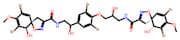
CAS 87099-50-1
:(5S,10R)-7,9-dibromo-N-(3-{2,6-dibromo-4-[2-({[(5S,10R)-7,9-dibromo-10-hydroxy-8-méthoxy-1-oxa-2-azaspiro[4.5]deca-2,6,8-trien-3-yl]carbonyl}amino)-1-hydroxyéthyl]phénoxy}-2-hydroxypropyl)-10-hydroxy-8-méthoxy-1-oxa-2-azaspiro[4.5]deca-2,6,8-triène-3-carb
Description :
La substance chimique identifiée par le nom "(5S,10R)-7,9-dibromo-N-(3-{2,6-dibromo-4-[2-({[(5S,10R)-7,9-dibromo-10-hydroxy-8-méthoxy-1-oxa-2-azaspiro[4.5]deca-2,6,8-trien-3-yl]carbonyl}amino)-1-hydroxyéthyl]phénoxy}-2-hydroxypropyl)-10-hydroxy-8-méthoxy-1-oxa-2-azaspiro[4.5]deca-2,6,8-triène-3-carb" et le numéro CAS "87099-50-1" est un composé organique complexe caractérisé par sa structure complexe, qui comprend plusieurs substituants bromés, des groupes hydroxyles et un cadre spirocyclique unique. Ce composé présente une combinaison d'hétéroatomes, spécifiquement de l'oxygène et de l'azote, contribuant à son activité biologique potentielle. La présence de plusieurs groupes fonctionnels suggère qu'il pourrait présenter une réactivité et une solubilité significatives dans divers solvants. Sa stéréochimie, indiquée par la configuration spécifique à plusieurs centres chiraux, peut influencer ses propriétés pharmacologiques et ses interactions avec des cibles biologiques. De tels composés sont souvent étudiés pour leurs applications potentielles en chimie médicinale, en particulier dans le développement de nouveaux agents thérapeutiques. D'autres études seraient nécessaires pour élucider ses propriétés spécifiques, y compris la stabilité, la réactivité et l'activité biologique.
Formule :C31H30Br6N4O11
InChI :InChI=1/C31H30Br6N4O11/c1-48-24-16(34)5-30(26(44)21(24)36)7-18(40-51-30)28(46)38-9-13(42)11-50-23-14(32)3-12(4-15(23)33)20(43)10-39-29(47)19-8-31(52-41-19)6-17(35)25(49-2)22(37)27(31)45/h3-6,13,20,26-27,42-45H,7-11H2,1-2H3,(H,38,46)(H,39,47)/t13?,20?,26-,27-,30+,31+/m0/s1
Trier par
Degré de pureté (%)
0
100
|
0
|
50
|
90
|
95
|
100
2 produits concernés.
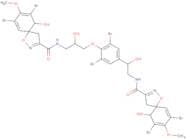
Isofistularin-3
CAS :Isofistularin-3 is a natural product that has been shown to be an apoptosis inducer in cancer cells. It has been shown to have the ability to induce autophagy and apoptosis in human immunodeficiency virus (HIV) cells. Isofistularin-3 inhibits HIV replication by preventing the expression of viral gene products, including Gag and Nef. Apoptosis induction may be due to Isofistularin-3's ability to inhibit cell proliferation, which is mediated through light exposure, or its ability to inhibit viral protein synthesis. Isofistularin-3 also has anti-inflammatory properties and can be used as a treatment for paraganglioma and other types of tumors.Formule :C31H30Br6N4O11Degré de pureté :Min. 95%Masse moléculaire :1,114 g/mol