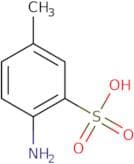
CAS 88-44-8
:Acide 2-amino-5-méthylbenzènesulfonique
Description :
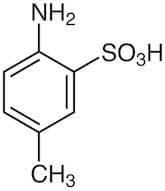
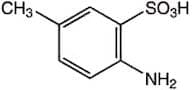
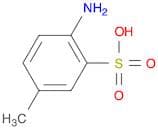
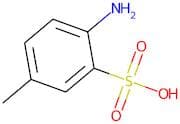
Acide 2-amino-5-méthylbenzènesulfonique, également connu sous le nom d'acide 5-méthyl-2-aminobenzènesulfonique, est un composé organique caractérisé par la présence d'un groupe amino (-NH2) et d'un groupe acide sulfonique (-SO3H) attachés à un cycle de benzène substitué par un méthyle. Ce composé est typiquement un solide cristallin blanc à blanc cassé qui est soluble dans l'eau en raison du groupe acide sulfonique, qui augmente sa polarité. Il a des applications dans divers domaines, y compris en tant que réactif dans la synthèse organique et comme intermédiaire de colorant. La présence des deux groupes fonctionnels, amino et acide sulfonique, permet une réactivité chimique diversifiée, ce qui le rend utile dans la synthèse d'autres composés chimiques. De plus, il est important de manipuler cette substance avec précaution, car elle peut présenter des risques pour la santé si elle est ingérée ou inhalée, et des mesures de sécurité appropriées doivent être prises lors de son utilisation dans des environnements de laboratoire. Dans l'ensemble, Acide 2-amino-5-méthylbenzènesulfonique est un composé significatif tant dans les applications industrielles que dans la recherche.
Formule :C7H9NO3S
InChI :InChI=1/C7H9NO3S/c1-5-2-3-6(8)7(4-5)12(9,10)11/h2-4H,8H2,1H3,(H,9,10,11)/p-1
Code InChI :InChIKey=LTPSRQRIPCVMKQ-UHFFFAOYSA-N
SMILES :S(=O)(=O)(O)C1=C(N)C=CC(C)=C1
Synonymes :- 1-Amino-4-methylbenzene-2-sulfonic acid
- 2-Amino-5-Methylbenzenesulfonate
- 2-Amino-5-methyl-1-benzenesulfonic acid
- 2-Amino-5-methylbenzenesulfonic acid
- 4-Amino-1-methylbenzene-3-sulfonic acid
- 4-Aminotoluene-3-Sulphonic Acid
- 4-Aminotoluene-3-sulfonic acid
- 4-Methyl-2-sulfoaniline
- 4-Methylaniline-2-sulfonic acid
- 4B acid
- Benzenesulfonic acid, 2-amino-5-methyl-
- NSC 7544
- Ptmsa
- m-Toluenesulfonic acid, 6-amino-
- p-Toluidine-2-sulfonic acid
- p-Toluidine-m-sulfonic acid
- PTMS
- 2-amino-5-methyl-benzenesulfonicaci
- 3-Methyl-6-aminobenzenesulfonicacid
- p-Methylaniline-2-sulfonicaicd
- 2-AMINO-5-METHYLBENZENE-1-SULFONIC ACID
- 6-amino-m-toluenesulfonicaci
- kyselina4-toluidin-3-sulfonova
- 6-AMINO-M-TOLUENESULFONIC ACID
- p-Toluidine-2-sulfonicscid
- toluidine-sulfonicacid
- red4bacid
- Voir plus de synonymes
Trier par
Degré de pureté (%)
0
100
|
0
|
50
|
90
|
95
|
100
7 produits trouvés.
p-Toluidine-2-sulfonic Acid
CAS :Formule :C7H9NO3SDegré de pureté :>98.0%(T)(HPLC)Couleur et forme :White to Light yellow to Light orange powder to crystalMasse moléculaire :187.212-Amino-5-methylbenzenesulfonic acid, 99%
CAS :This Thermo Scientific Chemicals brand product was originally part of the Alfa Aesar product portfolio. Some documentation and label information may refer to the legacy brand. The original Alfa Aesar product / item code or SKU reference has not changed as a part of the brand transition to Thermo SciFormule :C7H9NO3SDegré de pureté :99%Couleur et forme :Powder, Pale cream to cream to brownMasse moléculaire :187.222-Amino-5-methylbenzenesulfonic acid
CAS :Formule :C7H9NO3SDegré de pureté :98%Couleur et forme :SolidMasse moléculaire :187.21632-amino-5-methylbenzene-1-sulphonic acid
CAS :2-amino-5-methylbenzene-1-sulphonic acidDegré de pureté :98%Masse moléculaire :187.22g/mol2-Amino-5-methylbenzenesulfonic acid
CAS :Formule :C7H9NO3SDegré de pureté :98%Couleur et forme :SolidMasse moléculaire :187.214-Aminotoluene-3-sulfonic acid
CAS :4-Aminotoluene-3-sulfonic acid (ATSA) is a chemical compound that is used as a solvent in organic synthesis. It has been shown to inhibit the acetylation of histone H3, which may be the cause of autoimmune diseases and metabolic disorders. ATSA also blocks colony-stimulating factor (CSF), which is an effector protein that regulates the proliferation and differentiation of cells, including T cells and B cells. This compound has been used as a model system for studying the mechanism of CSF regulation and intermolecular hydrogen bonding. ATSA binds to CSF by forming hydrogen bonds with amino acid residues on the surface of CSF. Structural analysis has revealed that ATSA interacts with protein in a manner similar to other inhibitors of CSF.Formule :C7H9NO3SDegré de pureté :Min. 95%Masse moléculaire :187.22 g/mol