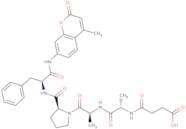
![N-(3-carboxypropanoyl)-L-alanyl-L-alanyl-N-{(2S)-2-[(4-methyl-2-oxo-2H-chromen-7-yl)amino]-3-pheny…](/_next/image/?url=https%3A%2Fstatic.cymitquimica.com%2Fcas-image%2Fthumb-webp%2F314990-n-3-carboxypropanoyl-l-alanyl-l-alanyl-n-2s-2-4-methyl-2-oxo-2h-chromen-7-yl-amino-3-phenylpropanoyl-l-prolinamide.webp&w=3840&q=75)
CAS 88467-45-2
:N-(3-carboxypropanoyl)-L-alanyl-L-alanyl-N-{(2S)-2-[(4-méthyl-2-oxo-2H-chromén-7-yl)amino]-3-phénylpropanoyl}-L-prolinamide
- Factor Xiia Substrate Dihydrochloride
Suc-Ala-Ala-Pro-Phe-AMC
CAS :The peptidylprolyl isomerase substrate Suc-AAPF-AMC is also hydrolyzed by carboxypeptidase Y, cathepsin G, and chymotrypsin. Suc-AAPF-AMC has also been used to analyze the chymotrypsin-like activity of trypsins.Formule :C34H39N5O9Degré de pureté :99.5%Couleur et forme :WhiteMasse moléculaire :661.71Suc-Ala-Ala-Pro-Phe-AMC
CAS :Suc-Ala-Ala-Pro-Phe-AMC is a peptide that is an activator of the acetylcholine receptor. Suc-Ala-Ala-Pro-Phe-AMC has been shown to inhibit the binding of the ligand to the receptor and also prevent activation of ion channels. It has been used as a research tool for studying protein interactions, as well as, antibody production and cell biology. This peptide can also be used as a pharmacological agent, which may be useful in treating diseases such as Alzheimer's disease.
Formule :C34H39N5O9Degré de pureté :Min. 95%Masse moléculaire :661.7 g/molSuc-Ala-Ala-Pro-Phe-AMC
CAS :Suc-Ala-Ala-Pro-Phe-AMC is a synthetic substrate for proteolytic enzymes. This substrate has been shown to be hydrolyzed by pancreatic trypsin and soybean trypsin with similar rates. Suc-Ala-Ala-Pro-Phe-AMC is also a substrate for erythrocyte eosinophil peroxidase, which has been shown to have an optimum pH of 5.0. The reaction mechanism of this substrate is not yet fully understood, but it may involve the formation of a Schiff base between the amino group on the proline residue and the carbonyl group on the AMC moiety. Suc-Ala-Ala-Pro-Phe-AMC also reacts with surface membranes and can be used as an indicator of protease activity.
Formule :C34H39N5O9Degré de pureté :Min. 98 Area-%Couleur et forme :PowderMasse moléculaire :661.7 g/mol