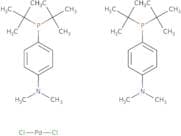
![Dichlorobis[di-tert-butyl(4-dimethylaminophenyl)phosphino]palladium(II)](/_next/image/?url=https%3A%2Fstatic.cymitquimica.com%2Fcas-image%2Fthumb-webp%2F308009-dichlorobis-di-tert-butyl-4-dimethylaminophenyl-phosphino-palladium-ii.webp&w=3840&q=75)
CAS 887919-35-9
:Dichlorobis[di-tert-butyl(4-diméthylaminophényl)phosphino]palladium(II)
Description :
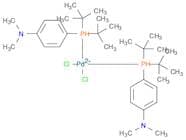
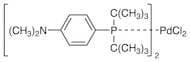
Dichlorobis[di-tert-butyl(4-diméthylaminophényl)phosphino]palladium(II) est un complexe de palladium caractérisé par sa coordination de palladium avec deux ligands de phosphine bidentés. La structure présente un centre de palladium coordonné à deux ions chlorure et deux ligands de phosphine encombrants, dérivés de la di-tert-butyle(4-diméthylaminophényl)phosphine. Ce complexe est remarquable pour ses applications potentielles en catalyse, en particulier dans les réactions de couplage croisé, en raison des propriétés électroniques et stériques favorables conférées par les ligands de phosphine. La présence du groupe diméthylamino améliore la capacité de donation d'électrons des ligands, ce qui peut influencer la réactivité du centre de palladium. De plus, les groupes tert-butyles encombrants fournissent un encombrement stérique, ce qui peut aider à stabiliser le complexe et à prévenir les réactions secondaires indésirables. Dans l'ensemble, ce composé illustre la polyvalence des complexes de palladium dans la synthèse organique et la science des matériaux, mettant en évidence l'interaction entre la conception des ligands et l'activité catalytique.
Formule :C32H56Cl2N2P2Pd
InChI :InChI=1/2C16H28NP.2ClH.Pd/c2*1-15(2,3)18(16(4,5)6)14-11-9-13(10-12-14)17(7)8;;;/h2*9-12H,1-8H3;2*1H;/q;;;;+2/p-2
SMILES :CC(C)(C)P(c1ccc(cc1)N(C)C)C(C)(C)C.CC(C)(C)P(c1ccc(cc1)N(C)C)C(C)(C)C.Cl.Cl.[Pd]
Synonymes :- 4-(Di-tert-butylphosphino)-N,N-dimethylaniline-dichloropalladium (2:1)
- 4-(di-tert-butylphosphanyl)-N,N-dimethylaniline-dichloropalladium (2:1)
- Bis(di-tert-butyl(4-dimethylaminophenyl)phosphine)dichloropalladium(II)
- Dichlorobis(di-tert-butyl-4-dimethylaminophenylphosphine) palladium(II)
- (A-taPhos)2PdCl2
- (AmPhos)2PdCl2
Trier par
Degré de pureté (%)
0
100
|
0
|
50
|
90
|
95
|
100
8 produits concernés.
Bis[di-tert-butyl(4-dimethylaminophenyl)phosphine]dichloropalladium(II)
CAS :Formule :C32H56Cl2N2P2PdDegré de pureté :>98.0%(T)Couleur et forme :Light yellow to Yellow to Orange powder to crystalMasse moléculaire :708.08Dichlorobis[di-tert-butyl(4-dimethylaminophenyl)phosphine]palladium(II), Pd 15%
CAS :Dichlorobis[di-tert-butyl(4-dimethylaminophenyl)phosphine]palladium(II) is a highly active, air-stable catalyst for Suzuki-Miyaura cross-coupling with aryl halides including 5- and 6-membered heteroaryl chlorides. This Thermo Scientific brand product was originally part of the Alfa Aesar product porFormule :C32H56Cl2N2P2PdMasse moléculaire :708.08Bis(4-(di-tert-Butylphosphanyl)-N,N-dimethylaniline); palladium chloride
CAS :Formule :C32H56Cl2N2P2PdDegré de pureté :98%Couleur et forme :SolidMasse moléculaire :708.0740Bis{bis(tert-butyl)[4-(dimethylamino)phenyl]phosphine}palladium(II) chloride
CAS :Bis{bis(tert-butyl)[4-(dimethylamino)phenyl]phosphine}palladium(II) chlorideFormule :·2C16H28NP·Cl2PdDegré de pureté :97%Couleur et forme : yellow solidMasse moléculaire :708.07396g/molPdCl2(amphos)2 (HPMC encapsulated)
CAS :Formule :C32H56Cl2N2P2PdCouleur et forme :White to Light yellow capsuleMasse moléculaire :708.08Bis(4-(di-tert-Butylphosphanyl)-N,N-dimethylaniline)-palladium chloride
CAS :Formule :C32H56Cl2N2P2PdDegré de pureté :98%Couleur et forme :SolidMasse moléculaire :708.08Dichlorobis{[4-(N,N-dimethylamino)phenyl]di-t-butylphosphino}palladium(II), min. 98% PdAmphos
CAS :Dichlorobis{[4-(N,N-dimethylamino)phenyl]di-t-butylphosphino}palladium(II), min. 98% PdAmphos
Formule :(C16H28NP)2PdCl2Degré de pureté :min. 98%Couleur et forme :yellow pwdr.Masse moléculaire :708.07Bis(4-(di-tert-butylphosphino)-N,N-dimethylbenzenamine) palladium dichloride
CAS :Produit contrôléBis(4-(di-tert-butylphosphanyl)-N,N-dimethylaniline) is a boronic acid that has been used as a surfactant in organic chemistry. It is hydrophobic and has hydrogen bonding interactions with other molecules. Bis(4-(di-tert-butylphosphanyl)-N,N-dimethylaniline) is also a proton acceptor and can form stable complexes with metal ions such as palladium chloride. This compound is kinase selective and can be used to inhibit tyrosine kinases by binding to the ATP binding site of the enzyme's kinase domain. The functional groups of this compound are able to undergo cross-coupling reactions with other functional groups that have been activated by a reagent such as palladium chloride. Bis(4-(di-tert-butylphosphanyl)-N,N-dimethylaniline) has been used in highFormule :C32H56Cl2N2P2PdDegré de pureté :Min. 95%Couleur et forme :PowderMasse moléculaire :708.07 g/mol
![Bis[di-tert-butyl(4-dimethylaminophenyl)phosphine]dichloropalladium(II)](/_next/image/?url=https%3A%2Fstatic.cymitquimica.com%2Fproducts%2F3B%2Fthumb%2FB6255.jpg&w=3840&q=75)

![Dichlorobis[di-tert-butyl(4-dimethylaminophenyl)phosphine]palladium(II), Pd 15%](/_next/image/?url=https%3A%2Fstatic.cymitquimica.com%2Fproducts%2F02%2Fthumb%2F045511.jpg&w=3840&q=75)


![Bis{bis(tert-butyl)[4-(dimethylamino)phenyl]phosphine}palladium(II) chloride](/_next/image/?url=https%3A%2Fstatic.cymitquimica.com%2Fproducts%2F54%2Fthumb%2FOR17048.jpg&w=3840&q=75)



![Dichlorobis{[4-(N,N-dimethylamino)phenyl]di-t-butylphosphino}palladium(II), min. 98% PdAmphos](/_next/image/?url=https%3A%2Fstatic.cymitquimica.com%2Fproducts%2F08%2Fthumb%2F46-0825.jpg&w=3840&q=75)