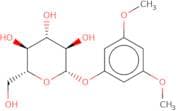
CAS 90-71-1
:alpha-(3,5-diméthoxyphényl)-beta-D-glucopyranoside
Description :
alpha-(3,5-diméthoxyphényl)-beta-D-glucopyranoside, également connu sous son numéro CAS 90-71-1, est un composé glycosidique caractérisé par la présence d'un moiety de glucose lié à un groupe 3,5-diméthoxyphényle. Ce composé présente généralement une apparence cristalline blanche à blanc cassé et est soluble dans des solvants polaires tels que l'eau et le méthanol, reflétant sa nature glycosidique. Les groupes méthoxy sur l'anneau phénolique contribuent à ses caractéristiques hydrophobes, influençant sa solubilité et sa réactivité. Il est souvent étudié pour ses potentielles activités biologiques, y compris des propriétés antioxydantes et anti-inflammatoires, qui peuvent être attribuées à la structure phénolique. La liaison glycosidique dans ce composé le rend stable dans des conditions neutres mais susceptible à l'hydrolyse dans des environnements acides ou enzymatiques, entraînant la libération de l'aglycone et du glucose. Dans l'ensemble, alpha-(3,5-diméthoxyphényl)-beta-D-glucopyranoside constitue un sujet intéressant tant en chimie synthétique qu'en chimie médicinale en raison de ses caractéristiques structurelles et de ses applications potentielles.
Formule :C14H20O8
InChI :InChI=1/C14H20O8/c1-19-7-3-8(20-2)5-9(4-7)21-14-13(18)12(17)11(16)10(6-15)22-14/h3-5,10-18H,6H2,1-2H3/t10-,11-,12+,13-,14+/m1/s1
Synonymes :- Taxicatin
Trier par
Degré de pureté (%)
0
100
|
0
|
50
|
90
|
95
|
100
1 produits concernés.
Taxicatin
CAS :Taxicatin is a secondary metabolite, which is a plant-derived alkaloid with significant pharmacological activity. It is sourced from a specific species of plant known for its bioactive compounds, often found within the tropics. The mode of action of Taxicatin involves the disruption of critical cellular processes, including the inhibition of microtubule assembly during cell division, which ultimately leads to apoptosis in rapidly dividing cells. This makes it a potent candidate for research into anticancer therapies. Taxicatin's uses and applications are primarily in the area of oncology, where its efficacy in interfering with malignant cell proliferation is being rigorously evaluated. Furthermore, its role as a template in drug design and development is of considerable interest, owing to its unique structural characteristics that can be utilized to synthesize novel compounds with improved therapeutic indices. Research is ongoing to explore the full spectrum of its biochemical interactions and potential synergistic effects when combined with other therapeutic agents.Formule :C14H20O8Degré de pureté :Min. 95%Couleur et forme :PowderMasse moléculaire :316.3 g/mol