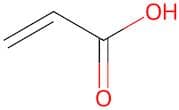
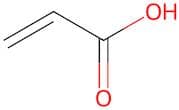
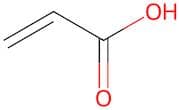
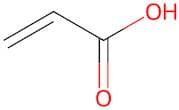
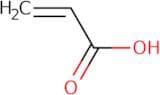
CAS 9003-01-4
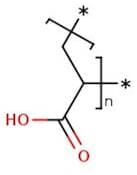
:Poly(acide acrylique)
Description :
Poly(acide acrylique) (PAA) est un polymère synthétique caractérisé par ses unités répétitives d'acide acrylique. C'est un polymère anionique soluble dans l'eau qui présente des propriétés uniques, notamment une viscosité élevée et des capacités d'épaississement, ce qui le rend utile dans diverses applications telles que les adhésifs, les revêtements et les produits de soin personnel. Le PAA est connu pour sa capacité à former des gels et son comportement sensible au pH, qui lui permet de gonfler dans des conditions alcalines tout en se contractant dans des environnements acides. Cette propriété le rend précieux dans les systèmes de délivrance de médicaments et comme matériau superabsorbant dans les produits d'hygiène. De plus, le PAA peut interagir avec des ions métalliques, augmentant son utilité dans le traitement de l'eau et comme dispersant. Sa biocompatibilité et sa non-toxicité contribuent encore à son attrait dans les applications biomédicales. Dans l'ensemble, Poly(acide acrylique) est un polymère polyvalent d'une importance industrielle et pharmaceutique significative en raison de ses propriétés chimiques et physiques uniques.
Formule :(C3H4O2)x
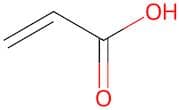
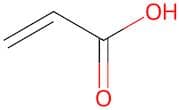
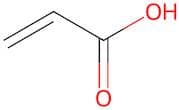
InChI :InChI=1S/C3H4O2/c1-2-3(4)5/h2H,1H2,(H,4,5)
Code InChI :InChIKey=NIXOWILDQLNWCW-UHFFFAOYSA-N
SMILES :C(C=C)(O)=O
Synonymes :- Arespol
- Aron
- Carbomer
- Carboxypolymethylene
- Gr-F
- Hydroplus
- K-Sorb
- PAA
- Polyacrylate
- Rh-E
- Sopronyl
- Tg-Sap
- XPA
- Xh-B
- Acrysol A 1
- Polyacrylic Acid
- Carbomer 910
- Propenoic acid, homopolymer
- Fluorosulfuric acid
- Propenoic acid, polymers, homopolymer
- Acrylic acid, polymers
- 2-Propenoic acid, homopolymer
- Carbopol
- Acrysol A 3
- Acrylic acid polymer
- Acrylic Acid glacial
- poly(1-carboxyethylene)
- 2-Propenoic acid, homopolymer
- acrylicacid,poly
- Acrylic polymer resins
- Propenoic acid polymer
- Poly(acrylic acid)
- Voir plus de synonymes
Trier par
Degré de pureté (%)
0
100
|
0
|
50
|
90
|
95
|
100
17 produits concernés.
Poly(acrylic acid), 25 wt% soln. in water
CAS :Polyacrylic acid is used in disposable diapers and in ion exchange resins. It is also used to study solute diffusion in polyvinyl alcohol/polyacrylic acid copolymer hydrogel. It is also employed as a thickening, suspending, emulsifying and dispersing agent in pharmaceuticals, cosmetics, adhesives anFormule :(C3H4O2)nCouleur et forme :LiquidMasse moléculaire :72.02113Poly(acrylic acid), 25% soln in water
CAS :Formule :C4H8O2Degré de pureté :95%Couleur et forme :LiquidMasse moléculaire :88.1051Poly(acrylic acid); 35% solution in water
CAS :Formule :CH2CH(CO2H)Couleur et forme :Viscous, colourless to light-yellow liquidMasse moléculaire :72.02113Poly(acrylic acid)
CAS :Poly(acrylic acid) prevents corrosion on aluminium in acid; used as a pharmaceutical coating and inactive ingredient affecting drug ADME.Formule :(C3H4O2)xCouleur et forme :SolidMasse moléculaire :4000000(Average)Carbomer 980
CAS :Carbomer 980 is a broad-spectrum antimicrobial that is used as an absorption enhancer. It has been shown to be effective against many Gram-positive and Gram-negative bacteria, including methicillin-resistant Staphylococcus aureus. It also has shown activity against protozoa, fungi, and yeast. Carbomer 980 is a cationic surfactant that enhances the absorption of other active ingredients into the skin. This agent also has immune reaction effects and may cause adverse reactions in humans. Carbomer 980 is poorly bioavailable because it binds to fatty acids in the bloodstream and amines in skin tissue.Formule :(C3H4O2)xCouleur et forme :White PowderPoly(acrylic acid) solution
CAS :Poly(acrylic acid) solution is a polymer that is used in water treatment. It has been shown to be effective in removing sulfate and carbonates from water. Poly(acrylic acid) solution has a molecular weight of about 10,000 Daltons and a number average molecular weight of about 4,000 Daltons. This solution is supersaturated with poly(acrylic acid) but it does not form crystals because it crystallizes at high temperature and pressure. The polymers are adsorbed onto the surface of the particles in the water and then can form crystals when the polymers are forced to nucleate by lowering the temperature or increasing the force applied to them.Formule :(C3H4O2)xCouleur et forme :Colorless Clear LiquidCarbopol 940 (Carboxy Vinyl Polymer 940) extrapure
CAS :Formule :(C5H12O4)nCouleur et forme :White - off white, PowderCarbopol 934 (Carboxy Vinyl Polymer 934) extrapure
CAS :Degré de pureté :56.0 - 68.0% (For carboxylic acid content)Couleur et forme :White, Hygroscopic powder