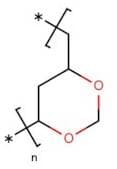
![Ethene, 1,1′-[methylenebis(oxy)]bis-, homopolymer](/_next/image/?url=https%3A%2Fstatic.cymitquimica.com%2Fcas-image%2Fthumb-webp%2F390320-poly-vinyl-formal.webp&w=3840&q=75)
CAS 9003-33-2
:Éthène, 1,1′-[méthylènebis(oxy)]bis-, homopolymère
- Ethene, 1,1′-[methylenebis(oxy)]bis-, homopolymer
- Formaldehyde-Ethenol (1:1)
- Methane, bis(vinyloxy)-, polymers
- Poly(divinyl formal)
- FORMVAR 15/95
- Vinylacetate,polymerwithformaldehyde
- VINYLEC K
- POLY(VINYL FORMAL)
- vinyl formal homopolymer
- FORMVAR RESIN
- 1,1’-[methylenebis(oxy)]bis-ethenhomopolymer
- FORMVAR 15/95 RESIN
- FORMVAR 15/95 (POLY[VINYL FORMAL]), 0.5% SOLN. IN ETHYLENE DICHLORIDE
- polyvinylformalstaplefiber
- Poly(vinyl formal) powder
- Voir plus de synonymes
Poly(vinyl formal)
CAS :It is used in the anomalous sorption and pervaporation of aqueous organic mixtures by poly(vinyl acetal) membranes. Poly(vinyl formal) is mainly used in three general applications wire coatings, surface coatings and adhesives. The first and extensive application of poly(vinyl formal) is in the manufPoly(vinyl formal), Mw66,000-75,000
CAS :Poly(vinyl formal) is a polymer that has been used extensively in the field of biochemistry. It has a weight-average molecular weight (Mw) of 66,000-75,000 and a hydroxyl group at one end. Poly(vinyl formal) is activated by hydrochloric acid, which is a strong acid catalyst. The process is carried out in an organic solvent to dissolve the polymer. The activation energy for this process is about 28 kcal/mol for the first step and about 50 kcal/mol for the second step. Poly(vinyl formal) crystallizes from solution with a combination of water and ethylene glycol as its solvent. This process occurs through a crystallization process that can be described by three steps: nucleation, crystal growth, and termination. Poly(vinyl formal) has functional groups such as carboxylic acid, alcohol, or amine groups on its backbone chain that are responsible for its water permeability. These functional
Formule :(C5H8O2)xDegré de pureté :Min. 95%Couleur et forme :White To Off-White Solid