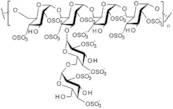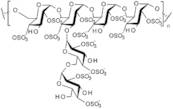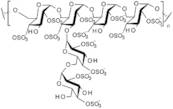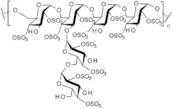
CAS 9011-18-1
:Sulfate de dextrane sodique
Description :
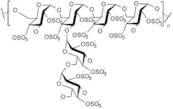
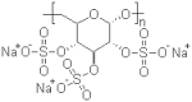
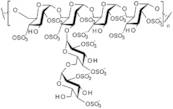
Sulfate de dextrane sodique est un polysaccharide sulfaté dérivé du dextran, un glucane ramifié complexe. Il se caractérise par son poids moléculaire élevé et est généralement utilisé comme anticoagulant et dans diverses applications biomédicales. La substance apparaît sous forme de poudre blanche à blanc cassé et est soluble dans l'eau, formant une solution visqueuse. Sulfate de dextrane sodique présente une charge négative en raison des groupes sulfate, ce qui contribue à sa capacité à interagir avec des protéines et d'autres biomolécules, le rendant utile dans les systèmes de délivrance de médicaments et comme agent stabilisant dans diverses formulations. De plus, il a été étudié pour ses effets thérapeutiques potentiels, y compris des propriétés antivirales et anti-inflammatoires. Son profil de sécurité est généralement favorable, mais il peut provoquer des réactions indésirables chez certaines personnes, en particulier à des concentrations élevées. Comme pour toute substance chimique, des directives appropriées de manipulation et d'utilisation doivent être suivies pour garantir la sécurité et l'efficacité de ses applications.
Formule :H2O4S·xNa·xUnspecified
Synonymes :- Asuro
- Colyonal
- Dexnon
- Dextralip 15
- Dextran Sulfate Sodium
- Dextran sodium sulfate
- Dextran sulfate sodium salt
- Dextran sulfuric acid ester sodium salt
- Dextran, hydrogen sulfate, sodium salt
- Dextransulfate sodium sulfur
- Dextrarine
- Dexulate
- MDS (polysaccharide)
- MDS-Kowa A
- Voir plus de synonymes
Trier par
Degré de pureté (%)
0
100
|
0
|
50
|
90
|
95
|
100
Dextran sulfate sodium, MW 100,000
CAS :Dextran sulphate is a dextran derivative whose ulcer (colitis) -causing properties were first reported in hamsters and extrapolated a few years later to mice and rats. The exact mechanisms through which dextran sulphate induces intestinal inflammation are unclear but may be the result of direct damage of the monolayer of epithelial cells in the colon, leading to the crossing of intestinal contents (for e.g. commensal bacteria and their products) into underlying tissue and therefore induction of inflammation. The dextran sulphate sodium induced ulceration model in laboratory animals has some advantages, when compared to other animal models of colitis, due to its simplicity and similarities to human inflammatory bowel disease.Couleur et forme :PowderDextran sulfate sodium salt - MW 9,000-11,000 - from Leuconostoc spp
CAS :Dextran sulphate is a dextran derivative whose ulcer (colitis) -causing properties were first reported in hamsters and extrapolated a few years later to mice and rats. The exact mechanisms through which dextran sulphate induces intestinal inflammation are unclear but may be the result of direct damage of the monolayer of epithelial cells in the colon, leading to the crossing of intestinal contents (for e.g. commensal bacteria and their products) into underlying tissue and therefore induction of inflammation. The dextran sulphate sodium induced ulceration model in laboratory animals has some advantages, when compared to other animal models of colitis, due to its simplicity and similarities to human inflammatory bowel disease.Degré de pureté :Min. 95%Couleur et forme :PowderDextran sulfate sodium, MW 20,000
CAS :Sodium carboxymethyl dextran (CM-dextran) is a white, odourless and tasteless powder, which is freely soluble in water or electrolyte solutions. The product has a pronounced polyanionic character, due to the high degree of carboxyl substitution. Applications that have been described for CM-dextran include carriers of paramagnetic contrast agents, preparation of conjugates of pharmacologically active compounds and CM-dextrans in biosensors. A number of other uses in cosmetics, agriculture, foods, paints and textiles have been the subject of patent applications.Couleur et forme :PowderDextran sulfate sodium salt - MW 500,000
CAS :Dextran sulphate is a dextran derivative whose ulcer (colitis) -causing properties were first reported in hamsters and extrapolated a few years later to mice and rats. The exact mechanisms through which dextran sulphate induces intestinal inflammation are unclear but may be the result of direct damage of the monolayer of epithelial cells in the colon, leading to the crossing of intestinal contents (for e.g. commensal bacteria and their products) into underlying tissue and therefore induction of inflammation. The dextran sulphate sodium induced ulceration model in laboratory animals has some advantages, when compared to other animal models of colitis, due to its simplicity and similarities to human inflammatory bowel disease.Formule :C9H11NO2Degré de pureté :Min. 95%Couleur et forme :White PowderDextran sulfate sodium - MW 5,000-8,000
CAS :Dextran sulphate is a dextran derivative whose ulcer (colitis) -causing properties were first reported in hamsters and extrapolated a few years later to mice and rats. The exact mechanisms through which dextran sulphate induces intestinal inflammation are unclear but may be the result of direct damage of the monolayer of epithelial cells in the colon, leading to the crossing of intestinal contents (for e.g. commensal bacteria and their products) into underlying tissue and therefore induction of inflammation. The dextran sulphate sodium induced ulceration model in laboratory animals has some advantages, when compared to other animal models of colitis, due to its simplicity and similarities to human inflammatory bowel disease.Formule :(C6H7Na3O14S3)nDegré de pureté :Min. 95%Couleur et forme :PowderDextran Sulphate Sodium Salt 30-50(DSS 35-50) ex. Leuconostoc Sp.Colitis Grade for molecular biology
CAS :Couleur et forme :White to off-white, Powder, Clear, Colourless to pale yellowMasse moléculaire :made from Dextran 35 - 50 KDaDextran Sulphate Sodium Salt 500 (DSS 500) ex. Leuconostoc Sp. for molecular biology
CAS :Couleur et forme :White to pale yellow, Powder, ClearMasse moléculaire :made from Dextran 500 KDaDextran sulfate sodium - MW 3000-6000
CAS :Dextran sulfate sodium is a complex carbohydrate that consists of a linear chain of many glucose molecules. It is often used as a gel to protect the bowel during radiation therapy and in the treatment of severe burns. Dextran sulfate sodium can be modified with methylation, click modification, fluorination, saccharide, or glycosylation. Dextran sulfate sodium also has many applications in biochemistry and medicine such as being used as an osmotic agent in cell culture media, after being glycosylated it can be used to treat inflammatory bowel disease. This product is custom synthesized by our company and is available in various sizes from MW 3000-6000.Degré de pureté :Min. 95%Couleur et forme :PowderDextran sulfate sodium salt - MW 150,000
CAS :Induces ulceration; used to model inflammatory bowel diseaseDegré de pureté :Min. 95%Couleur et forme :Powder