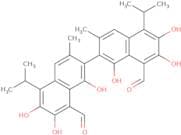
CAS 90141-22-3
:(-)-Gossypol
Description :
(-)-Gossypol est un composé polyphénolique d'origine naturelle, principalement dérivé des graines et des feuilles de la plante de coton (espèces de Gossypium). Il se caractérise par sa couleur jaunâtre et est connu pour sa structure complexe, qui comprend plusieurs cycles aromatiques et groupes hydroxyles. Ce composé présente une gamme d'activités biologiques, y compris des propriétés antifongiques, antibactériennes et antivirales, et a été étudié pour son utilisation potentielle dans la thérapie du cancer en raison de sa capacité à inhiber la prolifération cellulaire et à induire l'apoptose dans certaines lignées cellulaires cancéreuses. (-)-Gossypol est également reconnu pour son rôle en tant qu'agent contraceptif masculin, car il peut affecter la production et la motilité des spermatozoïdes. Cependant, son utilisation est limitée par sa toxicité et ses effets secondaires potentiels, nécessitant une attention particulière dans les applications thérapeutiques. Le composé est soluble dans des solvants organiques mais a une solubilité limitée dans l'eau, ce qui influence sa biodisponibilité et sa pharmacocinétique. Dans l'ensemble, (-)-Gossypol est un composé d'un grand intérêt tant en chimie médicinale qu'en recherche agricole.
Formule :C30H30O8
InChI :InChI=1S/C30H30O8/c1-11(2)19-15-7-13(5)21(27(35)23(15)17(9-31)25(33)29(19)37)22-14(6)8-16-20(12(3)4)30(38)26(34)18(10-32)24(16)28(22)36/h7-12,33-38H,1-6H3
Code InChI :InChIKey=QBKSWRVVCFFDOT-UHFFFAOYSA-N
SMILES :C(C)(C)C=1C2=C(C(C=O)=C(O)C1O)C(O)=C(C(C)=C2)C3=C(O)C4=C(C=C3C)C(C(C)C)=C(O)C(O)=C4C=O
Synonymes :- (-)-Gossypol
- (2R)-1,1′,6,6′,7,7′-Hexahydroxy-3,3′-dimethyl-5,5′-bis(1-methylethyl)[2,2′-binaphthalene]-8,8′-dicarboxaldehyde
- (R)-(-)-Gossypol
- At 101
- Sml 0433
- [2,2'-Binaphthalene]-8,8'-dicarboxaldehyde,1,1',6,6',7,7'-hexahydroxy-3,3'-dimethyl-5,5'-bis(1-methylethyl)-, (R)-
- [2,2′-Binaphthalene]-8,8′-dicarboxaldehyde, 1,1′,6,6′,7,7′-hexahydroxy-3,3′-dimethyl-5,5′-bis(1-methylethyl)-, (2R)-
- [2,2′-Binaphthalene]-8,8′-dicarboxaldehyde, 1,1′,6,6′,7,7′-hexahydroxy-3,3′-dimethyl-5,5′-bis(1-methylethyl)-, (R)-
- C:C&B61
- DL-gossypol acetic acid
- CS-619
- (-)-Gossypol USP/EP/BP
- R-(-)-gossypol acetic acid
- (R)-1,1',6,6',7,7'-Hexahydroxy-3,3'-dimethyl-5,5'-bis(1-methylethyl)-[2,2'-binaphthalene]-8,8'-dicarboxaldehyde
- GOSSYPOL,AT101
- (R)-(-)-GOSSYPOL;R-(-)-GOSSYPOL ACETIC ACID
- AT 101, >=98%
- [2,2'-Binaphthalene]-8,8'-dicarboxaldehyde, 1,1',6,6',7,7'-hexahydroxy-3,3'-dimethyl-5,5'-bis(1-methylethyl)-, (2R)-
- Voir plus de synonymes
Trier par
Degré de pureté (%)
0
100
|
0
|
50
|
90
|
95
|
100
1 produits concernés.
AT 101
CAS :AT-101 is a natural compound that belongs to the group of complex enzymes. It has been shown to have a number of physiological effects on plants, including inhibition of cotton fiber elongation and seed development. AT-101 also inhibits hyperproliferative disease in animals. The binding form of AT-101 is bound through hydrolysis to its target enzyme and does not depend on caspase activity for cell death. This makes it an attractive candidate for treating cancer cells that are resistant to apoptosis induced by caspases. AT-101 has been shown to inhibit energy metabolism in insects, which may be due to its ability to bind ATP synthase and prevent ATP production. This can lead to insect resistance against toxic compounds such as gossypol or other pharmacological agents.Formule :C30H30O8Degré de pureté :Min. 95%Masse moléculaire :518.56 g/mol