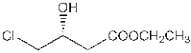
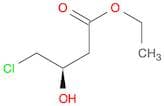
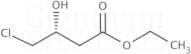
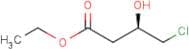
CAS 90866-33-4
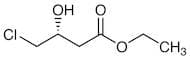
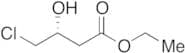
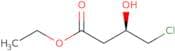
:(R)-(+)-éthyl-4-chloro-3-hydroxybutanoate
Description :
(R)-(+)-éthyl-4-chloro-3-hydroxybutanoate est un composé organique caractérisé par sa nature chirale, indiquée par la configuration (R). Ce composé présente un substituant chloro au quatrième carbone et un groupe hydroxy au troisième carbone d'une chaîne de butanoate, contribuant à sa réactivité et à ses applications potentielles en synthèse. C'est un ester, dérivé de la réaction d'un acide carboxylique et d'un alcool, spécifiquement de l'alcool éthylique dans ce cas. La présence du groupe hydroxy suggère qu'il peut participer à des liaisons hydrogène, influençant sa solubilité et son point d'ébullition. Le groupe chloro peut également servir de site pour des réactions de substitution nucléophile, en faisant un intermédiaire précieux dans la synthèse organique. Ce composé est généralement utilisé dans la recherche et le développement pharmaceutique, en particulier dans la synthèse de molécules biologiquement actives. Sa stéréochimie spécifique peut affecter l'activité biologique et l'interaction avec d'autres molécules, ce qui le rend important dans la synthèse chirale et la conception de médicaments.
Formule :C6H11ClO3
InChI :InChI=1/C6H11ClO3/c1-2-10-6(9)3-5(8)4-7/h5,8H,2-4H2,1H3
SMILES :CCOC(=O)CC(CCl)O
Synonymes :- Ethyl (R)-(+)-4-chloro-3-hydroxybutyrate
- (R)-(+)-4-Chloro-
- 3-hydroxybutyric acid ethyl ester
- (R)-4-chloro-3-hydroxybutyric acid ethyl ester
- (R)-4-Chloro-3-hydroxybutanoic acid ethyl ester
- Ethyl (R)-4-chloro-3-Hydroxybutanoate
- butanoic acid, 4-chloro-3-hydroxy-, Ethyl ESTER,(R)
- 4-Chloro-3-hydroxybutyric acid ethyl ester
- (R)-(+)-Ethyl-4-chloro-3-hydroxybutyrate
- Ethyl(R)-(+)-4-chloro-3-hydroxy butyrate
- R(+)-Ethyl-4-Chloro-3-Hydroxybutanoate
Trier par
Degré de pureté (%)
0
100
|
0
|
50
|
90
|
95
|
100
10 produits concernés.
Ethyl (R)-(+)-4-chloro-3-hydroxybutyrate, 97%, ee 96%
CAS :This Thermo Scientific Chemicals brand product was originally part of the Alfa Aesar product portfolio. Some documentation and label information may refer to the legacy brand. The original Alfa Aesar product / item code or SKU reference has not changed as a part of the brand transition to Thermo SciFormule :C6H11ClO3Degré de pureté :96%Couleur et forme :Liquid, Clear colorlessMasse moléculaire :166.60Ethyl (R)-(+)-4-Chloro-3-Hydroxybutyrate
CAS :Formule :C6H11ClO3Degré de pureté :97%Couleur et forme :LiquidMasse moléculaire :166.6027Ethyl (R)-(+)-4-chloro-3-hydroxybutyrate
CAS :Ethyl (R)-(+)-4-chloro-3-hydroxybutyrateDegré de pureté :98%Masse moléculaire :166.60g/molEthyl (R)-4-Chloro-3-hydroxybutanoate
CAS :Formule :C6H11ClO3Degré de pureté :>97.0%(GC)Couleur et forme :Colorless to Light yellow clear liquidMasse moléculaire :166.60(R)-Ethyl 4-chloro-3-hydroxybutanoate
CAS :Formule :C6H11ClO3Degré de pureté :95%Couleur et forme :LiquidMasse moléculaire :166.6(R)-Ethyl 4-Chloro-3-hydroxybutanoate (~90%)
CAS :Produit contrôléApplications (R)-Ethyl 4-chloro-3-hydroxybutanoate is used in biological studies for asymmetric reduction of ethyl 4-chloro-3-oxobutanoate to ethyl (R)-4-chloro-3-hydroxybutanoate with two co-existing, recombinant Escherichia coli strains.
References Liu, Y., et al.: Biotech. Lett., 27, 119 (2005);Formule :C6H11ClO3Degré de pureté :~90%Couleur et forme :NeatMasse moléculaire :166.6Ethyl (R)-(+)-4-chloro-3-hydroxybutyrate
CAS :Ethyl (R)-(+)-4-chloro-3-hydroxybutyrate is a chiral compound with two stereoisomers, one of which is the natural form. It can be synthesized by asymmetric synthesis from ethylene diamine and acetaldehyde. This reaction is catalysed by enzymes such as dehydrogenase, which are used in the biosynthesis of other compounds. The enzyme catalysis results in a high activation energy. Ethyl (R)-(+)-4-chloro-3-hydroxybutyrate also has an organic solvent that is required for its synthesis, d-xylose. The enzyme expression plasmid that is used to express this compound requires recombinant cells.Formule :C6H11ClO3Degré de pureté :Min. 95%Couleur et forme :Clear LiquidMasse moléculaire :166.6 g/mol