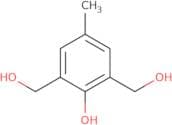
CAS 91-04-3
:2,6-Bis(hydroxyméthyl)-p-crésol
Description :
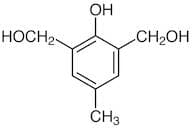
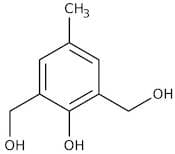
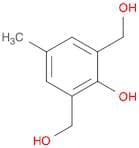
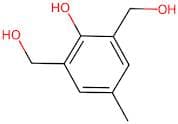
2,6-Bis(hydroxyméthyl)-p-crésol, communément connu comme un composé phénolique, se caractérise par sa structure, qui comprend deux groupes hydroxyméthyles attachés à l'anneau aromatique du p-cresol. Ce composé est typiquement un solide cristallin blanc à blanc cassé à température ambiante et est soluble dans l'eau et les solvants organiques, ce qui le rend polyvalent pour diverses applications. Il présente des propriétés antioxydantes, ce qui le rend utile pour stabiliser les plastiques et d'autres matériaux contre la dégradation oxydative. De plus, il a des applications dans les industries pharmaceutiques et cosmétiques en raison de ses propriétés antimicrobiennes. Le composé est également connu pour sa capacité à agir comme conservateur, aidant à prolonger la durée de vie des produits. Les données de sécurité indiquent qu'il doit être manipulé avec précaution, car il peut provoquer des irritations au contact de la peau ou des yeux. Dans l'ensemble, 2,6-Bis(hydroxyméthyl)-p-crésol est un produit chimique précieux avec des applications diverses, en particulier pour améliorer la stabilité et la longévité de diverses formulations.
Formule :C9H12O3
InChI :InChI=1S/C9H12O3/c1-6-2-7(4-10)9(12)8(3-6)5-11/h2-3,10-12H,4-5H2,1H3
Code InChI :InChIKey=KUMMBDBTERQYCG-UHFFFAOYSA-N
SMILES :C(O)C1=C(O)C(CO)=CC(C)=C1
Synonymes :- (2-Hydroxy-5-methyl-1,3-phenylene)dimethanol
- 1,3-Benzenedimethanol, 2-hydroxy-5-methyl-
- 2,3-Bis(Hydroxymethyl)-4-Methylphenol
- 2,6-Bis(Hydroxymethyl)-4-Methylphenol
- 2,6-Bis(hydroxymethyl)-p-cresol
- 2,6-Di(Hydroxymethyl)-4-Methylphenol
- 2,6-Di(hydroxymethyl)-p-cresol
- 2,6-Dimethylol-4-methylphenol
- 2,6-Dimethylol-p-cresol
- 26Dmpc
- 4-Methyl-2,6-bis(hydroxymethyl)phenol
- AV Lite 26DMPC
- Dml-Pc
- NSC 15838
- α<sup>1</sup>,α<sup>3</sup>,2-Trihydroxymesitylene
- α<sup>1</sup>,α<sup>3</sup>-Mesitylenediol, 2-hydroxy-
- α1,α3-Mesitylenediol, 2-hydroxy-
- Voir plus de synonymes
Trier par
Degré de pureté (%)
0
100
|
0
|
50
|
90
|
95
|
100
6 produits concernés.
2,6-Bis(hydroxymethyl)-p-cresol
CAS :Formule :C9H12O3Degré de pureté :>98.0%(GC)Couleur et forme :White to Yellow to Orange powder to crystalMasse moléculaire :168.192,6-Bis(hydroxymethyl)-p-cresol, tech. 90%
CAS :This Thermo Scientific Chemicals brand product was originally part of the Alfa Aesar product portfolio. Some documentation and label information may refer to the legacy brand. The original Alfa Aesar product / item code or SKU reference has not changed as a part of the brand transition to Thermo SciFormule :C9H12O3Degré de pureté :90%Couleur et forme :Cream or orange to pale brown, powderMasse moléculaire :168.192,6-Bis(hydroxymethyl)-p-cresol
CAS :Formule :C9H12O3Degré de pureté :97%Couleur et forme :SolidMasse moléculaire :168.18982,6-Bis(hydroxymethyl)-4-methylphenol
CAS :2,6-Bis(hydroxymethyl)-4-methylphenolFormule :C9H12O3Degré de pureté :95%Couleur et forme : pale brown crystals/ powderMasse moléculaire :168.19g/mol(2-Hydroxy-5-methyl-1,3-phenylene)dimethanol
CAS :Formule :C9H12O3Degré de pureté :95%Couleur et forme :Solid, No data available.Masse moléculaire :168.1922,6-Bis(hydroxymethyl)-p-cresol
CAS :2,6-Bis(hydroxymethyl)-p-cresol (BHMC) is a cross-linking agent that reacts with the hydroxyl groups of polymers to form covalent bonds. This reaction is irreversible and has been shown to be effective in thermal expansion applications. BHMC is insoluble in water and so can be used as a proton donor for the synthesis of polymer hydrogels. BHMC has also been used as a molecular modeling probe for studying protein structure and function. This compound reacts with nucleophiles by nucleophilic attack on the carbonyl carbon atom, producing an intermediate that tautomerizes to the corresponding enone. The reaction mechanism involves formation of a tetranuclear transition state followed by acid catalysis. Functional groups such as -OH, -NH2, or -COOH are required for this reaction to occur. NMR spectra have shown that there are three different chemical structuresFormule :C9H12O3Degré de pureté :Min. 95%Couleur et forme :PowderMasse moléculaire :168.19 g/mol