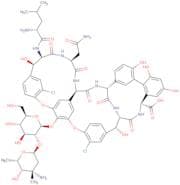
CAS 91700-98-0
:Norvancomycine
Description :
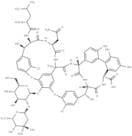
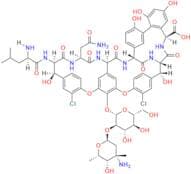
Norvancomycine est un antibiotique glycopeptidique dérivé de la vancomycine, principalement utilisé dans le traitement des infections causées par des bactéries Gram-positives, en particulier celles résistantes à d'autres antibiotiques. Il présente un mécanisme d'action similaire à celui de la vancomycine, en inhibant la synthèse de la paroi cellulaire bactérienne en se liant au terminus D-alanyl-D-alanine des précurseurs de la paroi cellulaire. Cette action perturbe l'intégrité de la paroi cellulaire bactérienne, entraînant la lyse cellulaire et la mort. Norvancomycine est particulièrement efficace contre les souches de Staphylococcus aureus, y compris Staphylococcus aureus résistant à la méthicilline (MRSA). Le composé se caractérise par sa structure complexe, qui comprend plusieurs cycles aromatiques et des moieties de sucre, contribuant à sa solubilité et à sa stabilité. Sa pharmacocinétique, y compris l'absorption, la distribution, le métabolisme et l'excrétion, est similaire à celle de la vancomycine, bien que des paramètres spécifiques puissent varier. Norvancomycine est généralement administré par voie intraveineuse, en particulier dans les infections graves, et son utilisation est étroitement surveillée pour prévenir la toxicité et le développement de résistance. Dans l'ensemble, Norvancomycine représente une option thérapeutique importante dans la lutte contre les infections bactériennes résistantes.
Formule :C65H73Cl2N9O24
InChI :InChI=1/C65H73Cl2N9O24/c1-5-22(2)44(69)58(88)75-48-50(82)25-7-10-36(31(66)13-25)96-38-15-27-16-39(54(38)100-64-55(53(85)52(84)40(21-77)98-64)99-42-20-65(4,70)56(86)23(3)95-42)97-37-11-8-26(14-32(37)67)51(83)49-62(92)74-47(63(93)94)30-17-28(78)18-35(80)43(30)29-12-24(6-9-34(29)79)45(59(89)76-49)73-60(90)46(27)72-57(87)33(19-41(68)81)71-61(48)91/h6-18,22-23,33,40,42,44-53,55-56,64,77-80,82-86H,5,19-21,69-70H2,1-4H3,(H2,68,81)(H,71,91)(H,72,87)(H,73,90)(H,74,92)(H,75,88)(H,76,89)(H,93,94)/t22?,23-,33-,40+,42-,44+,45+,46+,47+,48+,49-,50+,51+,52+,53-,55+,56+,64-,65-/m0/s1
Code InChI :InChIKey=NUAQIRUAZSJTAI-YRPZDAAMSA-N
SMILES :O(C=1C2=CC3=CC1OC=4C(Cl)=CC(=CC4)[C@@H](O)[C@@H](NC([C@@H](CC(C)C)N)=O)C(=O)N[C@@H](CC(N)=O)C(=O)N[C@]3(C(=O)N[C@@]5(C=6C=C(C=7C([C@@H](C(O)=O)NC(=O)[C@]([C@H](O)C=8C=C(Cl)C(O2)=CC8)(NC5=O)[H])=CC(O)=CC7O)C(O)=CC6)[H])[H])[C@H]9[C@H](O[C@H]%10C[C@](C)(N)[C@H](O)[C@H](C)O%10)[C@@H](O)[C@H](O)[C@@H](CO)O9
Synonymes :- 56-Demethylvancomycin
- N-Demethylvancomycin
- Antibiotic A 51568A
- Vancomycin, 56-demethyl-
- 22H-8,11:18,21-Dietheno-23,36-(iminomethano)-13,16:31,35-dimetheno-1H,16H-[1,6,9]oxadiazacyclohexadecino[4,5-m][10,2,16]benzoxadiazacyclotetracosine, vancomycin deriv.
Trier par
Degré de pureté (%)
0
100
|
0
|
50
|
90
|
95
|
100
5 produits concernés.
N-Demethylvancomycin
CAS :N-Demethylvancomycin is a glycopeptide antibiotic that can be extracted from Nocardia orientalis and exhibits activity against various strains of Staphylococcus aureus and Staphylococcus epidermidis. It is utilized in research related to infections.Formule :C65H73Cl2N9O24Couleur et forme :SolidMasse moléculaire :1435.23Norvancomycin Trifluoroacetic Acid Salt >85%
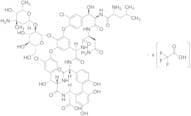
CAS :Produit contrôléFormule :C65H73Cl2N9O24(freeamine)Degré de pureté :>85%Couleur et forme :NeatMasse moléculaire :1435.23Norvancomycin trifluoroacetate
CAS :Norvancomycin trifluoroacetate is an antibiotic compound, which is a glycopeptide derived from the bacterium Amycolatopsis orientalis. Its mode of action involves inhibiting bacterial cell wall synthesis. Specifically, Norvancomycin disrupts the cross-linking of peptidoglycan layers in the bacterial cell wall by binding to the D-alanyl-D-alanine terminus of cell wall precursors. This disruption weakens the bacterial cell wall, ultimately leading to cell lysis and death, thereby exerting a bactericidal effect.Formule :C65H73Cl2N9O24•(C2HF3O2)xDegré de pureté :Min. 95%Norvancomycin
CAS :Norvancomycin is an antimicrobial agent that is used as a treatment for infectious diseases. It prevents bacterial growth by binding to the D-alanyl-D-alanine moiety of the peptidoglycan cell wall, which inhibits cell wall synthesis. Norvancomycin has been shown to be effective against Gram-positive bacteria such as Staphylococcus aureus and Enterococcus faecalis and Gram-negative bacteria such as Escherichia coli and Pseudomonas aeruginosa. Norvancomycin also has the ability to inhibit transcriptional regulation, leading to decreased production of proteins essential for bacterial growth. Norvancomycin has been shown to have a long half-life in humans, making it useful for pharmacokinetic studies in human serum.
Formule :C65H73Cl2N9O24Degré de pureté :Min. 95%Masse moléculaire :1,435.23 g/mol