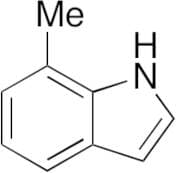
CAS 933-67-5
:7-Méthylindole
Description :
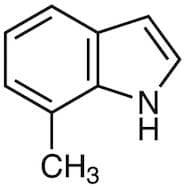
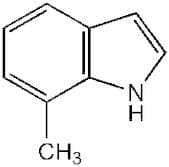
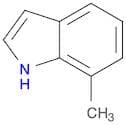
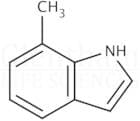
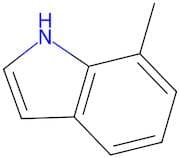
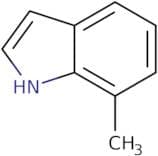
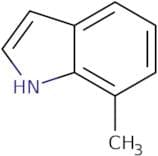
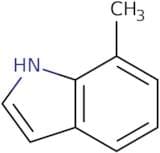
7-Méthylindole, avec le numéro CAS 933-67-5, est un composé organique qui appartient à la famille des indoles, caractérisé par une structure bicyclique composée d'un anneau de benzène fusionné à un anneau de pyrrole. Ce composé présente un groupe méthyle attaché à la structure d'indole contenant de l'azote à la position 7. C'est un liquide incolore à jaune pâle avec une odeur aromatique distincte. 7-Méthylindole est connu pour son rôle dans diverses réactions chimiques et est souvent utilisé dans la synthèse organique et comme intermédiaire dans la production de produits pharmaceutiques et d'agrochimiques. Le composé présente une solubilité modérée dans les solvants organiques et est relativement stable dans des conditions standard. Ses propriétés chimiques incluent la capacité de subir des réactions de substitution électrophile, ce qui en fait un élément de construction polyvalent en chimie organique synthétique. De plus, 7-Méthylindole a été étudié pour ses activités biologiques, y compris ses effets potentiels sur la santé humaine et son rôle dans l'environnement, en particulier en ce qui concerne sa présence dans certains produits naturels et ses implications en toxicologie.
Formule :C9H9N
InChI :InChI=1S/C9H9N/c1-7-3-2-4-8-5-6-10-9(7)8/h2-6,10H,1H3
Code InChI :InChIKey=KGWPHCDTOLQQEP-UHFFFAOYSA-N
SMILES :CC1=C2C(=CC=C1)C=CN2
Synonymes :- 1H-Indole, 7-methyl-
- 7-Methyl-1H-indole
- Indole, 7-methyl-
- NSC 618
- 7-Methylindole
Trier par
Degré de pureté (%)
0
100
|
0
|
50
|
90
|
95
|
100
11 produits concernés.
7-Methylindole
CAS :Formule :C9H9NDegré de pureté :>98.0%(GC)Couleur et forme :White to Light yellow to Light orange powder to crystalMasse moléculaire :131.187-Methylindole, 98%
CAS :It is a reactant for preparation of pharmaceutically active pyrrolidine analogues via Markovnikov addition, tryptophan dioxygenase inhibitors pyridyl-ethenyl-indoles as potential anticancer immunomodulators, plant growth inhibitors, antifungal agents, sodium-Dependent Glucose Co-transporter 2 (SGLT2Formule :C9H9NDegré de pureté :98%Couleur et forme :White to cream to yellow to pale brown, Crystals or powder or crystalline powderMasse moléculaire :131.187-Methyl-1H-indole
CAS :Formule :C9H9NDegré de pureté :98%Couleur et forme :SolidMasse moléculaire :131.1745Ref: IN-DA0063QU
1g21,00€5g25,00€10g40,00€15g56,00€25g65,00€50g96,00€75g114,00€100g146,00€200g200,00€300g295,00€400g518,00€500g571,00€7-Methylindole
CAS :Formule :C9H9NDegré de pureté :≥ 98.0%Couleur et forme :White crystalsMasse moléculaire :131.187-Methyl-1H-indole
CAS :7-Methyl-1H-indoleFormule :C9H9NDegré de pureté :98%Couleur et forme : pale yellow solidMasse moléculaire :131.17g/mol7-Methylindole technical grade
CAS :7-Methylidole is a heterocyclic chemical compound that is used as a precursor in the synthesis of many pharmaceuticals. It has been shown to have an inhibitory effect on the growth of cancer cells in tissue cultures and can be used as a marker for cancer cells. 7-Methylidole is also a virulence factor, which can be seen through assays on bacterial strains. This compound has been proven to be reactive with Polygonum cuspidatum. The reaction produces indirubin, which is a red pigment that is found in some species of Polygonum and other plants.Formule :C9H9NDegré de pureté :Min. 95%Couleur et forme :PowderMasse moléculaire :131.17 g/mol7-Methylindole
CAS :7-Methylindole is a biochemical substance that is synthesized in the body. It is produced in the liver, and it can be found in the brain, heart, and kidney. 7-Methylindole has been shown to have cancer-fighting properties. 7-Methylindole binds to DNA by methylating nucleic acid bases, which causes a change in the genetic code. This leads to tumor cells being more sensitive to treatment with other substances that inhibit DNA synthesis or repair, such as anthranilate and 5-methoxyindole.
Formule :C9H9NDegré de pureté :Min 98%Couleur et forme :PowderMasse moléculaire :131.17 g/mol7-Methylindole
CAS :7-Methylindole is a chemical compound with the formula C8H7N. It is a colorless solid with a pleasant aromatic odor. It is used as a building block in organic chemistry and as a reagent for organic synthesis. 7-Methylindole can be converted to other compounds through reactions with various reagents, such as halogens and hydrogen halides, nitrous acid, alkylating agents, and sulfur dioxide. The resulting products are useful research chemicals or natural products. 7-Methylindole is also used to produce indigo dye from indigo blue pigment.Formule :C9H9NMasse moléculaire :131.18 g/molRef: 3D-M-3944
-Unit-ggÀ demander1kgÀ demander25gÀ demander100gÀ demander250gÀ demander500gÀ demander7-Methyl-1H-indole
CAS :Formule :C9H9NDegré de pureté :97%Couleur et forme :SolidMasse moléculaire :131.1787-Methylindole
CAS :Produit contrôléApplications 7-Methylindole is a reactant in the synthesis of α-amino amides that are found in a variety of biological-active compounds.
References Box, H.K., et. al.: Tetrahedron, 70, 9709 (2014)Formule :C9H9NCouleur et forme :NeatMasse moléculaire :131.17