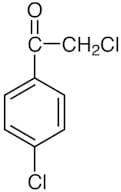
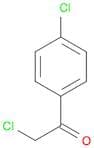
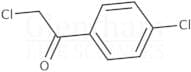
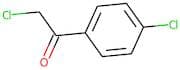
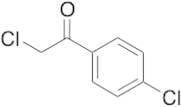
CAS 937-20-2
:2,4′-Dichloroacétophénone
- Ethanone, 2-chloro-1-(4-chlorophenyl)-
- Acetophenone, 2,4′-dichloro-
- α-Chloro-p-chloroacetophenone
- 2-Chloro-1-(4-chlorophenyl)ethanone
- p-Chlorophenacyl chloride
- 4-CHLOROPHENACYL CHLORIDE
- 2,4DICHLOROACETOPHENONE(2,4'-DICHLOROISOMER)
- alpha,4-Dichloroacetophenone,97%
- 2,4'-Dichloroacetophenone, 98+%
- 2,4'-DICHLOROACETOPHENONE
- 2,4'-Dichloroacetophenone 2-Chloro-1-(4-Chlorophenyl)ethanone
- à,4-dichloroacetophenone
- 4',α-Dichloroacetophenone
- 2,4'-DICHLOROACETOPHENONE, 99+%
- ALPHA,4-DICHLOROACETOPHENONE
- 2,4'-Dichloroacetophenone
- Chloromethyl 4-chlorophenyl ketone
- 2-Chloro-1-(4-chlorophenyl)-1-ethanone
- α,4'-Dichloroacetophenone
- 2-Chloro-4Chloroacetophenone
- 1-(4-Chlorophenyl)-2-chloroethanone
- Voir plus de synonymes
4-Chlorophenacyl Chloride
CAS :Formule :C8H6Cl2ODegré de pureté :>98.0%(GC)Couleur et forme :White to Almost white powder to crystalMasse moléculaire :189.042-chloro-1-(4-chlorophenyl)ethanone
CAS :Formule :C8H6Cl2ODegré de pureté :97%Couleur et forme :SolidMasse moléculaire :189.03864-Chlorophenacyl chloride
CAS :4-Chlorophenacyl chlorideDegré de pureté :98%Masse moléculaire :189.04g/mol2-Chloro-1-(4-chlorophenyl)ethanone
CAS :Formule :C8H6Cl2ODegré de pureté :95%Couleur et forme :Solid, White - Almost white powderMasse moléculaire :189.042-Chloro-1-(4-chlorophenyl)ethanone
CAS :Produit contrôléApplications 2-chloro-1-(4-chlorophenyl)ethanone (cas# 937-20-2) is a useful research chemical.
Formule :C8H6OCl2Couleur et forme :NeatMasse moléculaire :189.032-Chloro-1-(4-chlorophenyl)ethanone
CAS :2-Chloro-1-(4-chlorophenyl)ethanone is a pyrazole derivative that inhibits the production of proinflammatory cytokines, such as tumor necrosis factor-α (TNF-α), interleukin 1β (IL-1β), and IL-6. It also exhibits significant anti-inflammatory activity. 2-Chloro-1-(4-chlorophenyl)ethanone is synthesized from the Grignard reagent and chloroacetaldehyde. The synthesis proceeds in two steps: first, the Grignard reagent is added to chloroacetaldehyde in DMF at -78°C to form an organometallic intermediate; second, the organometallic intermediate reacts with an acid chloride to produce the desired product. This reaction can be catalyzed by aluminium chloride or zinc chloride. 2CPAE has a high solubility in organic solvents and surfactants such as sodium dodecyl
Formule :C8H6Cl2ODegré de pureté :Min. 95%Masse moléculaire :189.04 g/mol