CAS 94-65-5
:2-Propylcyclohexanone
Description :
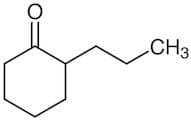
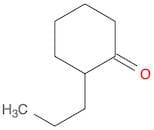
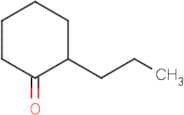
2-Propylcyclohexanone est une cétone cyclique caractérisée par un anneau de cyclohexane avec un groupe propyle et un groupe carbonyle (C=O) attaché. Ce composé apparaît généralement sous la forme d'un liquide incolore à jaune pâle avec une odeur distinctive. Il a un point d'ébullition modéré et est relativement soluble dans les solvants organiques, tout en étant moins soluble dans l'eau en raison de sa nature hydrophobe. La présence du groupe fonctionnel cétone contribue à sa réactivité, en faisant un intermédiaire utile dans la synthèse organique et les applications industrielles. 2-Propylcyclohexanone peut subir diverses réactions chimiques, y compris l'addition nucléophile et l'oxydation. Les considérations de sécurité incluent des effets irritants potentiels sur la peau et les yeux, et il doit être manipulé avec les précautions appropriées dans un endroit bien ventilé. Ses applications s'étendent à la production de parfums, d'arômes et en tant que solvant dans les processus chimiques. Dans l'ensemble, 2-Propylcyclohexanone est un composé polyvalent d'une grande pertinence tant dans les laboratoires que dans les environnements industriels.
Formule :C9H16O
InChI :InChI=1S/C9H16O/c1-2-5-8-6-3-4-7-9(8)10/h8H,2-7H2,1H3
Code InChI :InChIKey=OCJLPZCBZSCVCO-UHFFFAOYSA-N
SMILES :C(CC)C1C(=O)CCCC1
Synonymes :- 2-(n-Propyl)cyclohexanone
- 2-Propylcyclohexan-1-one
- Cyclohexanone, 2-propyl-
- Nsc 54015
- 2-Propylcyclohexanone
Trier par
Degré de pureté (%)
0
100
|
0
|
50
|
90
|
95
|
100
4 produits concernés.
2-Propylcyclohexanone
CAS :Formule :C9H16ODegré de pureté :>98.0%(GC)Couleur et forme :Colorless to Light yellow to Light orange clear liquidMasse moléculaire :140.232-Propylcyclohexanone
CAS :2-Propylcyclohexanone is a competitive inhibitor of the binding of choline to acetylcholine receptors in rat brain membranes. It has a significant inhibitory effect on the binding of acetylcholine to its receptor, with an inhibition constant (Ki) of 0.2 mM. 2-Propylcyclohexanone also inhibits bacterial growth by interacting with the active site of enzymes that catalyze the synthesis or breakdown of biomolecules. 2-Propylcyclohexanone has shown antibacterial activity against both Gram-positive and Gram-negative bacteria, including Staphylococcus aureus, Pseudomonas aeruginosa, and Escherichia coli. The mechanism is not known for this drug's anti-bacterial activity, but it may be due to its ability to bind to substrates in the active site of enzymes that catalyze the synthesis or breakdown of biomolecules or inhibit adsorption equilibrium by actingFormule :C9H16ODegré de pureté :Min. 95%Masse moléculaire :140.23 g/mol