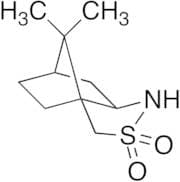
CAS 94594-90-8
:(2R)-Bornane-10,2-sultame
Description :
(2R)-Bornane-10,2-sultame, avec le numéro CAS 94594-90-8, est un composé de sulfonamide cyclique caractérisé par sa structure bicyclique unique dérivée du bornane. Ce composé présente un groupe fonctionnel de sulfonamide, qui contribue à sa réactivité chimique et à ses applications potentielles dans divers domaines, y compris la chimie médicinale. La présence de l'anneau de sultam indique qu'il possède des atomes d'azote et de soufre dans sa structure, ce qui peut influencer sa solubilité et son interaction avec les systèmes biologiques. En général, les sultams présentent des propriétés intéressantes telles que la stabilité dans certaines conditions et la capacité à participer à diverses réactions chimiques, y compris les substitutions nucléophiles. La stéréochimie désignée par (2R) indique un arrangement spatial spécifique des atomes, ce qui peut affecter l'activité biologique du composé et ses interactions. Dans l'ensemble, (2R)-Bornane-10,2-sultame présente un intérêt pour ses applications potentielles dans le développement de médicaments et en tant qu'intermédiaire synthétique en chimie organique.
Formule :C10H17NO2S
InChI :InChI=1/C10H17NO2S/c1-9(2)7-3-4-10(9)6-14(12,13)11-8(10)5-7/h7-8,11H,3-6H2,1-2H3/t7-,8-,10+/m0/s1
Synonymes :- [3aS-(3aalpha,6alpha,7abeta)]-Hexahydro-8,8-dimethyl-3H-3a,6-methano-2,1-benzisothiazole 2,2-dioxide
- (1S)-(-)-2,10,Camphor sultam
- 8,8-Dimethyloctahydro-4,7-Methano-2,1-Benzothiazole 2,2-Dioxide
- (7aR)-8,8-dimethylhexahydro-3a,6-methano-2,1-benzothiazole 2,2-dioxide
- (3aS,6R,7aR)-8,8-dimethylhexahydro-3a,6-methano-2,1-benzothiazole 2,2-dioxide
- (6R)-8,8-dimethylhexahydro-3a,6-methano-2,1-benzisothiazole 2,2-dioxide
- (3aS,6S,7aS)-8,8-dimethylhexahydro-3a,6-methano-2,1-benzisothiazole 2,2-dioxide
- (-)-Camphorsultam
- (1S)-(-)-2,10-Camphorsultam
- (1S)-(-)-2,11-Camphorsultam
Trier par
Degré de pureté (%)
0
100
|
0
|
50
|
90
|
95
|
100
8 produits concernés.
(-)-10,2-Camphorsultam
CAS :Formule :C10H17NO2SDegré de pureté :>98.0%(GC)Couleur et forme :White to Almost white powder to crystalMasse moléculaire :215.31(1S,2R)-(-)-10,2-Camphorsultam, 99%
CAS :(1S,2R)-(-)-10,2-Camphorsultam is used in the asymmetric synthesis of (S)- and (R)-N-Fmoc-S-trityl--methylcysteine. It is used as proton source in the synthesis of chiral ,-substituted -butyrolactones. It is also employed as a chiral probe for the optical resolution by HPLC and X-ray crystallographiFormule :C10H17NO2SDegré de pureté :99%Couleur et forme :Crystals or powder or crystalline powder, White to pale creamMasse moléculaire :215.31(3aS,6R,7aR)-8,8-Dimethylhexahydro-1H-3a,6-methanobenzo[c]isothiazole 2,2-dioxide
CAS :Formule :C10H17NO2SDegré de pureté :98%Couleur et forme :SolidMasse moléculaire :215.3125(1S,5R)-10,10-Dimethyl-3-Thia-4-Azatricyclo[5.2.1.0(1,5)]Decane 3,3-Dioxide
CAS :(1S,5R)-10,10-Dimethyl-3-Thia-4-Azatricyclo[5.2.1.0(1,5)]Decane 3,3-DioxideDegré de pureté :97%Masse moléculaire :215.31g/mol(1S)-(-)-2,10-Camphorsultam
CAS :Formule :C10H17NO2SDegré de pureté :98%Couleur et forme :CrystallineMasse moléculaire :215.31(1S)-Camphorsultam
CAS :Produit contrôléApplications (1S)-Camphorsultam is used as a chiral auxiliary to control the stereochemistry in order to obtain the desired stereoselective product. It’s also a reagent used to make Camphorsultam conjugates, and used as a catalyst with the help of a lewis acid in organic reactions such as the Diels-Alder reaction, and the Grignard reaction.
References Springthorpe, B., et al.: Bioorg. Med. Chem. Lett., 17, 6013 (2007); Inoue, M., et al.: Nat. Chem., 2, 280 (2010); Chapuis, C., et al.: Pol. J. Chem., 68, 2323-31 (1994); Merhcan, F.L., et al.: Tetrahedron: Asymmetry, 7, 667-70 (1996);Formule :C10H17NO2SCouleur et forme :NeatMasse moléculaire :215.13
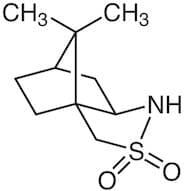



![(3aS,6R,7aR)-8,8-Dimethylhexahydro-1H-3a,6-methanobenzo[c]isothiazole 2,2-dioxide](/_next/image/?url=https%3A%2Fstatic.cymitquimica.com%2Fproducts%2FIN%2Fthumb%2FDA003BJT.jpg&w=3840&q=75)

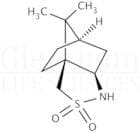

![(1S,5R)-10,10-Dimethyl-3-Thia-4-Azatricyclo[5.2.1.0(1,5)]Decane 3,3-Dioxide](/_next/image/?url=https%3A%2Fstatic.cymitquimica.com%2Fproducts%2F54%2Fthumb%2FOR1007931.jpg&w=3840&q=75)