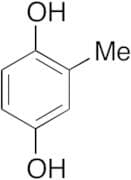
CAS 95-71-6
:Méthylhydroquinone
Description :
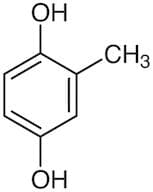
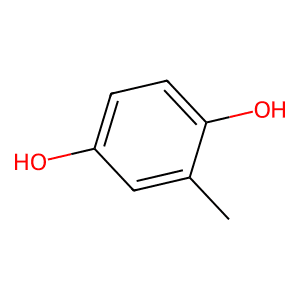
Méthylhydroquinone, également connu sous le nom de 2-Méthylhydroquinone, est un composé organique avec la formule chimique C7H8O2. C'est un dérivé de l'hydroquinone, présentant un groupe méthyle attaché à l'un des atomes de carbone dans l'anneau benzénique. Ce composé apparaît sous forme de solide cristallin blanc à jaune pâle et est soluble dans des solvants organiques tels que l'éthanol et l'éther, mais a une solubilité limitée dans l'eau. Méthylhydroquinone est principalement utilisé comme antioxydant dans diverses applications industrielles, y compris la stabilisation des plastiques et comme réactif dans la synthèse organique. Il présente des propriétés similaires à celles de l'hydroquinone, y compris la capacité d'agir comme agent réducteur. Cependant, il est important de manipuler cette substance avec précaution, car elle peut être un irritant pour la peau et les yeux. De plus, il convient de consulter les fiches de données de sécurité pour les procédures appropriées de manipulation et d'élimination, ainsi que les effets potentiels sur la santé associés à l'exposition.
Formule :C7H8O2
InChI :InChI=1S/C7H8O2/c1-5-4-6(8)2-3-7(5)9/h2-4,8-9H,1H3
Code InChI :InChIKey=CNHDIAIOKMXOLK-UHFFFAOYSA-N
SMILES :CC1=C(O)C=CC(O)=C1
Synonymes :- 1,4-Benzenediol, 2-methyl-
- 1,4-Dihydroxy-2-methylbenzene
- 2,5-Toluenediol
- 2-Methyl Hydroquinone
- 2-Methyl-1,4-benzenediol
- 2-Methyl-1,4-dihydroxybenzene
- 2-Methyl-1,4-hydroquinone
- 2-Methyl-p-hydroquinone
- 2-Methylbenzene-1,4-Diol
- 2-Methylhydrochinon
- 2-Methylhydroquinone
- 2-Metilhidroquinona
- 4-Hydroxy-2-methylphenol
- Ai3-14932
- Hydroquinone, 2-Methyl-
- Hydroquinone, methyl-
- M-Hq
- Methyl 1,4-dihydroxybenzene
- Methyl-p-hydroquinone
- Methylhydrochinon
- Methylhydroquinone
- Nsc 4962
- O-Methyl hydroquinone
- O-Methylhydroquinone
- Pyrolin
- THQ
- Toluhydroquinone
- Tolylhydroquinone
- m-Methylhydroquinone
- p-Toluhydroquinol
- p-Toluhydroquinone
- Voir plus de synonymes
Trier par
Degré de pureté (%)
0
100
|
0
|
50
|
90
|
95
|
100
11 produits concernés.
Methylhydroquinone
CAS :Formule :C7H8O2Degré de pureté :>98.0%(T)Couleur et forme :White to Light yellow powder to crystalMasse moléculaire :124.142-Methylhydroquinone, 99%
CAS :This Thermo Scientific Chemicals brand product was originally part of the Alfa Aesar product portfolio. Some documentation and label information may refer to the legacy brand. The original Alfa Aesar product / item code or SKU reference has not changed as a part of the brand transition to Thermo SciFormule :C7H8O2Degré de pureté :99%Couleur et forme :Pale cream, Crystals or powder or crystalline powderMasse moléculaire :124.142-Methylbenzene-1,4-diol
CAS :Formule :C7H8O2Degré de pureté :95%Couleur et forme :SolidMasse moléculaire :124.1372Pyrolin, 10mM (in DMSO)
CAS :Pyrolin, 10mM (in DMSO)Degré de pureté :≥98%Masse moléculaire :124.14g/molPyrolin
CAS :Pyrolin has a strong antifungal activity and exerts a potent impact on the ultrastructure of M.fructicola.Formule :C7H8O2Degré de pureté :99.38%Couleur et forme :Beige Solid CrystallineMasse moléculaire :124.142-Methylhydroquinone
CAS :2-Methylhydroquinone is a reactive oxygen species (ROS) that can bind to DNA, forming covalent adducts. It has been shown to have an optimum concentration of 10 μM, and the hydroxyl group on its phenolic ring enables it to form hydrogen bonding interactions with nucleic acids. 2-Methylhydroquinone has been shown to inhibit angiogenic process in vitro and in vivo, as well as inhibiting the growth of tumor cells by binding to DNA. This compound also inhibits the transfer of methyl groups from methyl donors such as S-adenosylhomocysteine and methionine to acceptor molecules such as p-hydroxybenzoic acid.Formule :C7H8O2Degré de pureté :Min. 95%Couleur et forme :PowderMasse moléculaire :124.14 g/mol2-Methylbenzene-1,4-diol
CAS :Formule :C7H8O2Degré de pureté :98%Couleur et forme :CrystallineMasse moléculaire :124.139Methylhydroquinone
CAS :Produit contrôléApplications Methylhydroquinone is a marine fungus metabolite, showing activity as an angiosupressor that interferes with the Akt pathway. Allows for screening of novel inhibitors of angiogenesis.
References Garcia-Caballero, M. et al.: Biochem. Pharm., 85, 1727 (2013);Formule :C7H8O2Couleur et forme :NeatMasse moléculaire :124.14