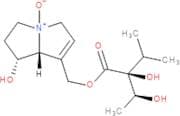
CAS 95462-15-0
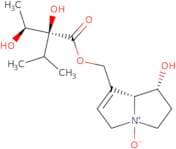
:Lycopsamine-N-oxide 100 µg/mL in Water
CAS :Produit contrôléFormule :C15H25NO6Couleur et forme :Single SolutionMasse moléculaire :315.36Lycopsamine n-oxide
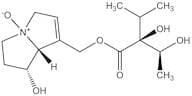
CAS :Natural alkaloidFormule :C15H25NO6Degré de pureté :≥ 90.0 % (HPLC)Couleur et forme :PowderMasse moléculaire :315.36(+)-Lycopsamine N-Oxide (>85%)
CAS :Applications (+)-Lycopsamine N-Oxide, is occurs in pyrrolizidine alkaloid-containing plants, which are the most common poisonous plants affecting livestock, wildlife, and humans. Thye are being known as hepatotoxins and tumorigens.
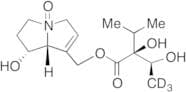
References Qingsu, X., et al.: Chem. Res. Toxic., 26, 1384 (2013); Bosi,, C. F., et al.: Revista Brasileira de Farmacognosia, 23, 425 (2013);Formule :C15H25NO6Degré de pureté :>85%Couleur et forme :NeatMasse moléculaire :315.36(+)-Lycopsamine N-Oxide-D7
CAS :Produit contrôléStability Hygroscopic
Applications (+)-Lycopsamine N-Oxide-D7 is a labelled analogue of (+)-Lycopsamine N-Oxide (L487530). (+)-Lycopsamine N-Oxide is a pyrrolizidine alkaloid that is found in honey and in comfrey, a topical anti-inflammatory agent used to treat patients with arthritis and gout.
Not a dangerous good if item is equal to or less than 1g/ml and there is less than 100g/ml in the package
References Culvenor, C., et al.: J. Agr. Food Chem., 29 958 (1981); Janes, D., et al.: Nat. Prod. Comm., 7, 861 (2012); Pawar, R., et al.: J. Sep. Sci., 33, 200 (2010)Formule :C152H7H18NO6Couleur et forme :White To BeigeMasse moléculaire :322.4Lycopsamine N-oxide
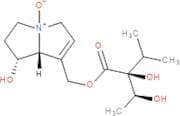
CAS :Lycopsamine N-oxide is a pyrrolizidine alkaloid derivative, which is a naturally occurring compound found in certain plant species, particularly within the Boraginaceae family. This compound is typically produced as a secondary metabolite in these plants. Its mode of action involves metabolic activation in the liver, where enzymes convert it into reactive intermediates capable of binding to cellular macromolecules, ultimately leading to toxic effects.
Formule :C15H25NO6Degré de pureté :Min. 95%Masse moléculaire :315.36 g/mol