CAS 95906-11-9
:Tris(2,4-di-tert-butylphényl) phosphate
Description :
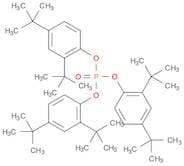
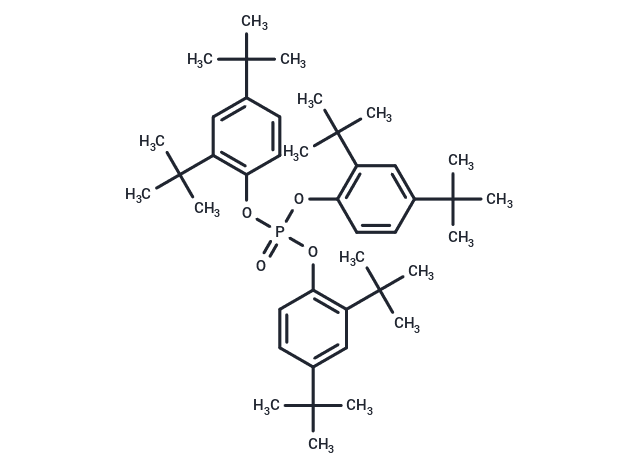
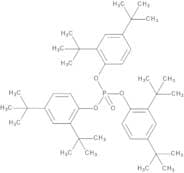
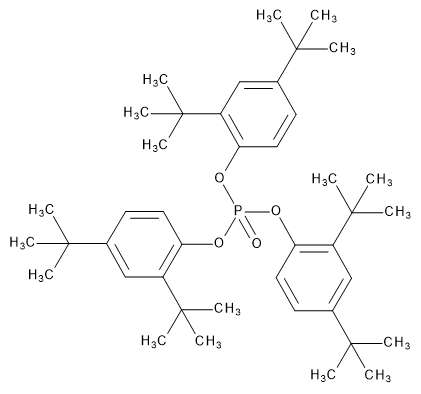
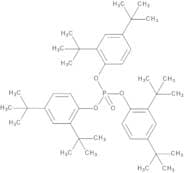
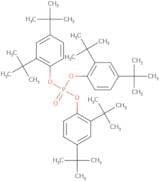
Tris(2,4-di-tert-butylphényl) phosphate, avec le numéro CAS 95906-11-9, est un composé organophosphoré principalement utilisé comme retardant de flamme et plastifiant dans diverses applications, y compris les polymères et les revêtements. Cette substance se caractérise par sa haute stabilité thermique et sa résistance à la dégradation, ce qui la rend adaptée à une utilisation dans des environnements à haute température. Elle présente un groupe phosphate lié à trois groupes 2,4-di-tert-butylphényle encombrants, qui contribuent à son efficacité en tant que retardant de flamme en interrompant le processus de combustion. Les groupes tert-butyles encombrants améliorent son hydrophobicité et réduisent sa volatilité, ce qui aide à maintenir ses performances dans les formulations. De plus, Tris(2,4-di-tert-butylphényl) phosphate présente une faible toxicité et est considéré comme ayant un profil environnemental favorable par rapport à d'autres retardants de flamme. Cependant, comme de nombreux organophosphorés, il doit être manipulé avec précaution pour éviter les risques potentiels pour la santé associés à l'exposition. Ses applications vont au-delà de la résistance au feu, y compris son utilisation dans les lubrifiants et comme additif dans divers processus industriels.
Formule :C42H63O4P
InChI :InChI=1S/C42H63O4P/c1-37(2,3)28-19-22-34(31(25-28)40(10,11)12)44-47(43,45-35-23-20-29(38(4,5)6)26-32(35)41(13,14)15)46-36-24-21-30(39(7,8)9)27-33(36)42(16,17)18/h19-27H,1-18H3
Code InChI :InChIKey=AZSKHRTUXHLAHS-UHFFFAOYSA-N
SMILES :P(OC1=C(C(C)(C)C)C=C(C(C)(C)C)C=C1)(OC2=C(C(C)(C)C)C=C(C(C)(C)C)C=C2)(OC3=C(C(C)(C)C)C=C(C(C)(C)C)C=C3)=O
Synonymes :- D 16-834
- Phenol, 2,4-bis(1,1-dimethylethyl)-, 1,1′,1′′-phosphate
- P 3
- Phenol, 2,4-bis(1,1-dimethylethyl)-, phosphate (3:1)
- Tris(2,4-di-tert-butylphenyl) phosphate
Trier par
Degré de pureté (%)
0
100
|
0
|
50
|
90
|
95
|
100
11 produits concernés.
Tris(2,4-di-tert-butylphenyl)phosphate (Tri(2,4-di-tert-butylphenyl) phosphate)
CAS :Other aromatic phosphoric esters and their salts, including lactophosphates; their halogenated, sulfonated, nitrated or nitrosated derivativesFormule :C42H63O4PCouleur et forme :White SolidMasse moléculaire :662.4464Phenol, 2,4-bis(1,1-dimethylethyl)-, phosphate (3:1)
CAS :Formule :C42H63O4PDegré de pureté :98%Couleur et forme :SolidMasse moléculaire :662.9210Tris(2,4-di-tert-butylphenyl)phosphate
CAS :Tris(2,4-di-tert-butylphenyl)phosphate (TDTBPP) inhibits secretory phospholipase A2 (sPLA2) with anti-inflammatory effect. Cost-effective and quality-assured.Formule :C42H63O4PDegré de pureté :99.73%Couleur et forme :SolidMasse moléculaire :662.92Tris(2,4-di-tert-butylphenyl)phosphate
CAS :Tris(2,4-di-tert-butylphenyl)phosphateDegré de pureté :≥98%Masse moléculaire :662.92g/molTris(2,4-Di-Tert-Butylphenyl) Phosphate
CAS :Tris(2,4-Di-Tert-Butylphenyl) PhosphateDegré de pureté :99%Masse moléculaire :662.92g/molTris (2,4-ditert-butylphenyl) Phosphate
CAS :Formule :C42H63O4PCouleur et forme :Pale Yellow SolidMasse moléculaire :662.94Tris(2,4-di-tert-butylphenyl) phosphate
CAS :Formule :C42H63O4PCouleur et forme :NeatMasse moléculaire :662.92Tris(2,4-di-tert-butylphenyl)phosphate
CAS :Stability Moisture Sensitive
Applications Tris(2,4-di-tert-butylphenyl)phosphate is used as a processing stabilizer for polymers.
References Thilen, M., et al.: J. Appl. Polym. Sci., 76, 938 (2000); Pfaendner, R., et al.: Polym. Degrad. Stab., 91, 2249 (2006);Formule :C42H63O4PCouleur et forme :Light YellowMasse moléculaire :662.92Tris(2,4-di-tert-butylphenyl)phosphate
CAS :Tris(2,4-di-tert-butylphenyl)phosphate (TDBP) is a phosphite that is used as an antioxidant. TDBP has been shown to inhibit the formation of secretory phospholipase A2 (sPLA2), which in turn inhibits the release of arachidonic acid and prostaglandin E2. TDBP also inhibits the activity of hydrogen bond polymerase chain reaction (PCR). This inhibition has been shown to be due to its ability to bind to DNA and prevent the synthesis of RNA, which decreases the production of proteins necessary for cell division. The matrix effect can be used in analytical methods because it has a high solubility in organic solvents and is stable at alkaline pH. TDBP can be used as a sample preparation reagent for mitochondrial membrane potential measurements because it increases mitochondrial membrane potential by inhibiting calcium ion influx. It also exhibits chemical properties such as being a strong base, formingFormule :C42H63O4PDegré de pureté :Min. 95%Couleur et forme :PowderMasse moléculaire :662.92 g/mol