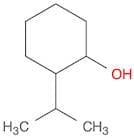
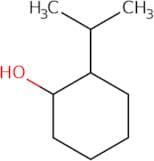
CAS 96-07-1
:2-(1-Méthyléthyl) cyclohexanol
Description :
2-(1-Méthyléthyl) cyclohexanol, également connu sous le nom d'isopropylcyclohexanol, est un composé organique caractérisé par son cycle de cyclohexane substitué par un groupe hydroxyle et un groupe isopropyle. C'est un liquide incolore à jaune pâle avec une odeur caractéristique. La présence du groupe hydroxyle (-OH) le classe comme un alcool, ce qui contribue à sa solubilité dans les solvants polaires et à sa capacité à participer à des liaisons hydrogène. Ce composé a un point d'ébullition relativement bas et une volatilité modérée, ce qui le rend utile dans diverses applications, y compris comme solvant et dans la synthèse d'autres composés organiques. Sa structure chimique permet une réactivité potentielle dans les réactions organiques, telles que la déshydratation et l'oxydation. De plus, 2-(1-Méthyléthyl) cyclohexanol suscite un intérêt dans l'étude de la chimie des parfums et des arômes en raison de son profil olfactif agréable. Les données de sécurité indiquent que, comme de nombreux solvants organiques, il doit être manipulé avec précaution pour éviter l'inhalation ou le contact avec la peau.
Formule :C9H18O
InChI :InChI=1S/C9H18O/c1-7(2)8-5-3-4-6-9(8)10/h7-10H,3-6H2,1-2H3
Code InChI :InChIKey=IXVGVVQGNQZQGD-UHFFFAOYSA-N
SMILES :C(C)(C)C1C(O)CCCC1
Synonymes :- (1S,2R)-2-isopropylcyclohexanol
- 2-(1-Methylethyl)cyclohexanol
- 2-(Propan-2-Yl)Cyclohexanol
- 2-(Propan-2-yl)cyclohexan-1-ol
- 2-Propan-2-ylcyclohexan-1-ol
- Cyclohexanol, 2-(1-methylethyl)-
- Cyclohexanol, 2-isopropyl-
- NSC 2330
- 2-Isopropylcyclohexanol
Trier par
Degré de pureté (%)
0
100
|
0
|
50
|
90
|
95
|
100
3 produits concernés.
2-(Propan-2-yl)cyclohexan-1-ol
CAS :Formule :C9H18ODegré de pureté :98%Couleur et forme :SolidMasse moléculaire :142.23862-Isopropylcyclohexan-1-ol
CAS :2-Isopropylcyclohexan-1-ol is a nonpolar organic compound with a high boiling point. It is used in the industrial production of β-lactam antibiotics, such as cephalosporins and carbapenems. The synthesis of 2-isopropylcyclohexanol involves an asymmetric process that produces two enantiomers. One enantiomer can be converted to an α-hydroxy acid (2-isopropylmalic acid) and the other to a β hydroxy acid (2-isobutyric acid). 2-Isopropylcyclohexan-1-ol is also used in chromatographic science as a solute for column chromatography. It has been shown that magnesium sulfate can be used to increase the separation efficiency of 2-isopropylcyclohexanol, which may be because it increases the adsorption of this solute on silicaFormule :C9H18ODegré de pureté :Min. 95%Masse moléculaire :142.24 g/mol