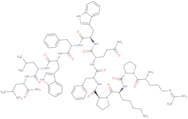
CAS 96736-12-8
:L-Leucinamide, D-arginyl-L-prolyl-L-lysyl-L-prolyl-D-phénylalanil-L-glutaminyl-D-tryptophanyl-L-phénylalanil-D-tryptophanyl-L-leucyl-
Description :
L-Leucinamide, D-arginyl-L-prolyl-L-lysyl-L-prolyl-D-phenylalanine-L-glutamine-D-tryptophan-L-phenylalanine-D-tryptophan-L-leucine est un peptide complexe composé de divers acides aminés, y compris des énantiomères L et D. Cette structure suggère qu'elle pourrait présenter des propriétés biologiques uniques en raison de la présence des deux formes d'acides aminés, qui peuvent influencer ses interactions avec les systèmes biologiques. La présence de multiples résidus de proline peut contribuer à sa stabilité structurelle et à son potentiel de formation de conformations spécifiques. La séquence du peptide indique un rôle potentiel dans les processus biologiques, possiblement lié à des fonctions de signalisation ou structurelles dans les protéines. Son numéro CAS, 96736-12-8, permet une identification précise dans les bases de données chimiques. Cependant, des informations détaillées concernant sa solubilité, sa stabilité et ses activités biologiques spécifiques nécessiteraient des études empiriques, car ces caractéristiques peuvent varier considérablement en fonction de la conformation et de l'environnement du peptide. Dans l'ensemble, ce composé représente un domaine fascinant d'étude en chimie des peptides et en biochimie.
Formule :C79H109N19O12
Synonymes :- SubstanceP,1-D-arginine-5-D-phenylalanine-7-D-tryptophan-9-D-tryptophan-11-L-leucinamide-
- L 756867
- [D-Arg1,D-Phe5,D-Trp7,9,Leu11]substance P
- D-Arg-Pro-Lys-Pro-D-Phe-Gln-D-Trp-Phe-D-Trp-Leu-Leu-Nh2
Trier par
Degré de pureté (%)
0
100
|
0
|
50
|
90
|
95
|
100
5 produits concernés.
(D-Arg¹,D-Phe⁵,D-Trp⁷·⁹,Leu¹¹)-Substance P
CAS :(D-Arg¹,D-Phe⁵,D-Trp⁷·⁹,Leu¹¹)-Substance P initially described as a low potency ghrelin receptor antagonist has surprisingly been found to be a full inverse agonist (EC₅₀ = 5.2 nM). In COS-7 cells transiently transfected with the ghrelin receptor the substance P analog rPKPfQwFwLL decreased the constitutive signaling down to levels observed in untransfected cells. Assuming that constitutive signaling of the ghrelin receptor is of physiological relevance in the regulation of appetite control, inverse agonists of the ghrelin receptor could be interesting for the treatment of obesity. So, Asakawa et al. found that peripherally administered H-6395 decreased food intake in lean mice, in mice with diet induced obesity, and in ob/ob obese mice.Formule :C79H109N19O12Degré de pureté :98.2%Couleur et forme :White LyophilisateMasse moléculaire :1516.86[D-Arg1,D-Phe5,D-Trp7,9,Leu11]-Substance P
CAS :Broad-spectrum inverse agonist; potent at ghrelin receptor (EC50=5.2 nM); blocks other neuropeptide receptors; induces apoptosis; inhibits tumor growth.Formule :C79H109N19O12Degré de pureté :98%Couleur et forme :SolidMasse moléculaire :1516.85[D-Arg1, D-Phe5, D-Trp7,9, Leu11]-Substance P
CAS :Formule :C79H109N19O12Degré de pureté :≥ 95.0%Couleur et forme :White powderMasse moléculaire :1516.83[D-Arg1,D-Phe5,D-Trp7,9,Leu11]-Substance P
CAS :Substance P is a neuropeptide that belongs to the Feeding Regulatory Peptides family. It is synthesized in the hypothalamus and secreted by neurons in the spinal cord, brainstem, and gut. Substance P has been shown to regulate feeding behavior through its interaction with opioid receptors and the release of other neurotransmitters. The synthetic form of this peptide has been shown to reduce body fat in animal models and increased sensitivity to insulin in diabetic patients. This peptide also reduces camp levels in rats, which may be due to its ability to stimulate secretion of camp from pancreatic cells.Formule :C79H109N19O12Degré de pureté :Min. 95%Masse moléculaire :1,516.87 g/mol(D-Arg1,D-Phe5,D-Trp7·9,Leu11)-Substance P
CAS :Substance P is a neuropeptide that binds to the tachykinin receptor NK1. It has potent anti-inflammatory and mitogenic activities, which are mediated through its binding to the NK1 receptor. Substance P can stimulate lung cancer cells to proliferate and inhibit their apoptosis, which may be due to an autocrine mechanism. In addition, it has been shown that substance P can potentiate the growth of some cancers such as colon cancer in vitro and in vivo by increasing DNA synthesis and cell proliferation. This peptide also has a dose-dependent effect on cell growth, with high doses inhibiting cell proliferation at higher levels than low doses.Formule :C79H109N19O12Degré de pureté :Min. 95%Masse moléculaire :1,516.83 g/mol
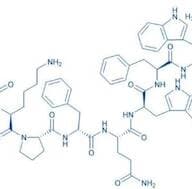

![[D-Arg1,D-Phe5,D-Trp7,9,Leu11]-Substance P](/_next/image/?url=https%3A%2Fstatic.cymitquimica.com%2Fproducts%2FTM%2Fthumb%2FTP1931.jpg&w=3840&q=75)

![[D-Arg1, D-Phe5, D-Trp7,9, Leu11]-Substance P](/_next/image/?url=https%3A%2Fstatic.cymitquimica.com%2Fproducts%2F7W%2Fthumb%2FGL9471.jpg&w=3840&q=75)

![[D-Arg1,D-Phe5,D-Trp7,9,Leu11]-Substance P](/_next/image/?url=https%3A%2Fstatic.cymitquimica.com%2Fproducts%2F3D%2Fthumb%2FPGH-3652-PI.jpg&w=3840&q=75)