CymitQuimica logo

CAS 98102-34-2

:

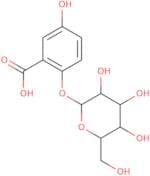
Acide 2-(β-D-glucopyranosyloxy)-5-hydroxybenzoïque

Description :
Acide 2-(β-D-glucopyranosyloxy)-5-hydroxybenzoïque, également connu sous le nom de glucoside d'acide salicylique, est un dérivé glycosylé de l'acide salicylique. Ce composé présente un groupe β-D-glucopyranosyle lié au groupe hydroxyle de la structure de l'acide salicylique, ce qui contribue à sa solubilité et à son activité biologique. Il apparaît généralement sous forme de solide blanc à blanc cassé et est soluble dans l'eau en raison de la présence du groupe glucopyranosyle. Le composé présente des propriétés antioxydantes et pourrait avoir des applications potentielles en pharmacie et en cosmétique, notamment pour ses effets anti-inflammatoires et apaisants pour la peau. Sa structure permet des interactions avec divers systèmes biologiques, ce qui le rend intéressant dans la recherche liée à la biochimie végétale et à la chimie médicinale. De plus, il pourrait être impliqué dans les mécanismes de défense des plantes et a été étudié pour ses potentiels bienfaits pour la santé chez l'homme. Comme de nombreux composés phénoliques, il pourrait également présenter une activité antimicrobienne.
Formule :C13H16O9
InChI :InChI=1S/C13H16O9/c14-4-8-9(16)10(17)11(18)13(22-8)21-7-2-1-5(15)3-6(7)12(19)20/h1-3,8-11,13-18H,4H2,(H,19,20)/t8-,9-,10+,11-,13-/m1/s1
Code InChI :InChIKey=GEZJVEGHJRPQEX-BZNQNGANSA-N
SMILES :O(C1=C(C(O)=O)C=C(O)C=C1)[C@@H]2O[C@H](CO)[C@@H](O)[C@H](O)[C@H]2O
Synonymes :
  • Orbicularin
  • Benzoic acid, 2-(β-D-glucopyranosyloxy)-5-hydroxy-
  • 2-(β-D-Glucopyranosyloxy)-5-hydroxybenzoic acid
Trier par

Degré de pureté (%)
0
100
|
0
|
50
|
90
|
95
|
100
1 produits concernés.
  • 2-O-β-4C1-Glucopyranoside-2,5-dihydroxybenzoic acid

    CAS :
    <p>2-O-beta-4C1-Glucopyranoside-2,5-dihydroxybenzoic acid is a glycoside compound, which is a type of structural derivative where a sugar moiety is bonded to a non-carbohydrate functional group or aglycone. It is derived from specific plant or microbial sources through biochemical synthesis or extraction. The mode of action involves the hydrolysis of the glycosidic bond, mediated by specific enzymes, which releases the aglycone and the sugar component. This feature is crucial for its role in metabolic pathways where sugars are utilized or modified.<br><br>In scientific research, this compound is used in studying carbohydrate metabolism and enzyme activity, particularly those involving glycosidases. Due to its structural characteristics, it may serve as a model compound in understanding glycoside biosynthesis and degradation processes. Additionally, its potential applications in pharmaceuticals are being explored, especially in designing drugs that target enzymatic pathways. The compound's unique structure and reactivity make it a valuable tool in the field of biochemistry and molecular biology, offering insights into glycosidic bond interactions and transformations.</p>
    Formule :C13H16O9
    Degré de pureté :Min. 95%
    Masse moléculaire :316.26 g/mol