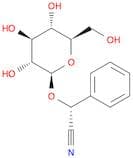
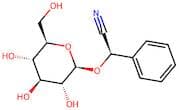
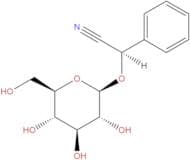
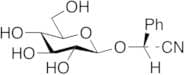
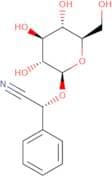
CAS 99-18-3
:Prunasine
- (2R)-Prunasin
- (R)-(beta-D-Glucopyranosyloxy)phenylacetonitrile
- (R)-Prunasin
- (R)-alpha-(beta-D-Glucopyranosyloxy)benzene-acetonitrile
- (αR)-α-(β-<span class="text-smallcaps">D</span>-Glucopyranosyloxy)benzeneacetonitrile
- <span class="text-smallcaps">D</span>-Prunasin
- Benzeneacetonitrile 7-O-β-<span class="text-smallcaps">D</span>-glucopyranoside
- Benzeneacetonitrile, alpha-(beta-D-glucopyranosyloxy)-, (R)- (9CI)
- Benzeneacetonitrile, α-(β-<span class="text-smallcaps">D</span>-glucopyranosyloxy)-, (R)-
- Benzeneacetonitrile, α-(β-<span class="text-smallcaps">D</span>-glucopyranosyloxy)-, (αR)-
- Brn 0091509
- D-Mandelonitrile-beta-D-glucoside
- D-Prunasin
- Prunasin
- Benzeneacetonitrile, α-(β-D-glucopyranosyloxy)-, (R)-
- 5-17-07-00405 (Beilstein Handbook Reference)
- (αR)-α-(β-D-Glucopyranosyloxy)benzeneacetonitrile
- Voir plus de synonymes
Prunasin
CAS :Formule :C14H17NO6Degré de pureté :93%Couleur et forme :SolidMasse moléculaire :295.2879Prunasin
CAS :Formule :C14H17NO6Degré de pureté :95%~99%Couleur et forme :PowderMasse moléculaire :295.291(R)-Prunasin
CAS :Stability Hygroscopic
Applications Used in the synthesis of cyanogen glycoside. A component of antiperspirants, deodorants, body soaps, shampoos, hair rinses, and hair; it inhibits volatile steroid formation by resident bacteria.
Not a dangerous good if item is equal to or less than 1g/ml and there is less than 100g/ml in the package
References Marouf, A., et al.: Pharm. Biol., 39, 263 (2001), Fukuda, T., et al.: Biol. Pharm. Bull., 26, 271 (2003), Butler, M., et al.: J. Nat. Prod., 67, 2141 (2004), He, J., et al.: J. Nat. Prod., 69, 121 (2006),Formule :C14H17NO6Couleur et forme :White To Off-WhiteMasse moléculaire :295.29R-Prunasin
CAS :R-Prunasin is a cyanogenic glycoside, which is a naturally occurring compound found in certain plants. It is primarily sourced from species within the Prunus genus, such as cherries and almonds. The mode of action of R-Prunasin involves its enzymatic hydrolysis by beta-glucosidase, leading to the release of hydrogen cyanide, benzaldehyde, and glucose. This reaction is a classical example of plant defense mechanisms against herbivores and pathogens.
Formule :C14H17NO6Degré de pureté :Min. 95%Couleur et forme :White/Off-White SolidMasse moléculaire :295.29 g/mol