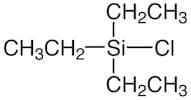
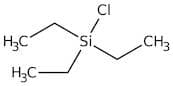
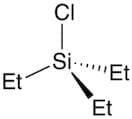
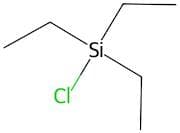
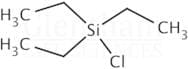
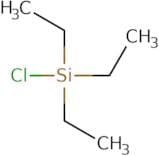
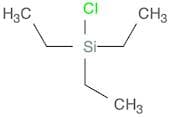
CAS 994-30-9
:Chlorure de triéthylsilyle
- Chlorotriethylsilane
- Chlortriethylsilan
- Clorotrietilsilano
- Silane, chlorotriethyl-
- TESCl
- Tesc
- Triethylsilyl chloride
- Triethylchlorosilane
Chlorotriethylsilane
CAS :Formule :C6H15ClSiDegré de pureté :>97.0%(GC)Couleur et forme :Colorless to Light yellow clear liquidMasse moléculaire :150.72Chlorotriethylsilane, 98+%
CAS :Chlorotriethylsilane is used in laboratory chemicals. It is used for preparing silylating agent and acts as a catalyst for lewis acid. It is used for executing chemical reactions for silicon oil, silicon resin and polysiloxane. It is also used for eradicating robe agent, and used as protective agentFormule :C6H15ClSiDegré de pureté :98+%Couleur et forme :Clear colorless to pale yellow, LiquidMasse moléculaire :150.72Triethylchlorosilane, 99%
CAS :Triethylchlorosilane, 99%
Formule :(C2H5)3SiClDegré de pureté :99%Couleur et forme :colorless liq.Masse moléculaire :150.73Chlorotriethylsilane
CAS :ChlorotriethylsilaneFormule :C6H15ClSiDegré de pureté :98+%Couleur et forme : clear colourless liquidMasse moléculaire :150.72g/molChlorotriethylsilane
CAS :Formule :C6H15ClSiDegré de pureté :≥ 98.0%Couleur et forme :Clear, colourless to light-yellow liquidMasse moléculaire :150.73TRIETHYLCHLOROSILANE
CAS :Trialkylsilyl Blocking Agent
Used as a protecting group for reactive hydrogens in alcohols, amines, thiols, and carboxylic acids. Organosilanes are hydrogen-like, can be introduced in high yield, and can be removed under selective conditions. They are stable over a wide range of reaction conditions and can be removed in the presence of other functional groups, including other protecting groups. The tolerance of silylated alcohols to chemical transformations summary is presented in Table 1 of the Silicon-Based Blocking Agents brochure.
Triethylchlorosilane; Chlorotriethylsilane; TES-Cl
Stability of ethers intermediate between TMS and TBS ethersGood for 1°, 2°, 3° alcoholsCan be cleaved in presence of TBS, TIPS and TBDPS ethersUsed primarily for the protection of alcoholsCan be used to protect amines and carboxylic acidsSummary of selective deprotection conditions is provided in Table 7 through Table 20 of the Silicon-Based Blocking Agents brochureFormule :C6H15ClSiDegré de pureté :97%Couleur et forme :LiquidMasse moléculaire :150.72Chlorotriethylsilane
CAS :Produit contrôléStability Moisture Sensitive
Applications Chlorotriethylsilane is used in the preparation of potent silylating agent and lewis acid catalyst. Chlorotriethylsilane derivatived ethers have been shown to be more stable towards hydrolysis than are trimethyl ethers.
E0
References Alvisi, C. et al.: J. Org. Chem., 63, 1330 (1998): Higashiya, S. et al.: J. Org. Chem., 69, 6326 (2004); Hicks, J.D. et al.: Org. Lett., 9, 5621 (2007);Formule :C6H15ClSiCouleur et forme :NeatMasse moléculaire :150.72Chlorotriethylsilane
CAS :Chlorotriethylsilane is a silylating agent that reacts with hydroxyl groups to form chloroethoxysilanes. It is used to prepare the 10-desacetyl paclitaxel intermediate, which is a precursor of paclitaxel, an anticancer drug. The reaction solution is typically prepared by mixing the reagents in a flow system and then treated with water vapor. This reaction produces hydrochloric acid as a by-product, so it must be conducted under an inert atmosphere or in a dry box. Chlorotriethylsilane also reacts with fatty acids to form chloroethoxy fatty acid esters that are used as detergents for fats and oils. Chlorotriethylsilane can react with terpenes and dibutyltin oxide to produce chlorodibutyltin compounds that are used as lubricants and antifouling agents for metal surfaces. Chlorotriethylsilane can
Formule :C6H15ClSiDegré de pureté :Min. 95%Couleur et forme :Colorless PowderMasse moléculaire :150.72 g/molTriethylchlorosilane
CAS :Formule :C6H15ClSiDegré de pureté :98%Couleur et forme :LiquidMasse moléculaire :150.7218Ref: IN-DA0035QQ
Produit arrêté