CymitQuimica logo

CAS 997-68-2

:

Saccharopine

Description :
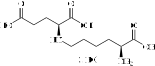
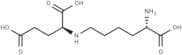
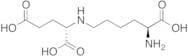
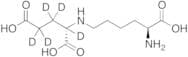
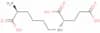
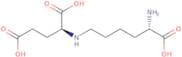
Saccharopine est un dérivé d'acide aminé qui joue un rôle significatif dans le métabolisme de la lysine, un acide aminé essentiel. Il se forme par la condensation de l'acide α-aminoadipique et du glutamate, servant d'intermédiaire dans la voie biosynthétique de la lysine, en particulier chez les organismes qui utilisent la voie de l'α-aminoadipate. Saccharopine se caractérise par sa structure, qui comprend un groupe amino, un groupe carboxyle et une chaîne latérale qui contribue à ses propriétés biochimiques. Il est soluble dans l'eau, ce qui facilite sa participation aux réactions métaboliques. Le composé est d'un intérêt particulier dans la recherche biochimique, notamment dans les études liées au métabolisme des acides aminés et aux troubles associés au métabolisme de la lysine. De plus, le rôle de Saccharopine dans la régulation du métabolisme de l'azote et ses implications potentielles dans les troubles métaboliques en font un sujet d'investigation scientifique en cours. Son numéro CAS, 997-68-2, est utilisé pour l'identification dans les bases de données chimiques et les contextes réglementaires.
Formule :C11H20N2O6
InChI :InChI=1S/C11H20N2O6/c12-7(10(16)17)3-1-2-6-13-8(11(18)19)4-5-9(14)15/h7-8,13H,1-6,12H2,(H,14,15)(H,16,17)(H,18,19)/t7-,8-/m0/s1
Code InChI :InChIKey=ZDGJAHTZVHVLOT-YUMQZZPRSA-N
SMILES :[C@@H](CCC(O)=O)(NCCCC[C@@H](C(O)=O)N)C(O)=O
Synonymes :
  • <span class="text-smallcaps">L</span>-Glutamic acid, N-(5-amino-5-carboxypentyl)-, (S)-
  • <span class="text-smallcaps">L</span>-Glutamic acid, N-[(5S)-5-amino-5-carboxypentyl]-
  • <span class="text-smallcaps">L</span>-Saccharopine
  • Glutamic acid, N-(5-amino-5-carboxypentyl)-, <span class="text-smallcaps">L</span>-
  • L-Glutamic acid, N-(5-amino-5-carboxypentyl)-, (S)-
  • N-(5-amino-5-carboxypentyl)glutamic acid
  • N-[(5S)-5-Amino-5-carboxypentyl]-<span class="text-smallcaps">L</span>-glutamic acid
  • N-[(5S)-5-amino-5-carboxypentyl]-L-glutamic acid
  • Saccharopin
  • Saccharopine
  • Voir plus de synonymes
Trier par

Degré de pureté (%)
0
100
|
0
|
50
|
90
|
95
|
100
6 produits concernés.
  • L-Saccharopine DiHCl

    CAS :
    Formule :C11H20N2O6·2HCl
    Masse moléculaire :276.29 2*36.46

    Ref: 4Z-S-112001

    5mg
    À demander
    10mg
    910,00€
    25mg
    1.638,00€
    50mg
    2.366,00€
    100mg
    À demander
  • Saccharopine

    CAS :
    <p>L-Saccharopine is a product of the breakdown of essential amino acid Lysine.</p>
    Formule :C11H20N2O6
    Couleur et forme :Solid
    Masse moléculaire :276.29
  • L-Saccharopine-d5

    CAS :
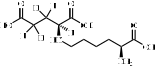
    Formule :C11H15D5N2O6
    Masse moléculaire :281.32

    Ref: 4Z-S-112002

    5mg
    À demander
    10mg
    À demander
    25mg
    À demander
    50mg
    À demander
    100mg
    À demander
  • L-Saccharopine

    CAS :
    <p>Stability Hygroscopic<br>Applications L-Saccharopine is a product of breakdown of essential amino acid Lysine (L468895). Saccharopine is also part of the α-aminoadipate pathway of fungal lysine biosynthesis.<br>References Higashino, K., et al.: Biochem. Biophys. Res. Commun., 20, 285 (1965); Johansson, E., et al.: Structure, 8, 1037 (2000)<br></p>
    Formule :C11H20N2O6
    Couleur et forme :Neat
    Masse moléculaire :276.29

    Ref: TR-S808340

    1mg
    246,00€
    5mg
    1.045,00€
    10mg
    1.655,00€
  • L-Saccharopine-d5

    Produit contrôlé
    CAS :
    Formule :C11H15D5N2O6
    Couleur et forme :Neat
    Masse moléculaire :281.32

    Ref: TR-S808341

    25mg
    6.273,00€
  • L-Saccharopine

    CAS :
    <p>L-Saccharopine is an intermediate in the biosynthesis of lysine. It has been shown to have a role in brain function and is a potential biomarker for infectious diseases. L-Saccharopine can be found in plants, fungi, and bacteria. This enzyme is produced by dehydrogenase form saccharopine. The activity of this enzyme is measured by measuring the amount of NADH oxidized per minute at 30°C. L-Saccharopine has been shown to have a low toxicity and does not cause any side effects when administered to rats orally or intravenously at doses up to 2 g/kg body weight. L-Saccharopine has also been shown to inhibit the growth of certain types of bacteria, such as E. coli, through its inhibition of protein synthesis (in vitro).</p>
    Formule :C11H20N2O6
    Degré de pureté :Min. 95%
    Masse moléculaire :276.29 g/mol
    Ref: 3D-FS172579

    1mg
    863,00€
    2mg
    921,00€
    5mg
    1.735,00€
    10mg
    2.852,00€