Substrats fluorogènes
297 produits trouvés pour "Substrats fluorogènes"
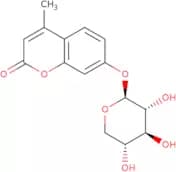
4-Methylumbelliferyl b-D-xylopyranoside
CAS :Please enquire for more information about 4-Methylumbelliferyl b-D-xylopyranoside including the price, delivery time and more detailed product information at the technical inquiry form on this page
Formule :C15H16O7Degré de pureté :Min. 98 Area-%Couleur et forme :PowderMasse moléculaire :308.28 g/mol4-Methylumbelliferyl myo-inositol-1-phosphate N-methyl-morpholine salt
CAS :Please enquire for more information about 4-Methylumbelliferyl myo-inositol-1-phosphate N-methyl-morpholine salt including the price, delivery time and more detailed product information at the technical inquiry form on this page
Formule :C16H19O11P·C5H11NOCouleur et forme :PowderMasse moléculaire :519.44 g/molBoc-Val-Pro-Arg-PAB-Resorufin
Boc-Val-Pro-Arg-PAB-Resorufin is fluorogenic substrate for thrombin and the thrombin-staphylocoagulase complex.
Formule :C40H50N8O8Degré de pureté :Min. 97 Area-%Masse moléculaire :770.87 g/molL-Arginyl-L-arginine 7-amido-4-methylcoumarin trihydrochloride
CAS :Fluorogenic substrate for cathepsin B or aminopeptidase III. Yields a blue fluorescent solution upon cleavage.
Formule :C22H36Cl3N9O4Degré de pureté :Min. 98 Area-%Masse moléculaire :596.95 g/mol4-Methylumbelliferyl a-D-mannopyranoside 6-sulfate sodium salt
4-Methylumbelliferyl alpha-D-mannopyranoside 6-sulfate sodium salt is a fluorogenic substrate for sulfatase. After enzymatic cleaveage, free 4-methylumbelliferone (also known as hymecromone) is released, exhibiting blue fluorescence upon excitation with UV light. The strongest fluorescence of 4-methylumbelliferone requires deprotonation of the hydroxyl group (thus requires alkaline pH), with a maximal fluorescence intensity obtained with excitation at 350 to 370 nm and emission at 440 to 470 nm. The use of 4-methylumbelliferyl alpha-D-mannopyranoside 6-sulfate sodium saltas a substrate for measuring the sulfatase activity is used for Mucopolysaccharidosis (MPS) screening and other lysosomal storage disorder diagnosis.
Formule :C16H17O11SNaDegré de pureté :Min. 98 Area-%Couleur et forme :White PowderMasse moléculaire :440.36 g/molResorufin b-D-cellobioside
CAS :Resorufin b-D-cellobioside is a fluorogenic substrate for measurement of cellulase activity. The product of enzyme reaction, resorufin, exhibits fluorescence emission at 585 nm with excitation at 571 nm at or near physiological pH values.
Formule :C24H27NO13Degré de pureté :Min. 95 Area-%Couleur et forme :Brown Orange PowderMasse moléculaire :537.47 g/molL-Pro-PAB-Resorufin
L-Pro-PAB-Resorufin is a highly sensitive chromogenic and fluorogenic indicator for L-proline aminopeptidase activity and related enzymes occurring in prokaryotic as well as eukaryotic organisms. After removal of the L-proline amide substructure by enzymatic hydrolysis and spontaneous elimination of the para-amino-benzyl (PAB) spacer, the initially orange colored compound yields an intense pink color. In addition, the released chromophor is an excellent fluorophor showing red fluorescence at an emission wavelength of 580 to 600 nm when excited at 560 to 570 nm.
Formule :C24H21N3O4Degré de pureté :Min. 70 Area-%Couleur et forme :PowderMasse moléculaire :415 g/mol4-Trifluoromethylumbelliferyl b-D-glucuronide potassium salt
CAS :4-Trifluoromethylumbelliferyl b-D-glucuronide potassium salt is a fluorogenic substrate for beta-glucuronidase. Upon hydrolysis, the fluorogenic moiety (blueish) 4-trifluoromethylumbelliferone (also known as TFMU) is released. 4-Trifluoromethylumbelliferyl b-D-glucuronide potassium salt is commonly used in bacterial detection and for drug metabolism studies as well as lysosomal storage disorder screening.Formule :C16H12F3O9KDegré de pureté :Min. 95 Area-%Couleur et forme :White PowderMasse moléculaire :444.35 g/mol4-Methylumbelliferyl lignocerate
CAS :4-Methylumbelliferyl lignocerate is a fluorogenic substrate for lipase. After enzymatic cleaveage, free 4-methylumbelliferone (also known as hymecromone) is released, exhibiting blue fluorescence upon excitation with UV light. The strongest fluorescence of 4-methylumbelliferone requires deprotonation of the hydroxyl group (thus requires alkaline pH), with a maximal fluorescence intensity obtained with excitation at 350 to 370 nm and emission at 440 to 470 nm. The use of 4-methylumbelliferyl lignocerateas a substrate for measuring the lipase activity is used for X-linked adrenoleukodystrophy diagnosis and peroxisomal disorder screening.
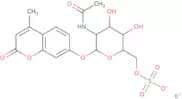
Formule :C34H54O4Degré de pureté :Min. 95%Couleur et forme :PowderMasse moléculaire :526.79 g/mol4-Methylumbelliferyl 2-acetamido-2-deoxy-b-D-galactopyranoside-6-sulfate potassium salt
CAS :4-Methylumbelliferyl 2-acetamido-2-deoxy-beta-D-galactopyranoside-6-sulfate potassium salt is a fluorogenic substrate for N-acetylgalactosamine-6-sulfatase. After enzymatic cleaveage, free 4-methylumbelliferone (also known as hymecromone) is released, exhibiting blue fluorescence upon excitation with UV light. The strongest fluorescence of 4-methylumbelliferone requires deprotonation of the hydroxyl group (thus requires alkaline pH), with a maximal fluorescence intensity obtained with excitation at 350 to 370 nm and emission at 440 to 470 nm. The use of 4-methylumbelliferyl 2-acetamido-2-deoxy-beta-D-galactopyranoside-6-sulfate potassium saltas a substrate for measuring the N-acetylgalactosamine-6-sulfatase activity is used for diagnosis of Mucopolysaccharidosis IVA (MPS IVA) (a rare lysosomal storage disorder) and Morquio A syndrome screening.
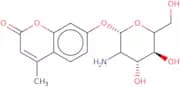
Formule :C18H20KNO11SDegré de pureté :Min. 95%Couleur et forme :PowderMasse moléculaire :497.52 g/mol4-Methylumbelliferyl b-D-glucosaminide - Moscerdam™ biochemical purity
CAS :A substrate used for the diagnosis of Sanfilippo disease C (MPS III C).
Formule :C16H19NO7Degré de pureté :Min. 98 Area-%Couleur et forme :White PowderMasse moléculaire :337.32 g/molRef: 3D-EM31025
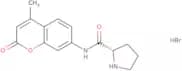
Produit arrêtéL-Proline 7-amido-4-methylcoumarin hydrobromide salt
CAS :L-Proline 7-amido-4-methylcoumarin hydrobromide salt is a fluorogenic peptide substrate for proline-specific peptidase. This AMC peptide substrate is normally used to rapidly profile the N-terminal specificity of proteases.Formule :C15H17BrN2O3Degré de pureté :Min. 95%Couleur et forme :PowderMasse moléculaire :353.22 g/mol4-Methylumbelliferyl β-D-glucopyranoside
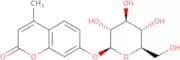
CAS :Fluorogenic substrate for β-glucosidase
Formule :C16H18O8Degré de pureté :Min. 98 Area-%Couleur et forme :PowderMasse moléculaire :338.31 g/molResorufin b-D-glucopyranoside
CAS :Resorufin b-D-glucopyranoside is a stable red fluorogenic galactosidase substrate.
Degré de pureté :Min. 95%Couleur et forme :Orange PowderMasse moléculaire :375.33 g/mol4-Methylumbelliferyl butyrate
CAS :Methylumbelliferyl butyrate is structurally based on 4-methylumbelliferone and is a MOSCERDAM® substrate. It targets the esterase enzyme.
Formule :C14H14O4Degré de pureté :Min. 95%Couleur et forme :White PowderMasse moléculaire :246.26 g/molBis-(4-methylumbelliferyl)phosphate
CAS :Bis-(4-methylumbelliferyl)phosphate, or bis-4MU-phopshate, is a fluorogenic substrate used to study phosphatase activity, particularly in enzyme-linked immunosorbent assays (ELISAs).
Formule :C20H15O8PDegré de pureté :Min. 95 Area-%Couleur et forme :White PowderMasse moléculaire :414.3 g/molRUG ®, Resorufin-beta-D-glucuronic acid methyl ester, Biosynth Patent: EP 2718458 and US 9127303
CAS :Living cells of Escherichia coli can be reliably detected with media that contain a chromogenic or fluorogenic substrate for beta-glucuronidase (also termed β-D-glucuronidase), an enzyme that occurs almost exclusively in E. coli. RUG®, Resorufin-beta-D-glucuronic acid methyl ester is a highly sensitive chromogenic and fluorogenic indicator for E. coli. After removal of the methyl ester group by unspecific hydrolysis, orange colored product is cleaved by beta-glucuronidase in liquid media or on agar plates and yields an intense pink color. Red fluorescence is obtained upon excitation at 560-570 nm.Formally ER175455.
Formule :C19H17NO9Degré de pureté :Min. 90.0 Area-%Masse moléculaire :403.34 g/molRef: 3D-R-2155_P00
Produit arrêtéMethyl 4-methylumbelliferyl hexyl phosphonate
CAS :Methyl 4-methylumbelliferyl hexyl phosphonate is a lipase suicide inhibitor that is a fluorogenic substrate for lipases which upon enzymatic action, binds irreversibly to the lipase and inactivates it. The substrate can be used for the determination of active sites in lipases and the fluorescent signal can be detected at Ex 363 nm and Em 465 nm.
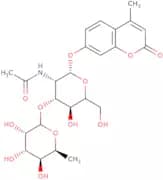
Degré de pureté :Min. 95%Masse moléculaire :338.344-Methylumbelliferyl 2-acetamido-2-deoxy-3-O-(a-L-fucopyranosyl)-b-D-glucopyranoside
CAS :4-Methylumbelliferyl 2-acetamido-2-deoxy-3-O-(alpha-L-fucopyranosyl)-beta-D-glucopyranoside is a fluorogenic substrate for alpha-L-fucosidase. After enzymatic cleaveage, free 4-methylumbelliferone (also known as hymecromone) is released, exhibiting blue fluorescence upon excitation with UV light. The strongest fluorescence of 4-methylumbelliferone requires deprotonation of the hydroxyl group (thus requires alkaline pH), with a maximal fluorescence intensity obtained with excitation at 350 to 370 nm and emission at 440 to 470 nm. The use of 4-methylumbelliferyl 2-acetamido-2-deoxy-3-O-(alpha-L-fucopyranosyl)-beta-D-glucopyranosideas a substrate for measuring the alpha-L-fucosidase activity is used for fucosidosis diagnosis (deficiency of the enzyme alpha-L-fucosidase) and lysosomal storage disorder screening.Formule :C24H31NO12Degré de pureté :Min. 95 Area-%Couleur et forme :White PowderMasse moléculaire :525.5 g/molRhodamine 110 bis-(L-aspartic acid amide) trifluoroacetic acid salt
CAS :Fluorogenic substrate targeting caspases 3 and 7
Degré de pureté :Min. 95%Masse moléculaire :788.56 g/mol