Substrats fluorogènes
Dans cette catégorie, vous trouverez une sélection complète de substrats fluorogènes conçus pour la catalyse enzymatique. Ces substrats sont utilisés avec divers types d'enzymes et sont capables de produire de la couleur et de la fluorescence lors de la réaction. Les substrats fluorogènes sont des outils essentiels dans la recherche en biochimie et biologie moléculaire, permettant la détection et la quantification de l'activité enzymatique avec une grande sensibilité et spécificité. Ils sont largement utilisés dans les essais pour étudier la cinétique enzymatique, rechercher des inhibiteurs d'enzymes et surveiller les processus cellulaires. Chez CymitQuimica, nous proposons des substrats fluorogènes de haute qualité pour soutenir vos recherches, garantissant des résultats fiables et précis dans vos essais enzymatiques.
297 produits trouvés pour "Substrats fluorogènes"
Trier par
Degré de pureté (%)
0
100
|
0
|
50
|
90
|
95
|
100
4-Methylumbelliferyl N-acetyl-a-D-neuraminic acid ammonium
CAS :<p>4-Methylumbelliferyl N-acetyl-alpha-D-neuraminic acid ammonium is a fluorogenic substrate for neuraminidase. After enzymatic cleaveage, free 4-methylumbelliferone (also known as hymecromone) is released, exhibiting blue fluorescence upon excitation with UV light. The strongest fluorescence of 4-methylumbelliferone requires deprotonation of the hydroxyl group (thus requires alkaline pH), with a maximal fluorescence intensity obtained with excitation at 350 to 370 nm and emission at 440 to 470 nm. The use of 4-methylumbelliferyl N-acetyl-alpha-D-neuraminic acid ammoniumas a substrate for measuring the neuraminidase activity is used for detecting the glycoproteins on the surface of influenza A and B viruses, as well as for sialidosis diagnosis.</p>Formule :C21H28N2O11Degré de pureté :Min. 95%Couleur et forme :PowderMasse moléculaire :471.44 g/mol4-Methylumbelliferyl b-D-chitobiose heptaacetate
CAS :<p>4-Methylumbelliferyl b-D-chitobiose heptaacetate is a fluorogenic substrate that is widely used in diagnostic and research applications. It can be used as a substrate for enzymes such as alkaline phosphatase, β-glucuronidase, β-galactosidase, β-glucosidase, α-amylase, α-glucosidase, α-mannosidase, and α-fucosidase. 4MUBH can also be used in the detection of bacterial growth. 4MUBH reacts with NADPH to produce light through chemiluminescence. This product has been shown to have a high purity and quality and should not be stored in UV light or strong acids. CAS No. 55900-34-0</p>Degré de pureté :Min. 95%Masse moléculaire :792.74 g/molRhodamine 110 bis-(L-aspartic acid amide) trifluoroacetic acid salt
CAS :<p>Fluorogenic substrate targeting caspases 3 and 7</p>Degré de pureté :Min. 95%Masse moléculaire :788.56 g/mol4-Methylumbelliferyl b-D-gentiotrioside
CAS :<p>4-Methylumbelliferyl beta-D-gentiotrioside is a fluorogenic substrate for beta-glucosidase. After enzymatic cleaveage, free 4-methylumbelliferone (also known as hymecromone) is released, exhibiting blue fluorescence upon excitation with UV light. The strongest fluorescence of 4-methylumbelliferone requires deprotonation of the hydroxyl group (thus requires alkaline pH), with a maximal fluorescence intensity obtained with excitation at 350 to 370 nm and emission at 440 to 470 nm. The use of 4-methylumbelliferyl beta-D-gentiotriosideas a substrate for measuring the beta-glucosidase activity is used for Gaucher disease screening.</p>Formule :C28H38O18Degré de pureté :Min. 98 Area-%Couleur et forme :PowderMasse moléculaire :662.59 g/molL-Glutamic acid γ-(7-amido-4-methylcoumarin)
CAS :<p>Substrate for aminopeptidase a or the assay of γ-glutamyl transferase yielding a blue fluorescent solution upon cleavage.</p>Formule :C15H16N2O5Degré de pureté :Min. 99 Area-%Masse moléculaire :304.31 g/molRef: 3D-G-3850
1gÀ demander50mgÀ demander250mgÀ demander500mgÀ demander2500mgÀ demander-Unit-ggÀ demanderFluorescein diphosphate tetraammonium salt
CAS :<p>Fluorogenic substrate targeting phosphatase</p>Formule :C20H14O11P2•(NH3)4Degré de pureté :Min. 90 Area-%Couleur et forme :Yellow PowderMasse moléculaire :560.39 g/mol6-Hexanoylamino-4-methylumbelliferyl b-D-galactopyranoside
<p>6-Hexanoylamino-4-methylumbelliferyl b-D-galactopyranoside is a chromogenic substrate for beta-galactosidase.</p>Degré de pureté :Min. 95%4-Methylumbelliferyl b-D-xylobioside
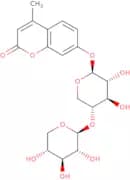
CAS :<p>4-Methylumbelliferyl beta-D-xylobioside is a fluorogenic substrate for xylanase. After enzymatic cleaveage, free 4-methylumbelliferone (also known as hymecromone) is released, exhibiting blue fluorescence upon excitation with UV light. The strongest fluorescence of 4-methylumbelliferone requires deprotonation of the hydroxyl group (thus requires alkaline pH), with a maximal fluorescence intensity obtained with excitation at 350 to 370 nm and emission at 440 to 470 nm. The use of 4-methylumbelliferyl beta-D-xylobiosideas a substrate for measuring the xylanase activity is used for detecting bacterial infection and gut microbiome analysis.</p>Formule :C20H24O11Degré de pureté :Min. 95 Area-%Couleur et forme :White PowderMasse moléculaire :440.4 g/mol6,8-Difluoro-4-methylumbelliferyl β-D-galactopyranoside
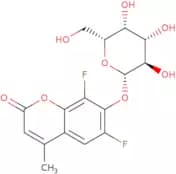
CAS :<p>6,8-Difluoro-4-methylumbelliferyl b-D-galactopyranoside, commonly known as DiFMUG, is a fluorogenic substrate to detect beta-galactosidase. It has higher sensitivity than the common MUG (4-methylumbelliferyl beta-D-galactopyranoside) subtrate.</p>Formule :C16H16F2O8Degré de pureté :Min. 95%Couleur et forme :PowderMasse moléculaire :374.29 g/mol4-Methylumbelliferyl β-D-glucopyranoside
CAS :<p>Fluorogenic substrate for β-glucosidase</p>Formule :C16H18O8Degré de pureté :Min. 98 Area-%Couleur et forme :PowderMasse moléculaire :338.31 g/mol4-Methylumbelliferyl b-D-galactopyranoside
CAS :<p>Fluorogenic substrate for β-galactosidase</p>Formule :C16H18O8Degré de pureté :Min. 95%Couleur et forme :White PowderMasse moléculaire :338.31 g/mol4-Methylumbelliferyl-β-D-xylopyranoside
CAS :<p>4-Methylumbelliferyl-β-D-xylopyranoside is a fluorescent probe that has been used to visualize the enzyme activities of glycosidases, such as endoglycosidase H and α-amylase. It is also used as a tool in structural analysis of oligosaccharides. 4-Methylumbelliferyl-β-D-xylopyranoside has been shown to inhibit collagenase activity in mice, which may be due to its ability to inhibit protein synthesis and cell division.</p>Formule :C15H16O7Degré de pureté :Min. 99.0 Area-%Masse moléculaire :308.29 g/mol4-Methylumbelliferyl α-L-idopyranosiduronic acid 2-sulfate disodium salt
CAS :<p>4-Methylumbelliferyl alpha-L-idopyranosiduronic acid 2-sulfate disodium salt is a chromogenic substrate that is used in the detection of glycosidases. It reacts with enzymes such as alpha-amylase, beta-galactosidase, and beta-glucosidase to produce a fluorescent product. This product can be detected using a fluorometer or spectrophotometer. The CAS number for 4-methylumbelliferyl alpha-L-idopyranosiduronic acid 2-sulfate disodium salt is 1045020-74-3.</p>Formule :C16H14Na2O12SDegré de pureté :Min. 99.0 Area-%Masse moléculaire :476.32 g/mol4-Methylumbelliferyl b-D-xylopyranoside
CAS :<p>Please enquire for more information about 4-Methylumbelliferyl b-D-xylopyranoside including the price, delivery time and more detailed product information at the technical inquiry form on this page</p>Formule :C15H16O7Degré de pureté :Min. 98 Area-%Couleur et forme :PowderMasse moléculaire :308.28 g/mol4-Methylumbelliferyl 2-acetamido-2-deoxy-b-D-galactopyranoside
CAS :<p>Please enquire for more information about 4-Methylumbelliferyl 2-acetamido-2-deoxy-b-D-galactopyranoside including the price, delivery time and more detailed product information at the technical inquiry form on this page</p>Formule :C18H21NO8Degré de pureté :Min. 98 Area-%Couleur et forme :White PowderMasse moléculaire :379.36 g/mol4-Methylumbelliferyl b-D-glucuronide hydrate
CAS :<p>4-Methylumbelliferyl beta;-D-glucuronide (MUG) is commonly used as a substrate for detecting beta;-glucuronidase. MUG is used for identifying E. coli contamination in food, drinkingwater, clinical samples and for rapid bacterial identification in blood cultures. It is recommended in international normatives (ISO, DIN) as a fluorogenic substrate for detection of E. coli. MUG is also a tool assaying the glucuronidase gene in plants.</p>Formule :C16H18O10Degré de pureté :(%) Min. 99%Couleur et forme :White PowderMasse moléculaire :352.29 g/mol2'-(4-Methylumbelliferyl)-α-D-N-acetylneuraminic acid, sodium salt
CAS :<p>2'-(4-Methylumbelliferyl)-alpha-D-N-acetylneuraminic acid, sodium salt is a fluorogenic substrate for alpha-galactosidase. It is used in the analysis of cultured media and as a conjugate for enzyme substrates. This product has been shown to be useful in food testing, diagnostics, and environmental testing. 2'-(4-Methylumbelliferyl)-alpha-D-N-acetylneuraminic acid, sodium salt has been used as a chromogenic substrate for the detection of alpha-galactosidase activity. This product is also used as a bioluminescent substrate for the detection of bioluminescence.</p>Formule :C21H24NNaO11Degré de pureté :Min. 96.5 Area-%Masse moléculaire :489.42 g/mol