Substrats fluorogènes
297 produits trouvés pour "Substrats fluorogènes"
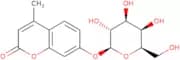
4-Methylumbelliferyl b-D-galactopyranoside
CAS :Fluorogenic substrate for β-galactosidase
Formule :C16H18O8Degré de pureté :Min. 95%Couleur et forme :White PowderMasse moléculaire :338.31 g/molFluorescein di-β-D-glucopyranoside
CAS :Fluorogenic substrate targeting beta-glucosidase
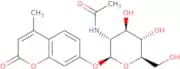
Formule :C32H32O15Degré de pureté :Min. 95%Couleur et forme :PowderMasse moléculaire :656.59 g/mol4-Methylumbelliferyl 2-acetamido-2-deoxy-b-D-glucopyranoside
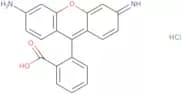
CAS :Fluorogenic substrate for chitinaseFormule :C18H21NO8Degré de pureté :Min. 99 Area-%Couleur et forme :White Off-White PowderMasse moléculaire :379.36 g/molRhodamine 110 chloride
CAS :Fluorescent dye substrate for flow cytometric measurements
Formule :C20H15O3N2ClDegré de pureté :Min. 95 Area-%Couleur et forme :Red PowderMasse moléculaire :366.8 g/molBis(4-methylumbelliferyl)phosphate
CAS :Bis(4-methylumbelliferyl)phosphate is a fluorescent probe that can be used for the diagnosis of β-glucosidase. It has a phosphate group and can be used to study phosphodiesterases and phosphodiesters. Bis(4-methylumbelliferyl)phosphate is also a liposomal probe that can be used in kinetic studies. This compound has been shown to inhibit β-glucosidase, which is an enzyme found in human saliva and pancreatic juice, at high concentrations. The inhibition of this enzyme leads to the accumulation of glucose and galactose in the blood, which can lead to diabetes mellitus or cancer.
Formule :C20H15O8PMasse moléculaire :414.31 g/mol4-Methylumbelliferyl elaidate
CAS :4-Methylumbelliferone is a fluorescent probe that can be used to study the metabolism of fatty acids in plants. It is also used as a marker for radiation and significant cytotoxicity. 4-Methylumbelliferone binds to the DNA termini, specifically at the 5' phosphate group, and inhibits phosphatase activity. This process increases levels of p-nitrophenyl phosphate (a substrate), which produces protocatechuic acid (an intermediate). The disulfide bond is then broken by hydrogen peroxide, leading to an increase in fluorescence. The optimum pH for this process is 7.5.
Formule :C28H40O4Degré de pureté :Min. 95 Area-%Masse moléculaire :440.63 g/molRef: 3D-M-5535
Produit arrêté4-Methylumbelliferyl a-D-mannopyranoside
CAS :4-Methylumbelliferyl alpha-D-mannopyranoside (4-MU-a-D-Man) is a fluorogenic substrate used in activity assays for alpha-mannosidase. When it is hydrolyzed by alpha-mannosidase, it produces a fluorescent compound, 4-methylumbelliferone (4-MU). 4-MU-a-D-Man is often used in medical research to monitor the activity of alpha-mannosidase, which is important in lysosomal storage diseases. In addition, 4-Methylumbelliferyl alpha-D-mannopyranoside has been used to study the the activity of concanavalin A, a lectin that specifically binds to alpha-D-mannopyranosyl and alpha-D-glucopyranosyl residues on various glycoproteins. The use of this fluorogenic enzyme substrate permits study the degree of alpha-D-mannosidic linkage cleavage by the enzyme.Formule :C16H18O8Degré de pureté :Min. 98 Area-%Couleur et forme :White Off-White PowderMasse moléculaire :338.31 g/mol4-Methylumbelliferyl b-D-glucuronide hydrate
CAS :4-Methylumbelliferyl beta;-D-glucuronide (MUG) is commonly used as a substrate for detecting beta;-glucuronidase. MUG is used for identifying E. coli contamination in food, drinkingwater, clinical samples and for rapid bacterial identification in blood cultures. It is recommended in international normatives (ISO, DIN) as a fluorogenic substrate for detection of E. coli. MUG is also a tool assaying the glucuronidase gene in plants.
Formule :C16H18O10Degré de pureté :(%) Min. 99%Couleur et forme :White PowderMasse moléculaire :352.29 g/mol4-Methylumbelliferyl sulfate potassium salt
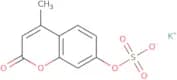
CAS :4-Methylumbelliferyl sulfate potassium salt serves as a superior fluorogenic substrate in enzyme detection assays. Upon enzymatic hydrolysis, it releases a highly fluorescent 4-methylumbelliferone moiety, enabling real-time analysis and quantification of enzyme activities. This product is ideal for a variety of biological assay applications, including in vitro diagnostics, drug discovery, and research purposes. Its excellent sensitivity, specificity, and performance ensure accurate and consistent results every time.Formule :C10H7KO6SDegré de pureté :Min. 98 Area-%Couleur et forme :White PowderMasse moléculaire :294.32 g/mol4-Methylumbelliferyl 6-thio-palmitate-b-D-glucopyranoside - Moscerdam™ biochemical purity
CAS :4-Methylumbelliferyl 6-thio-palmitate-b-D-glucopyranoside (Mu-6S-Palm-β-Glc) is a fluorogenic substrate of palmitoyl-protein thioesterase 1 (PPT1), used in the diagnosis of infantile neuronal ceroid lipofuscinosis (INCL). INCL, also known as infantile CLN1 disease, is a rapidly progressing lysosomal storage disorder (LSD), caused by a deficiency of PPT1. Mu-6S-Palm-β-Glc is also used as the substrate in the PPT assay to investigate the retention of lysosomal enzyme activity of bi-functional IgG-PPT1 fusion protein in the delivery across blood-brain barrier.
Formule :C32H48O8SDegré de pureté :Min. 95%Couleur et forme :White PowderMasse moléculaire :592.78 g/mol4-Methylumbelliferyl b-D-xylopyranoside
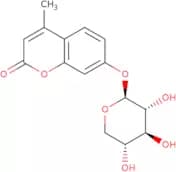
CAS :Please enquire for more information about 4-Methylumbelliferyl b-D-xylopyranoside including the price, delivery time and more detailed product information at the technical inquiry form on this page
Formule :C15H16O7Degré de pureté :Min. 98 Area-%Couleur et forme :PowderMasse moléculaire :308.28 g/mol4-Methylumbelliferyl myo-inositol-1-phosphate N-methyl-morpholine salt
CAS :Please enquire for more information about 4-Methylumbelliferyl myo-inositol-1-phosphate N-methyl-morpholine salt including the price, delivery time and more detailed product information at the technical inquiry form on this page
Formule :C16H19O11P·C5H11NOCouleur et forme :PowderMasse moléculaire :519.44 g/molBoc-Val-Pro-Arg-PAB-Resorufin
Boc-Val-Pro-Arg-PAB-Resorufin is fluorogenic substrate for thrombin and the thrombin-staphylocoagulase complex.
Formule :C40H50N8O8Degré de pureté :Min. 97 Area-%Masse moléculaire :770.87 g/molL-Arginyl-L-arginine 7-amido-4-methylcoumarin trihydrochloride
CAS :Fluorogenic substrate for cathepsin B or aminopeptidase III. Yields a blue fluorescent solution upon cleavage.
Formule :C22H36Cl3N9O4Degré de pureté :Min. 98 Area-%Masse moléculaire :596.95 g/mol4-Methylumbelliferyl a-D-mannopyranoside 6-sulfate sodium salt
4-Methylumbelliferyl alpha-D-mannopyranoside 6-sulfate sodium salt is a fluorogenic substrate for sulfatase. After enzymatic cleaveage, free 4-methylumbelliferone (also known as hymecromone) is released, exhibiting blue fluorescence upon excitation with UV light. The strongest fluorescence of 4-methylumbelliferone requires deprotonation of the hydroxyl group (thus requires alkaline pH), with a maximal fluorescence intensity obtained with excitation at 350 to 370 nm and emission at 440 to 470 nm. The use of 4-methylumbelliferyl alpha-D-mannopyranoside 6-sulfate sodium saltas a substrate for measuring the sulfatase activity is used for Mucopolysaccharidosis (MPS) screening and other lysosomal storage disorder diagnosis.
Formule :C16H17O11SNaDegré de pureté :Min. 98 Area-%Couleur et forme :White PowderMasse moléculaire :440.36 g/molResorufin b-D-cellobioside
CAS :Resorufin b-D-cellobioside is a fluorogenic substrate for measurement of cellulase activity. The product of enzyme reaction, resorufin, exhibits fluorescence emission at 585 nm with excitation at 571 nm at or near physiological pH values.
Formule :C24H27NO13Degré de pureté :Min. 95 Area-%Couleur et forme :Brown Orange PowderMasse moléculaire :537.47 g/molL-Pro-PAB-Resorufin
L-Pro-PAB-Resorufin is a highly sensitive chromogenic and fluorogenic indicator for L-proline aminopeptidase activity and related enzymes occurring in prokaryotic as well as eukaryotic organisms. After removal of the L-proline amide substructure by enzymatic hydrolysis and spontaneous elimination of the para-amino-benzyl (PAB) spacer, the initially orange colored compound yields an intense pink color. In addition, the released chromophor is an excellent fluorophor showing red fluorescence at an emission wavelength of 580 to 600 nm when excited at 560 to 570 nm.
Formule :C24H21N3O4Degré de pureté :Min. 70 Area-%Couleur et forme :PowderMasse moléculaire :415 g/mol4-Trifluoromethylumbelliferyl b-D-glucuronide potassium salt
CAS :4-Trifluoromethylumbelliferyl b-D-glucuronide potassium salt is a fluorogenic substrate for beta-glucuronidase. Upon hydrolysis, the fluorogenic moiety (blueish) 4-trifluoromethylumbelliferone (also known as TFMU) is released. 4-Trifluoromethylumbelliferyl b-D-glucuronide potassium salt is commonly used in bacterial detection and for drug metabolism studies as well as lysosomal storage disorder screening.Formule :C16H12F3O9KDegré de pureté :Min. 95 Area-%Couleur et forme :White PowderMasse moléculaire :444.35 g/mol4-Methylumbelliferyl lignocerate
CAS :4-Methylumbelliferyl lignocerate is a fluorogenic substrate for lipase. After enzymatic cleaveage, free 4-methylumbelliferone (also known as hymecromone) is released, exhibiting blue fluorescence upon excitation with UV light. The strongest fluorescence of 4-methylumbelliferone requires deprotonation of the hydroxyl group (thus requires alkaline pH), with a maximal fluorescence intensity obtained with excitation at 350 to 370 nm and emission at 440 to 470 nm. The use of 4-methylumbelliferyl lignocerateas a substrate for measuring the lipase activity is used for X-linked adrenoleukodystrophy diagnosis and peroxisomal disorder screening.
Formule :C34H54O4Degré de pureté :Min. 95%Couleur et forme :PowderMasse moléculaire :526.79 g/mol4-Methylumbelliferyl 2-acetamido-2-deoxy-b-D-galactopyranoside-6-sulfate potassium salt
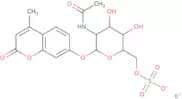
CAS :4-Methylumbelliferyl 2-acetamido-2-deoxy-beta-D-galactopyranoside-6-sulfate potassium salt is a fluorogenic substrate for N-acetylgalactosamine-6-sulfatase. After enzymatic cleaveage, free 4-methylumbelliferone (also known as hymecromone) is released, exhibiting blue fluorescence upon excitation with UV light. The strongest fluorescence of 4-methylumbelliferone requires deprotonation of the hydroxyl group (thus requires alkaline pH), with a maximal fluorescence intensity obtained with excitation at 350 to 370 nm and emission at 440 to 470 nm. The use of 4-methylumbelliferyl 2-acetamido-2-deoxy-beta-D-galactopyranoside-6-sulfate potassium saltas a substrate for measuring the N-acetylgalactosamine-6-sulfatase activity is used for diagnosis of Mucopolysaccharidosis IVA (MPS IVA) (a rare lysosomal storage disorder) and Morquio A syndrome screening.
Formule :C18H20KNO11SDegré de pureté :Min. 95%Couleur et forme :PowderMasse moléculaire :497.52 g/mol4-Methylumbelliferyl b-D-glucosaminide - Moscerdam™ biochemical purity
CAS :A substrate used for the diagnosis of Sanfilippo disease C (MPS III C).
Formule :C16H19NO7Degré de pureté :Min. 98 Area-%Couleur et forme :White PowderMasse moléculaire :337.32 g/molRef: 3D-EM31025
Produit arrêtéL-Proline 7-amido-4-methylcoumarin hydrobromide salt
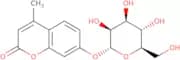
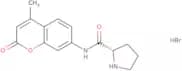
CAS :L-Proline 7-amido-4-methylcoumarin hydrobromide salt is a fluorogenic peptide substrate for proline-specific peptidase. This AMC peptide substrate is normally used to rapidly profile the N-terminal specificity of proteases.Formule :C15H17BrN2O3Degré de pureté :Min. 95%Couleur et forme :PowderMasse moléculaire :353.22 g/mol4-Methylumbelliferyl β-D-glucopyranoside
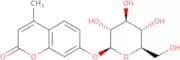
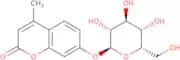
CAS :Fluorogenic substrate for β-glucosidase
Formule :C16H18O8Degré de pureté :Min. 98 Area-%Couleur et forme :PowderMasse moléculaire :338.31 g/molResorufin b-D-glucopyranoside
CAS :Resorufin b-D-glucopyranoside is a stable red fluorogenic galactosidase substrate.
Degré de pureté :Min. 95%Couleur et forme :Orange PowderMasse moléculaire :375.33 g/mol4-Methylumbelliferyl butyrate
CAS :Methylumbelliferyl butyrate is structurally based on 4-methylumbelliferone and is a MOSCERDAM® substrate. It targets the esterase enzyme.
Formule :C14H14O4Degré de pureté :Min. 95%Couleur et forme :White PowderMasse moléculaire :246.26 g/molBis-(4-methylumbelliferyl)phosphate
CAS :Bis-(4-methylumbelliferyl)phosphate, or bis-4MU-phopshate, is a fluorogenic substrate used to study phosphatase activity, particularly in enzyme-linked immunosorbent assays (ELISAs).
Formule :C20H15O8PDegré de pureté :Min. 95 Area-%Couleur et forme :White PowderMasse moléculaire :414.3 g/molRUG ®, Resorufin-beta-D-glucuronic acid methyl ester, Biosynth Patent: EP 2718458 and US 9127303
CAS :Living cells of Escherichia coli can be reliably detected with media that contain a chromogenic or fluorogenic substrate for beta-glucuronidase (also termed β-D-glucuronidase), an enzyme that occurs almost exclusively in E. coli. RUG®, Resorufin-beta-D-glucuronic acid methyl ester is a highly sensitive chromogenic and fluorogenic indicator for E. coli. After removal of the methyl ester group by unspecific hydrolysis, orange colored product is cleaved by beta-glucuronidase in liquid media or on agar plates and yields an intense pink color. Red fluorescence is obtained upon excitation at 560-570 nm.Formally ER175455.
Formule :C19H17NO9Degré de pureté :Min. 90.0 Area-%Masse moléculaire :403.34 g/molRef: 3D-R-2155_P00
Produit arrêtéMethyl 4-methylumbelliferyl hexyl phosphonate
CAS :Methyl 4-methylumbelliferyl hexyl phosphonate is a lipase suicide inhibitor that is a fluorogenic substrate for lipases which upon enzymatic action, binds irreversibly to the lipase and inactivates it. The substrate can be used for the determination of active sites in lipases and the fluorescent signal can be detected at Ex 363 nm and Em 465 nm.
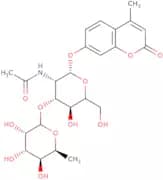
Degré de pureté :Min. 95%Masse moléculaire :338.344-Methylumbelliferyl 2-acetamido-2-deoxy-3-O-(a-L-fucopyranosyl)-b-D-glucopyranoside
CAS :4-Methylumbelliferyl 2-acetamido-2-deoxy-3-O-(alpha-L-fucopyranosyl)-beta-D-glucopyranoside is a fluorogenic substrate for alpha-L-fucosidase. After enzymatic cleaveage, free 4-methylumbelliferone (also known as hymecromone) is released, exhibiting blue fluorescence upon excitation with UV light. The strongest fluorescence of 4-methylumbelliferone requires deprotonation of the hydroxyl group (thus requires alkaline pH), with a maximal fluorescence intensity obtained with excitation at 350 to 370 nm and emission at 440 to 470 nm. The use of 4-methylumbelliferyl 2-acetamido-2-deoxy-3-O-(alpha-L-fucopyranosyl)-beta-D-glucopyranosideas a substrate for measuring the alpha-L-fucosidase activity is used for fucosidosis diagnosis (deficiency of the enzyme alpha-L-fucosidase) and lysosomal storage disorder screening.Formule :C24H31NO12Degré de pureté :Min. 95 Area-%Couleur et forme :White PowderMasse moléculaire :525.5 g/molRhodamine 110 bis-(L-aspartic acid amide) trifluoroacetic acid salt
CAS :Fluorogenic substrate targeting caspases 3 and 7
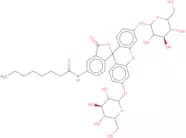
Degré de pureté :Min. 95%Masse moléculaire :788.56 g/mol5-Octanoylaminofluoroscein di-b-D-glactopyranoside
5-Octanoylaminofluoroscein di-b-D-glactopyranoside is a chemiluminescent substrate that can be used for the detection of peroxidase activity. It is a bifunctional substrate, which means it has two reactive groups: one at the 5 position and one at the 8 position. The 5-octanoylaminofluorescein reacts with hydrogen peroxide in a 1:1 ratio, emitting light at 490 nm. The 8-position amine reacts with 2,2'-azino-bis(3-ethylbenzthiazoline)6 sulphonic acid (ABTS) to produce an orange color product that acts as a chromogen. The substrate can be used in diagnostics, food testing, and enzyme substrates.
Degré de pureté :Min. 95%Masse moléculaire :797.8 g/mol4-Methylumbelliferyl 2,3,4-tri-O-benzoyl-b-D-galactopyranoside-6-sulfate
4-Methylumbelliferyl 2,3,4-tri-O-benzoyl-b-D-galactopyranoside-6-sulfate is a fluorogenic substrate for β-galactosidase and a chromogenic substrate for β-glucuronidase. It is used in food testing, environmental testing, and diagnostics.
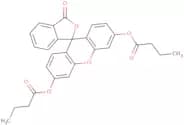
Degré de pureté :Min. 95%Masse moléculaire :730.69 g/molFluorescein dibutyrate
CAS :Fluorogenic substrate targeting esterase and lipase
Degré de pureté :Min. 95%Masse moléculaire :472.49 g/molResorufin methyl ether
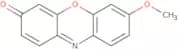
CAS :Fluorogenic substrate used to differentiate cytochrome P450 monooxygenases
Formule :C13H9NO3Degré de pureté :Min. 95%Couleur et forme :PowderMasse moléculaire :227.22 g/mol4-Methylumbelliferyl 2,3-di-O-benzoyl-4,6-O-benzylidene-b-D-galactopyranoside
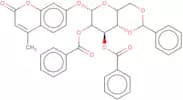
4-Methylumbelliferyl 2,3-di-O-benzoyl-4,6-O-benzylidene-b-D-galactopyranoside is a fluorogenic substrate that is used in the detection of β-galactosidase activity. This product is a white to off white powder that has a purity of 99.2%. It has been given CAS number 53654–95–1 and it can be found in the Diagnostics section of Acros Organics.
Degré de pureté :Min. 95%Masse moléculaire :634.63 g/mol4-Methylumbelliferyl-b-D-cellobiose heptaacetate
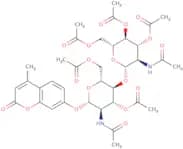
CAS :4-Methylumbelliferyl-beta-D-cellobioside heptaacetate is a fluorogenic substrate for beta-D-glucosidase and can be used to detect this enzyme in the presence of other glycosidases. It is also used as a chromogenic substrate for beta-galactosidase, alpha-mannosidase, alpha-fucosidase, and alpha-N-acetylgalactosaminidase. 4MMB Cellobiose Haptaacetate is a conjugate that can be used to measure the activity of beta-glucuronidase and beta-xylosidase. This product is suitable for use in diagnostics, ligands, food testing, environmental testing, and culture media.Degré de pureté :Min. 95%Masse moléculaire :794.71 g/mol2'-(4-Methylumbelliferyl)-α-D-N-acetylneuraminic acid, sodium salt
CAS :2'-(4-Methylumbelliferyl)-alpha-D-N-acetylneuraminic acid, sodium salt is a fluorogenic substrate for alpha-galactosidase. It is used in the analysis of cultured media and as a conjugate for enzyme substrates. This product has been shown to be useful in food testing, diagnostics, and environmental testing. 2'-(4-Methylumbelliferyl)-alpha-D-N-acetylneuraminic acid, sodium salt has been used as a chromogenic substrate for the detection of alpha-galactosidase activity. This product is also used as a bioluminescent substrate for the detection of bioluminescence.
Formule :C21H24NNaO11Degré de pureté :Min. 96.5 Area-%Masse moléculaire :489.42 g/mol6,8-Difluoro-4-methylumbelliferyl b-D-glucopyranoside
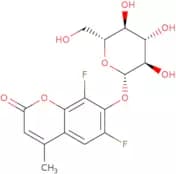
CAS :6,8-Difluoro-4-methylumbelliferyl b-D-glucopyranoside is a versatile fluorogenic substrate suitable for the measurement of various glycosidase enzymes. Its unique structure allows for enhanced sensitivity and selectivity in enzyme assays, making it ideal for studying enzyme kinetics and screening of potential enzyme inhibitors.
Degré de pureté :Min. 95%Masse moléculaire :374.29 g/mol4-Methylumbelliferyl-phosphoethanolamine
4-Methylumbelliferyl-phosphoethanolamine is a phosphorylated substrate that can be used in the detection of enzymes such as alkaline phosphatase, esterase, and lipase. This compound has been shown to be a fluorescent and chromogenic substrate for many diagnostic purposes. 4-Methylumbelliferyl-phosphoethanolamine is also used as a fluorogenic substrate for chemiluminescent reactions that are found in culture media and environmental testing.
Degré de pureté :Min. 95%2-Dodecylresorufin
CAS :2-Dodecylresorufin is a fluorescent probe that reacts with the hydroxyl radicals in the cell, which are generated by the enzyme superoxide dismutase. 2-Dodecylresorufin can be used to measure reactive oxygen species (ROS) and ROS-induced cellular damage. It is also used to study oxidative stress in vitro. The chemical structure of 2-dodecylresorufin contains a linker arm that provides a reversible linkage to the cell surface, allowing for extracellular measurements of reactive oxygen species (ROS). This compound has been shown to have high reactivity, making it useful for studying population dynamics and fluorescent techniques.
Degré de pureté :Min. 95%Masse moléculaire :381.51 g/molβ-Alanine 7-amido-4-methylcoumarin trifluoroacetate
CAS :Beta-alanine 7-amido-4-methylcoumarin, trifluoroacetate salt is a high purity, ligand, and conjugate. It can be used in the food testing and environmental testing fields. This product has been shown to be a good substrate for enzyme activity and can also function as a fluorescent dye in chemiluminescence assays. Beta-alanine 7-amido-4-methylcoumarin, trifluoroacetate salt is soluble in water and has a CAS number of 201847-54-3.
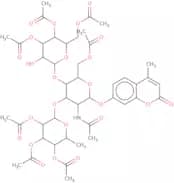
Formule :C15H15F3N2O5Masse moléculaire :360.29 g/mol4-Methylumbelliferyl 2-acetamido-3-O-(2,3,4-tri-O-acetyl-a-L-fucopyranosyl)-4-O-(2,3,4,6-tetra-O-acetyl-b-D-galactopyranosyl)-6-O-ac etyl-2-deoxy-b-D-glucopyranoside
4-Methylumbelliferyl 2-acetamido-3-O-(2,3,4-tri-O-acetyl-a-L-fucopyranosyl)-4-O-(2,3,4,6 -tetra-O-acetylbDgalactopyranosyl)-6-O-acetyldEoxybDglucopyranoside is a chemiluminescent substrate that has been used in the detection of beta galactosidase activity. It is a ligand for beta galactosidases and can be used for the study of enzyme kinetics. This compound also exhibits high purity and is available in CAS number: 916071. 4MUFAGAALF is suitable for use in culture media and environmental testing as well as diagnostics (e.g., bioluminescence), staining (fluorogenic substrate), and chromogenic substrates
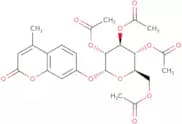
Degré de pureté :Min. 95%Masse moléculaire :1,023.94 g/mol4-Methylumbelliferyl 2,3,4,6-tetra-O-acetyl-a-D-glucopyranoside
CAS :4-Methylumbelliferyl 2,3,4,6-tetra-O-acetyl-a-D-glucopyranoside is a fluorescent marker for nucleic acid molecules. It can be applied to identify the metabolic pathways of bacteria in an ecosystem by using fluorescence microscopy. 4-Methylumbelliferyl 2,3,4,6-tetra-O-acetyl-a-D-glucopyranoside is also used to measure the activity of some enzymes in vitro. This compound has been shown to be effective against spittlebugs and other pests that feed on plant sap. The toxic effect of this compound is due to its ability to inhibit acetate synthesis and disrupt membrane transport systems.Degré de pureté :Min. 95%Masse moléculaire :506.46 g/mol4-Methylumbelliferyl a-L-idopyranoside
CAS :4-Methylumbelliferyl alpha-L-idopyranoside is a fluorogenic substrate for alpha-L-iduronidase. After enzymatic cleaveage, free 4-methylumbelliferone (also known as hymecromone) is released, exhibiting blue fluorescence upon excitation with UV light. The strongest fluorescence of 4-methylumbelliferone requires deprotonation of the hydroxyl group (thus requires alkaline pH), with a maximal fluorescence intensity obtained with excitation at 350 to 370 nm and emission at 440 to 470 nm. The use of 4-methylumbelliferyl alpha-L-idopyranosideas a substrate for measuring the alpha-L-iduronidase activity is used for Mucopolysaccharidosis I diagnosis and Hurler syndrome screening.
Formule :C16H18O8Degré de pureté :Min. 98 Area-%Couleur et forme :White PowderMasse moléculaire :338.31 g/molRhodamine 110 bis-(N-CBZ-L-aspartyl-L-glutamyl-L-valyl-L-aspartic acid amide
For fluorogenic detection of caspase 3
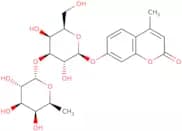
Degré de pureté :Min. 95%Masse moléculaire :974.96 g/mol4-Methylumbelliferyl 3-O-(a-L-fucopyranosyl)-b-D-galactopyranoside
CAS :4-Methylumbelliferyl 3-O-(α-L-fucopyranosyl)-β-D-galactopyranoside is an organic compound that is used as a radioactive marker for DNA. It can be synthesized in the laboratory and its use allows for the tracking of DNA molecules. The production of this marker is achieved by recombinant expression of the gene encoding the enzyme β-D-galactosidase, which hydrolyzes 4-methylumbelliferyl β-D-galactopyranoside to release 4-methylumbelliferone and α-L-fucopyranose. The enzyme uses UDP glucose as a cofactor to catalyse the reaction. This product has been isolated from Corynebacterium glutamicum, with recombinant expression vectors used to produce it in host cells such as Escherichia coli or Corynebacterium glutamicum. It has been found that
Formule :C22H28O12Degré de pureté :Min. 95%Couleur et forme :PowderMasse moléculaire :484.45 g/mol6-Hexanoylamino-4-methylumbelliferyl b-D-galactopyranoside
6-Hexanoylamino-4-methylumbelliferyl b-D-galactopyranoside is a chromogenic substrate for beta-galactosidase.Degré de pureté :Min. 95%