Substrats fluorogènes
284 produits trouvés pour "Substrats fluorogènes".
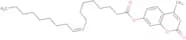
4-Methylumbelliferyl oleate
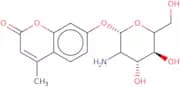
CAS :Methylumbelliferyl oleate is a MOSCERDAM® substrate targeting the lipase enzymeFormule :C28H40O4Degré de pureté :Min. 90 Area-%Couleur et forme :White PowderMasse moléculaire :440.61 g/mol4-Methylumbelliferyl b-D-glucosaminide - Moscerdam™ biochemical purity
CAS :A substrate used for the diagnosis of Sanfilippo disease C (MPS III C).
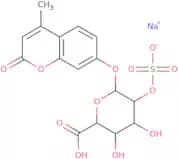
Formule :C16H19NO7Degré de pureté :Min. 98 Area-%Couleur et forme :White PowderMasse moléculaire :337.32 g/mol4-Methylumbelliferyl a-L-idopyranosiduronic acid 2-sulphate disodium salt - Moscerdam™ biochemical purity
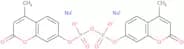
CAS :PAIRED PRODUCT AVAILABLE: alpha-L-iduronidase Enzyme, FI1793834MU-alpha-L-iduronide-2-sulphate (M2) is a fluorogenic substrate of iduronate-2-sulphatase (IDS), used in a 2-step assay coupled with alpha-L-iduronidase. The assay is used in biochemical testing for Hunter syndrome (mucopolysaccharidosis II / MPS II). In a first step, IDS from biological samples cleaves the sulphate group from M2. In a second step, exogeneous alpha-L-iduronidase which cleaves the 4-MU moiety is added to the reaction, resulting in release of a fluorescent signal (Ex 360 nm / Em 455 nm). The reaction is stopped by the addition of sodium carbonate.Formule :C16H14Na2O12SDegré de pureté :Min. 99 Area-%Couleur et forme :White PowderMasse moléculaire :476.32 g/mol4-Methylumbelliferyl pyrophosphate diester disodium salt
CAS :4-Methylumbelliferyl pyrophosphate diester disodium salt is a fluorogenic substrate for pyrophosphatases or diphosphatases. After enzymatic cleaveage, free 4-methylumbelliferone (also known as hymecromone) is released, exhibiting blue fluorescence upon excitation with UV light. The strongest fluorescence of 4-methylumbelliferone requires deprotonation of the hydroxyl group (thus requires alkaline pH), with a maximal fluorescence intensity obtained with excitation at 350 to 370 nm and emission at 440 to 470 nm. The use of 4-methylumbelliferyl pyrophosphate diester disodium saltas a substrate for measuring the pyrophosphatases or diphosphatases activity is used for monitoring and diagnosis of pyrophosphatase deficiency and bone metabolism disorder.Formule :C20H14Na2O11P2Degré de pureté :Min. 95%Couleur et forme :White PowderMasse moléculaire :538.25 g/mol4-Methylumbelliferyl beta-D-lactoside
CAS :Fluorogenic substrate for beta-galactosidaseFormule :C22H28O13Degré de pureté :Min. 98 Area-%Couleur et forme :White PowderMasse moléculaire :500.45 g/mol4-Methylumbelliferyl-2-O-(a-L-fucopyranosyl)-a-L-fucopyranoside
4-Methylumbelliferyl-2-O-(alpha-L-fucopyranosyl)-alpha-L-fucopyranoside is a fluorogenic substrate for alpha-L-fucosidase. After enzymatic cleaveage, free 4-methylumbelliferone (also known as hymecromone) is released, exhibiting blue fluorescence upon excitation with UV light. The strongest fluorescence of 4-methylumbelliferone requires deprotonation of the hydroxyl group (thus requires alkaline pH), with a maximal fluorescence intensity obtained with excitation at 350 to 370 nm and emission at 440 to 470 nm. The use of 4-methylumbelliferyl-2-O-(alpha-L-fucopyranosyl)-alpha-L-fucopyranosideas a substrate for measuring the alpha-L-fucosidase activity is used for fucosidosis diagnosis.
Degré de pureté :Min. 95%Couleur et forme :White PowderMasse moléculaire :468.45 g/molFLsharp™ - Phosphate, disodium salt
FLsharp™ - Phosphate, disodium salt is a fluorogenic water-soluble substrate for phosphatase enzymes. Its chemical name is 6-Chloro-2-[5-chloro-2-(phosphonooxy)phenyl]-4(1H)-quinazolinone disodium salt and was developed by Molecular Probes in the 1990s. After cleavage of the substrate by phosphatase activity, an insoluble product is formed that is highly fluorescent in the solid state. Upon UV irradiation this very stable fluorophore emits green light in the 530 nm range for an extended period of time. FLsharp™ is a unique substrate - optimized for the detection of phosphatase activity in solid matrices such as agar media, tissue sections or microscopic preparations. FLsharp™ - Phosphate, disodium salt is used in microbiology as a substrate for bacterial phosphatases.
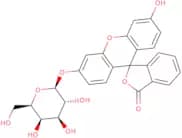
Degré de pureté :Min. 95%Fluorescein mono-b-D-galactopyranoside
CAS :Fluorescein mono-b-D-galactopyranoside or FMG is a fluorogenic substrate for beta-galactosidase. The fluorophore fluorescein is released after enzymatic cleavage, exhibiting a greenish fluorescent. This substrate is particularly valuable in gene expression studies (e.g., lacZ reporter assays) and as a probe for cell-based assays for real-time monitoring.Degré de pureté :Min. 95%Couleur et forme :PowderMasse moléculaire :494.45 g/molAcetyl-L-alanine 7-amido-4-methylcoumarin
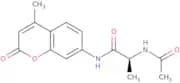
CAS :Acetyl-L-alanine 7-amido-4-methylcoumarin is a fluorogenic substrate for aminopeptidase. The enzyme cleaves the N-terminal amino acids, yielding a blue fluorescent solution.
Formule :C15H16N2O4Degré de pureté :Min. 98 Area-%Couleur et forme :PowderMasse moléculaire :288.3 g/mol(+)-Biotin 4-amidobenzoic acid sodium salt
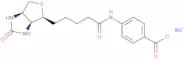
CAS :(+)-Biotin 4-amidobenzoic acid sodium salt, often referred as (+)-biotin PABA, is a fluorogenic substrate used to measure biotinidase activity, especially in newborn screening programs.
Formule :C17H20N3NaO4SDegré de pureté :Min. 95%Couleur et forme :White Slightly Yellow PowderMasse moléculaire :385.41 g/mol4-Methylumbelliferyl palmitate
CAS :Fluorogenic substrate for esterase yielding a blue fluorescent solution upon cleavage.Formule :C26H38O4Degré de pureté :Min. 99 Area-%Masse moléculaire :414.59 g/molRef: 3D-M-5750
-Unit-ggÀ demander1gÀ demander5gÀ demander250mgÀ demander500mgÀ demander2500mgÀ demander4-Methylumbelliferyl b-D-cellotrioside
CAS :Fluorogenic cellulose analogueFormule :C28H38O18Degré de pureté :Min. 95%Couleur et forme :PowderMasse moléculaire :662.6 g/mol4-Methylumbelliferyl palmitate
CAS :4-Methylumbelliferyl palmitate, commonly names as 4-MUP, is a fluorescent probe that binds to lipases, enzymes responsible to assist on the hydrolysis of fats. In diagnosis, 4-MUP is used for screening of lysosomal storage diseases (LSD) caused by a deficiency of a single enzyme involved in the metabolism of glycoproteins, lipids or mucopolysaccharides.
Formule :C26H38O4Degré de pureté :Min. 95%Couleur et forme :White PowderMasse moléculaire :414.58 g/molL-Histidine 7-amido-4-methylcoumarin hydrochloride
CAS :L-Histidine 7-amido-4-methylcoumarin hydrochloride is a synthetic peptide substrate used as a fluorogenic substrate for histidine aminopeptidase.Formule :C16H17ClN4O3Degré de pureté :Min. 95%Masse moléculaire :348.79 g/mol4-Methylumbelliferyl 6-deoxy-2,3,4,6-tetra-O-acetyl-6-thio-β-D-glucopyranoside
4-Methylumbelliferyl 6-deoxy-2,3,4,6-tetra-O-acetyl-6-thio-beta-D-glucopyranoside is a fluorogenic substrate for beta-glucosidase. After enzymatic cleaveage, free 4-methylumbelliferone (also known as hymecromone) is released, exhibiting blue fluorescence upon excitation with UV light. The strongest fluorescence of 4-methylumbelliferone requires deprotonation of the hydroxyl group (thus requires alkaline pH), with a maximal fluorescence intensity obtained with excitation at 350 to 370 nm and emission at 440 to 470 nm. The use of 4-methylumbelliferyl 6-deoxy-2,3,4,6-tetra-O-acetyl-6-thio-beta-D-glucopyranosideas a substrate for measuring the beta-glucosidase activity is used for Gaucher disease diagnosis.Formule :C24H26O11SDegré de pureté :Min. 95%Couleur et forme :White to off-white solid.Masse moléculaire :522.52 g/molResorufin b-D-glucuronide sodium salt
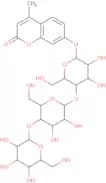
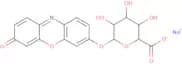
CAS :Resorufin b-D-glucuronide sodium salt is used as a fluorogenic substrate for beta-glucuronidase (GUS) to study drug metabolism.Degré de pureté :Min. 95%Couleur et forme :Brown Orange Red PowderMasse moléculaire :411.29 g/mol4-Methylumbelliferyl b-D-cellotetraoside
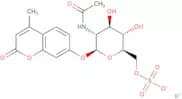
CAS :A fluorogenic MOSCERDAM® substrate targeting cellulasesFormule :C34H48O23Degré de pureté :Min. 95%Couleur et forme :PowderMasse moléculaire :824.73 g/mol4-Methylumbelliferyl 2-acetamido-2-deoxy-β-D-glucopyranoside-6-sulfate potassium salt
CAS :4-Methylumbelliferyl 2-acetamido-2-deoxy-beta-D-glucopyranoside-6-sulfate potassium salt is a fluorogenic substrate for beta-N-acetylglucosaminidase. After enzymatic cleaveage, free 4-methylumbelliferone (also known as hymecromone) is released, exhibiting blue fluorescence upon excitation with UV light. The strongest fluorescence of 4-methylumbelliferone requires deprotonation of the hydroxyl group (thus requires alkaline pH), with a maximal fluorescence intensity obtained with excitation at 350 to 370 nm and emission at 440 to 470 nm. The use of 4-methylumbelliferyl 2-acetamido-2-deoxy-beta-D-glucopyranoside-6-sulfate potassium saltas a substrate for measuring the beta-N-acetylglucosaminidase activity is used for diagnosis of Mucopolysaccharidosis IIIB (MPS IIIB) (a rare lysosomal storage disorder) and Sanfilippo B syndrome screening.
Formule :C18H20KNO11SDegré de pureté :Min. 95%Couleur et forme :White Off-White PowderMasse moléculaire :497.52 g/molN-alpha-CBZ-L-Arginine 7-amido-4-methylcoumarin hydrochloride
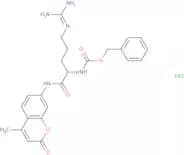
CAS :N-alpha-CBZ-L-Arginine 7-amido-4-methylcoumarin hydrochloride is a Ffluorogenic substrate used in protease activity assays.
Formule :C24H27N5O5·ClHDegré de pureté :Min. 95%Couleur et forme :PowderMasse moléculaire :501.96 g/molDDAO galactoside
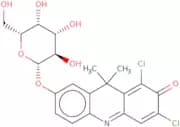
CAS :The DDAO molecule [7-hydroxy-9H-(1, 3-dichloro-9, 9 dimethylacridin-2-one] is used as a stain and a dye in molecular biology, due to its ability to bind intracellular and extracellular DNA. DDAO galactoside is a fluorogenic substrate for galactosidase.
Degré de pureté :Min. 95%Couleur et forme :PowderMasse moléculaire :470.3 g/mol