Microtubules associés
Les inhibiteurs des protéines associées aux microtubules ciblent les protéines qui interagissent avec les microtubules, les composants structurels du cytosquelette de la cellule qui sont essentiels à la division cellulaire. Ces protéines régulent la stabilité et la dynamique des microtubules pendant la mitose. L'inhibition des protéines associées aux microtubules peut perturber la fonction des microtubules, entraînant un arrêt du cycle cellulaire et l'apoptose, en particulier dans les cellules cancéreuses à division rapide. Ces inhibiteurs sont largement utilisés dans la recherche sur le cancer et le développement de médicaments. Chez CymitQuimica, nous offrons une gamme complète d'inhibiteurs de protéines associées aux microtubules de haute qualité pour soutenir vos recherches sur la division cellulaire, la dynamique du cytosquelette et la thérapie contre le cancer.
262 produits trouvés pour "Microtubules associés"
Trier par
Degré de pureté (%)
0
100
|
0
|
50
|
90
|
95
|
100
PM-060184
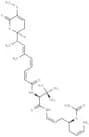
CAS :<p>PM-060184, a tubulin polymerisation inhibitor, is used potentially for the treatment of solid tumours and breast cancer.</p>Formule :C31H45N3O7Degré de pureté :98%Couleur et forme :SolidMasse moléculaire :571.7Tubulin polymerization-IN-35
<p>Tubulin-IN-35 inhibits oxazolylisoindole microtubule formation, targeting VL51 marginal zone lymphoma.</p>Formule :C31H35N3O5Couleur et forme :SolidMasse moléculaire :529.63Tubulin polymerization-IN-8
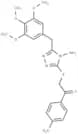
CAS :<p>Compound IIc inhibits tubulin polymerization, arrests cell cycle at G2/M in HCT116 cells, IC50 12.7 μM, potential for cancer research.</p>Formule :C21H24N4O4SCouleur et forme :SolidMasse moléculaire :428.5Epothilone E
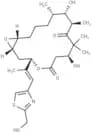
CAS :<p>Epothilone E, a derivative of epothilone, functions by inhibiting microtubule protein activity, thereby halting cell division and exhibiting anti-tumor</p>Formule :C26H39NO7SCouleur et forme :SolidMasse moléculaire :509.66Tubulin inhibitor 15
<p>Tubulin inhibitor 15 is a potent tubulin inhibitor with antiproliferative activity. Tubulin inhibitor 15 exhibits cytotoxicity in HepG2 cells [1].</p>Formule :C16H12FNO2Couleur et forme :SolidMasse moléculaire :269.27Tubulin inhibitor 49
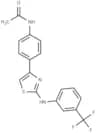
CAS :<p>Tubulin inhibitor 49 (Compound 18) is an inhibitor of tubulin polymerization with an IC50 of 48 μM. It disrupts the microtubule network of cells, causing cell cycle arrest in the G2 phase, and exhibits cytotoxicity with an IC50 of 8.8 μM in HeLa cells.</p>Formule :C18H14F3N3OSCouleur et forme :SolidMasse moléculaire :377.383Tau ligand-1
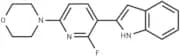
CAS :<p>Tau ligand-1 (Compound 75) is a ligand of aggregated tau protein that can penetrate the blood-brain barrier. In tissues affected by Alzheimer's disease, progressive supranuclear palsy, corticobasal degeneration, and Pick's disease, Tau ligand-1 shows high affinity for aggregated tau protein, with equilibrium dissociation constants (KD) ranging from 1 to 3.8 nM. It holds potential as a positron emission tomography (PET) tracer for imaging studies of tau-related diseases within the central nervous system.</p>Formule :C17H16FN3OCouleur et forme :SolidMasse moléculaire :297.327PROTAC α-synuclein degrader 6
CAS :<p>PROTACα-synuclein degrader 6 (compound T3) is a PROTAC degrader of α-synuclein and tau, with an EC50 of 1.57 μM and 4.09 μM, respectively. This compound plays a significant role in neurodegenerative disease (ND) research.</p>Formule :C37H39N5O9SMasse moléculaire :729.80Ombrabulin
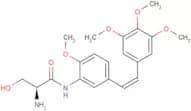
CAS :<p>Ombrabulin is a derivative of CA-4 phosphate. It is known to show antivascular effects through selective disruption of the tubulin cytoskeleton of endothelial cells.</p>Formule :C21H26N2O6Degré de pureté :98%Couleur et forme :SolidMasse moléculaire :402.44Tau tracer 2
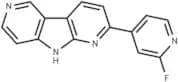
CAS :<p>Tau tracer 2 (Pl-2620) is a specific imaging agent designed to detect and visualize Tau protein aggregates, primarily used for diagnosing neurodegenerative diseases [1].</p>Formule :C15H9FN4Couleur et forme :SolidMasse moléculaire :264.263Cevipabulin fumarate
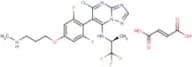
CAS :<p>Cevipabulin (TTI-237) fumarate is a microtubule-active antitumor compound and inhibits the binding of [3H] vinblastine to tubulin (IC50: 18-40 nM in the human tumor cell line).</p>Formule :C22H22ClF5N6O5Degré de pureté :98%Couleur et forme :SolidMasse moléculaire :580.89