Chromatine/Épigénétique
Les inhibiteurs de la chromatine/épigénétique sont des composés qui modulent la structure et la fonction de la chromatine ou interfèrent avec les modifications épigénétiques, telles que la méthylation de l'ADN et la modification des histones. Ces inhibiteurs sont des outils essentiels pour étudier la régulation de l'expression génique et le rôle de l'épigénétique dans des maladies telles que le cancer, les troubles neurologiques et les anomalies du développement. En ciblant les processus épigénétiques, ces inhibiteurs peuvent modifier les schémas d'expression génique et offrir de nouvelles perspectives thérapeutiques. Chez CymitQuimica, nous offrons une large sélection d'inhibiteurs de la chromatine/épigénétique de haute qualité pour soutenir vos recherches en biologie moléculaire, génétique et épigénétique.
Sous-catégories appartenant à la catégorie "Chromatine/Épigénétique"
2242 produits trouvés pour "Chromatine/Épigénétique"
Trier par
Degré de pureté (%)
0
100
|
0
|
50
|
90
|
95
|
100
MS2133
<p>MS2133 is a DOT1L PROTAC degrader. It facilitates the ubiquitination and degradation of DOT1L in THP-1 and MV4-11 cells, with DC50 values of 56 nM and 25 nM, respectively, and reduces H3K79 methylation. MS2133 also inhibits the growth of MLL-r leukemia cells, demonstrating anticancer activity.</p>Formule :C58H66ClF3N14O11S2Couleur et forme :SolidMasse moléculaire :1290.41175OKI-006
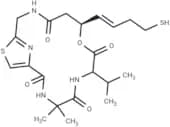
CAS :<p>OKI-006 is an oral HDAC inhibitor with potential for cancer research, derived from largazole.</p>Formule :C21H30N4O5S2Couleur et forme :SolidMasse moléculaire :482.62PROTAC SMARCA2/4-degrader-31
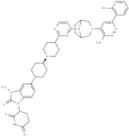
CAS :<p>PROTAC SMARCA2/4-degrader-31 (Compound I-280) serves as a degrader for the catalytic subunits SMARCA2 and SMARCA4 of the SWI/SNF complex. It effectively degrades SMARCA2 in A549 cells and SMARCA4 in MV411 cells, both with a degradation concentration (DC50) of less than 100 nM.</p>Formule :C44H51N11O4Couleur et forme :SolidMasse moléculaire :797.95Ep300/CREBBP-IN-3
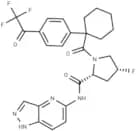
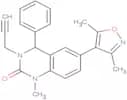
CAS :<p>Ep300/CREBBP-IN-3 inhibits Ep300 & CREBBP (IC50: 0.056 & 0.095 μM respectively); potential for cancer research.</p>Formule :C26H25F4N5O3Couleur et forme :SolidMasse moléculaire :531.50MRTX9768 hydrochloride
<p>MRTX9768 hydrochloride is a potent, orally active PRMT5 inhibitor.</p>Couleur et forme :SolidCD532 hydrochloride
<p>CD532 hydrochloride, potent Aurora A inhibitor (IC50=45 nM), hampers MYCN protein, changes AURKA's shape, aids cancer research.</p>Couleur et forme :SolidmUNO
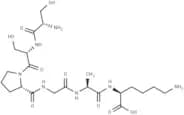
CAS :<p>mUNO is a tumor-homing peptide (mUNO, sequence: "CSPGAK") that specifically binds to murine CD206, targeting tumor-associated macrophages that express CD206/MRC1. Additionally, mUNO can interact with human recombinant CD206.</p>Formule :C22H39N7O8SCouleur et forme :SolidMasse moléculaire :561.652TAS-119
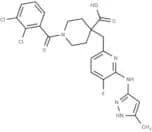
CAS :<p>TAS-119 (TAS-2104) is an orally available, selective and potent inhibitor of Aurora A with an IC50 of 1.0 nM.TAS-119 also inhibits Aurora B with an IC50 of 95</p>Formule :C23H22Cl2FN5O3Degré de pureté :99.65%Couleur et forme :SolidMasse moléculaire :506.36PROTAC BRD4-binding moiety 1
CAS :<p>BRD4-binding moiety 1 links to cereblon, forming a PROTAC that degrades BRD4 efficiently.</p>Formule :C23H21N3O2Degré de pureté :98%Couleur et forme :SolidMasse moléculaire :371.43JQ1-TCO
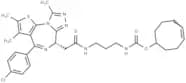
CAS :<p>JQ1-TCO, a BET inhibitor derivative, enables click chemistry for molecular probing in vivo and in vitro.</p>Formule :C31H37ClN6O3SCouleur et forme :SolidMasse moléculaire :609.18dBET23
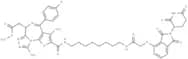
CAS :<p>dBET23 is a BRD4 degrader.</p>Formule :C43H45ClN8O9SCouleur et forme :SolidMasse moléculaire :885.38HDAC1/2-IN-3
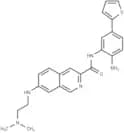
CAS :<p>HDAC1/2-IN-3 is an inhibitor of both HDAC1 and HDAC2, demonstrating IC50 values of 0-5 nM and 5-10 nM, respectively.</p>Formule :C24H25N5OSCouleur et forme :SolidMasse moléculaire :431.56TYK2 activator-1
<p>TYK2activator-1 (16b) is a TYK2 activator with an EC50 value of 1.78 μM. It inhibits JAK2 and JAK3 with IC50 values of 6.8 μM and 6.3 μM, respectively.</p>Formule :C23H21FN4O2Couleur et forme :SolidMasse moléculaire :404.16485PRMT1-IN-1
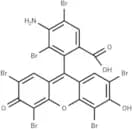
CAS :<p>PRMT1-IN-1 is a PRMT1 inhibitor.</p>Formule :C20H7Br6NO5Couleur et forme :SolidMasse moléculaire :820.702Nicotinamide riboside tartrate
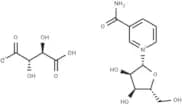
CAS :<p>NRT is an oral NAD+ precursor, boosts NAD+, activates SIRT1/3, provides vitamin B3, enhances metabolism, and may mitigate Alzheimer's.</p>Formule :C15H20N2O11Couleur et forme :SolidMasse moléculaire :404.33Myelin Basic Protein
CAS :<p>Myelin basic protein (MBP) is a protein believed to be important in the process of myelination of nerves in the nervous system.</p>Formule :C60H103N21O17Degré de pureté :98%Couleur et forme :SolidMasse moléculaire :1390.59ACBI2
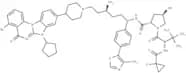
CAS :<p>ACBI2: potent, oral VHL PROTAC, EC50=7nM; degrades SMARCA2, DC50=1nM in RKO cells; for lung cancer research.</p>Formule :C56H68BrFN8O5SCouleur et forme :SolidMasse moléculaire :1064.16PROTAC SMARCA2/4-degrader-30
CAS :<p>Compound I-291, also known as PROTAC SMARCA2/4-degrader-30, targets the catalytic subunits of the SWI/SNF complex, specifically SMARCA2 and SMARCA4. It effectively degrades SMARCA2 in A549 and MV411 cells, as well as SMARCA4 in MV411 cells, with a degradation concentration (DC50) of less than 100 nM.</p>Formule :C44H51N11O4Couleur et forme :SolidMasse moléculaire :797.95EP300/CBP ligand 2
<p>EP300/CBP ligand 2 (compound S19) serves as a specific ligand for the bromodomain of CREB binding protein (CBP) and E1A-associated protein (EP300). It plays a critical role in PROTAC technology by acting as a target protein ligand. By linking to an E3 ubiquitin ligase ligand via the PROTAC Linker, it facilitates the synthesis of PROTAC molecules capable of targeted protein degradation. For instance, when EP300/CBP ligand 2 is connected to the conjugate (E3 ubiquitin enzyme ligand + Linker) Thalidomide-NH-C10-Boc, it results in the formation of the PROTAC molecule dCE-2.</p>Formule :C20H18N6OCouleur et forme :SolidMasse moléculaire :358.4Kiss2 peptide
CAS :<p>Kiss2 peptide functions as a positive regulator of reproductive behavior. In COS-7 cells, it binds to its homologous G-protein coupled receptor Kiss2R (GPR54), activating the PKA and PKC signaling pathways through Gas and Gaq proteins. This enhances the activity of cAMP response element-dependent luciferase (CRE-luc) and serum response element-dependent luciferase (SRE-luc).</p>Formule :C63H84N16O12Masse moléculaire :1257.44