Lipase
102 produits trouvés pour "Lipase".
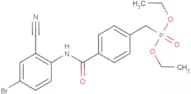
Ibrolipim
CAS :Ibrolipim (NO-1886) attenuates high glucose-induced endothelial dysfunction in cultured human umbilical vein endothelial cells via PI3K/Akt pathway.Formule :C19H20BrN2O4PDegré de pureté :98.04%Couleur et forme :SolidMasse moléculaire :451.25ABX-1431
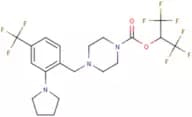
CAS :ABX-1431 (Elcubragistat) is a selective and orally available CNS-penetrant monoacylglycerol lipase (MAGL/MGLL) inhibitor (IC50: 14 nM).Formule :C20H22F9N3O2Degré de pureté :99.8% - 99.96%Couleur et forme :SolidMasse moléculaire :507.39HSL-IN-3
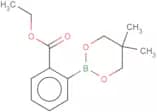
CAS :HSL-IN-3 (HSL inhibitor 3) is a boronic acid derivative that is an inhibitor of hormone-sensitive lipase(HSL).Formule :C14H19BO4Degré de pureté :99.40%Couleur et forme :SolidMasse moléculaire :262.11JZL 184
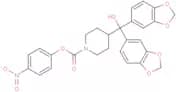
CAS :JZL 184 is a potent and selective inhibitor of MAGL with IC50 of 8 nM and 4 μM for inhibition of MAGL and FAAH in mouse brain membranes respectively.Formule :C27H24N2O9Degré de pureté :97.56% - 99.31%Couleur et forme :White SolidMasse moléculaire :520.49WWL70
CAS :WWL70 is a selective alpha/beta hydrolase domain 6 inhibitors (IC50: 70 nM).Formule :C27H23N3O3Degré de pureté :98.38% - 98.53%Couleur et forme :SolidMasse moléculaire :437.49EUCODIS® Lipase 030, screening grade, recombinant, from microbial sources - EL030
Lipase 30 recombinantly expressed in E. coli comes in a spray-dried formulation. It has its pH optimum at 5.5-8 and temp. optimum at >55°C. Lipases belong to the family of esterases and naturally act on triglycerides at lipid-water interfaces catalyzing hydrolytic reactions, esterifications and transesterification reactions in industrial and food applications. Lipase 30 was shown to hydrolyze p-Nitrophenyl esters of butyrate (100 % activity), octanoate (72 %), laurate (38 %), palmitate (7 %) and stearate (2 %).
EUCODIS® Lipase 004, screening grade, recombinant, from microbial sources - EL004
Lipase 04 recombinantly expressed in E. coli comes in a spray-dried formulation. It has its pH optimum at 6-7 and temp. optimum at 60-70°C. Lipases belong to the family of esterases and naturally act on triglycerides at lipid-water interfaces catalyzing hydrolytic reactions, esterifications and transesterification reactions in industrial and food applications. Lipase 04 was shown to hydrolyze p-Nitrophenyl esters of butyrate (100 % activity), octanoate (68 %), laurate (2 %), palmitate (2 %), stearate (2 %), arachidate (2 %) and behenate (2 %).
Lipase 014
CAS :Lipases belong to the family of esterases and naturally act on triglycerides at lipid-water interfaces. Lipases/esterases can be used as versatile tools in hydrolytic reactions, esterifications and transesterification reactions in industrial and food applications.EUCODIS® Lipase 006, screening grade, recombinant, from microbial sources - EL006
Lipase 06 recombinantly expressed in E. coli comes in a freeze-dried formulation. It has its pH optimum at 7 and temp. optimum at 30-45°C. Lipases belong to the family of esterases and naturally act on triglycerides at lipid-water interfaces catalyzing hydrolytic reactions, esterifications and transesterification reactions in industrial and food applications. Lipase 06 was shown to hydrolyze p-Nitrophenyl esters of butyrate (91 % activity compared to octanoate), octanoate (100 %), laurate (13 %), palmitate (1 %), stearate (2 %), arachidate (0.3 %) and behenate (1 %).Lipase 001
CAS :Lipases belong to the family of esterases and naturally act on triglycerides at lipid-water interfaces. Lipases/esterases can be used as versatile tools in hydrolytic reactions, esterifications and transesterification reactions in industrial and food applications.
Lipase 030
CAS :Lipases belong to the family of esterases and naturally act on triglycerides at lipid-water interfaces. Lipases/esterases can be used as versatile tools in hydrolytic reactions, esterifications and transesterification reactions in industrial and food applications.Lipase 070
CAS :Lipases belong to the family of esterases and naturally act on triglycerides at lipid-water interfaces. Lipases/esterases can be used as versatile tools in hydrolytic reactions, esterifications and transesterification reactions in industrial and food applications.EUCODIS® Lipase 056, screening grade, recombinant, from microbial sources - EL056
Lipase 56 recombinantly expressed in E. coli comes in a spray-dried formulation. It has its pH optimum at 8 and temp. optimum at 40-50°C. Lipases belong to the family of esterases and naturally act on triglycerides at lipid-water interfaces catalyzing hydrolytic reactions, esterifications and transesterification reactions in industrial and food applications. Lipase 56 was shown to hydrolyze p-Nitrophenyl esters of butyrate (79 % activity compared to octanoate), octanoate (100 %), laurate (51 %), palmitate (29 %), stearate (15 %), arachidate (0.2 %) and behenate (0.1 %).Lipase 068
CAS :Lipases belong to the family of esterases and naturally act on triglycerides at lipid-water interfaces. Lipases/esterases can be used as versatile tools in hydrolytic reactions, esterifications and transesterification reactions in industrial and food applications.
Lipase 032
CAS :Lipases belong to the family of esterases and naturally act on triglycerides at lipid-water interfaces. Lipases/esterases can be used as versatile tools in hydrolytic reactions, esterifications and transesterification reactions in industrial and food applications.EUCODIS® Lipase 020, screening grade, recombinant, from microbial sources - EL020
Lipase 20 recombinantly expressed in P. pastoris comes in a spray-dried formulation. It has its pH optimum at 7-8. Lipases belong to the family of esterases and naturally act on triglycerides at lipid-water interfaces catalyzing hydrolytic reactions, esterifications and transesterification reactions in industrial and food applications. Lipase 20 was shown to hydrolyze p-Nitrophenyl esters of butyrate (3 % activity compared to octanoate), octanoate (100 %), laurate (85 %), palmitate (52 %), stearate (29 %), arachidate (22 %) and behenate (8 %).
EUCODIS® Lipase 008, screening grade, recombinant, from microbial sources - EL008
Lipase 08 recombinantly expressed in E. coli comes in a spray-dried formulation. It has its pH optimum at 6-8 and temp. optimum at 20-60°C. Lipases belong to the family of esterases and naturally act on triglycerides at lipid-water interfaces catalyzing hydrolytic reactions, esterifications and transesterification reactions in industrial and food applications. Lipase 08 was shown to hydrolyze p-Nitrophenyl esters of butyrate (100 % activity), octanoate (60 %), laurate (7 %), palmitate (0.5 %), stearate (0.2 %), arachidate (0.1 %) and behenate (0.1 %).Lipase 064
CAS :Lipases belong to the family of esterases and naturally act on triglycerides at lipid-water interfaces. Lipases/esterases can be used as versatile tools in hydrolytic reactions, esterifications and transesterification reactions in industrial and food applications.EUCODIS® Lipase 070, screening grade, recombinant, from microbial sources - EL070
Lipase 70 recombinantly expressed in E. coli comes in a spray-dried formulation. It has its pH optimum at 6-8 and temp. optimum at 35-45°C. Lipases belong to the family of esterases and naturally act on triglycerides at lipid-water interfaces catalyzing hydrolytic reactions, esterifications and transesterification reactions in industrial and food applications. Lipase 70 was shown to hydrolyze p-Nitrophenyl esters of butyrate (100 % activity), octanoate (62 %), laurate (15 %), palmitate (4 %), stearate (3 %), arachidate (2 %) and behenate (0.2 %).EUCODIS® Lipase 014, screening grade, recombinant, from microbial sources - EL014
Lipase 14 recombinantly expressed in E. coli comes in a spray-dried formulation. It has its pH optimum at 6-8 and temp. optimum at 30-40°C. Lipases belong to the family of esterases and naturally act on triglycerides at lipid-water interfaces catalyzing hydrolytic reactions, esterifications and transesterification reactions in industrial and food applications. Lipase 14 was shown to hydrolyze p-Nitrophenyl esters of butyrate (74 % activity compared to octanoate), octanoate (100 %), laurate (8 %), palmitate (5 %), stearate (4 %), arachidate (1 %) and behenate (0.6 %).