Oligosaccharides
Les oligosaccharides sont des glucides composés d'un petit nombre d'unités monosaccharidiques liées par des liaisons glycosidiques. Ces molécules jouent des rôles importants dans divers processus biologiques, notamment la reconnaissance cellulaire, la signalisation et les réponses immunitaires. Dans cette section, vous trouverez une large sélection d'oligosaccharides essentiels pour la recherche en glycosciences, biochimie et biologie moléculaire. Ces composés sont essentiels pour étudier les structures complexes des glucides, leurs fonctions et leurs interactions avec d'autres biomolécules. Chez CymitQuimica, nous proposons des oligosaccharides de haute qualité pour répondre à vos besoins en recherche et développement, garantissant des résultats précis et fiables dans vos expériences.
Sous-catégories appartenant à la catégorie "Oligosaccharides"
- Aminoéthyl Glycosides, Aminopropyl Glycosides(14 produits)
- Glycanes liant les Asn(33 produits)
- Oligosaccharides biotinées(13 produits)
- Groupes sanguins et antigènes de Lewis(11 produits)
- Oligosaccharides du groupe sanguin(13 produits)
- Cellooligosaccharides(1 produits)
- Cyclodextrines(183 produits)
- Disaccharides(192 produits)
- Oligosaccharides d'épitopes(19 produits)
- Fructooligosaccharides(2 produits)
- Oligosaccharides fonctionnels(554 produits)
- Oligosaccharides fonctionnalisés(1 produits)
- Galactosamine(41 produits)
- Galactoses(261 produits)
- Galb (1-3) GalNAc(21 produits)
- Série Ganglio(11 produits)
- Séries Globo et Isoglobo(17 produits)
- Glucosamine(128 produits)
- Acides glucuroniques(51 produits)
- Glycoprotéines, Glycopeptides(59 produits)
- Glycosaminoglycane(26 produits)
- Oligosaccharides du lait maternel(19 produits)
- O-Glycanes marqués(9 produits)
- Oligosaccharides marqués(36 produits)
- LacNAc(53 produits)
- Séries Lacto et Néolacto(14 produits)
- Lacto-N-biose(10 produits)
- Lactooligosaccharides(7 produits)
- Liaison attachée aux oligosaccharides(19 produits)
- Maltooligosaccharides(6 produits)
- Oligosaccharides du lait(31 produits)
- N-Glycanes(149 produits)
- Glycosides naturels(177 produits)
- Oligosaccharides naturels(103 produits)
- O-Glycane(18 produits)
- Building Blocks d’Oligosaccharides(7 produits)
- Remplacement des oligosaccharides(2 produits)
- Oligosaccharides par composant Sucre(225 produits)
- Oligoses(24 produits)
- Autres Oligosaccharides(14 produits)
- Oligomères de PEG(33 produits)
- Sucres phosphatés(17 produits)
- Sucres protégés(526 produits)
- Réactifs pour la synthèse d'oligosaccharides(254 produits)
- Glycanes de liaison Ser, Thr(9 produits)
- Oligosaccharides sialylés(3 produits)
- Sphingoglycolipides(42 produits)
- Acides aminés de sucre, Peptides de sucre(20 produits)
- Antigènes de sucre(31 produits)
- Building Blocks Sucrés par Oligosaccharides Cibles(225 produits)
- Conjugués de sucre(100 produits)
- Sucres sulfatés(16 produits)
- Tétrasaccharides(34 produits)
- Trisaccharides et autres(95 produits)
- Xylooligosaccharides(5 produits)
Affichez 47 plus de sous-catégories
2278 produits trouvés pour "Oligosaccharides"
Trier par
Degré de pureté (%)
0
100
|
0
|
50
|
90
|
95
|
100
O-(2,3,4,6-Tetra-O-benzyl-a-D-gal)-(1-4)-O-(2,3,6-tri-O-benzyl-b-D-gal)-(1-4)-2,3,6-tri-O-benzyl-D-glc
<p>O-(2,3,4,6-Tetra-O-benzyl-a-D-gal)-(1-4)-O-(2,3,6-tri-O-benzyl-b-D-gal)-(1-4)-2,3,6-tri-O-benzyl D glucal is a modification of the Oligosaccharide carbohydrate. It is synthesized by custom synthesis and is high purity. The CAS number for this product is . The monosaccharide in this product is methylated and glycosylated. This product has fluorination and saccharide properties.</p>Degré de pureté :Min. 95%4-Cyclohexylbutyl-4-O-(α-D-glucopyranosyl)-β-D-glucopyranoside
CAS :<p>For more than two decades, there has been substantial interest in developing novel membrane mimics specifically targeted for the biochemical and biophysical characterization of membrane proteins. Examples include new types of detergents, such as cycloalkyl maltosides (CYMAL detergents).</p>Formule :C22H40O11Couleur et forme :PowderMasse moléculaire :480.55 g/molTriisopropylsilyl 2-azido-3-O-(2,3,4,6-tetra-O-benzoyl-b-D-galactopyranosyl)-4,6-O-benzylidene-2-deoxy-a-D-thiogalactopyranoside
<p>Triisopropylsilyl 2-azido-3-O-(2,3,4,6-tetra-O-benzoyl-b-D-galactopyranosyl)-4,6-O-benzylidene-2-deoxy--aDthiogalactopyranoside is an azido glycoside that can be used in the synthesis of oligosaccharides. It has been shown to be a potent inhibitor of bacterial growth. This compound is synthesized by reacting 2-(trimethylsilyl)ethanol with 3-[(2,3,4,6-tetraacetyl bDgalactopyranosyl)oxy]propionic acid and sodium azide in the presence of triethylamine. The reaction produces a mixture of products which are purified by chromatography. This product is then reacted with benzaldehyde to produce the desired product.</p>Formule :C56H61N3O13SSiDegré de pureté :Min. 95%Masse moléculaire :1,044.25 g/molMethyl 2-O-(a-D-mannopyranosyl)-a-D-mannopyranoside
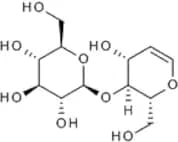
CAS :<p>Used for structural and conformational studies and as enzyme substrates</p>Formule :C13H24O11Degré de pureté :Min. 95%Couleur et forme :PowderMasse moléculaire :356.32 g/molD-Cellobial
CAS :<p>This compound has been used in the study of cellulase kinetics</p>Formule :C12H20O9Degré de pureté :Min. 95%Couleur et forme :PowderMasse moléculaire :308.28 g/mol1,4-D-Xylobiose
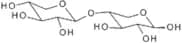
CAS :<p>1,4-D-Xylobiose, also called 4-O-(b-D-Xylopyranosyl)-D-xylopyranose, is a beta 1-4 linked disaccharide made of 2 xylose monomers. 1,4-D-Xylobiose is a low-calories sweetener that can be used as an alternative or additive to sucrose. Supplementing a high fat diet with 1,4-D-xylobiose has been shown to prevent and treat obesity in mice.</p>Formule :C10H18O9Degré de pureté :Min. 95 Area-%Couleur et forme :White PowderMasse moléculaire :282.25 g/molTetra-mannuronic acid sodium
<p>Tetra-mannuronic acid sodium salt (β-1,4-linked sodium mannuronotetraose) is one of a number of oligosaccharides obtained from alginate which is a polysaccharide in brown seaweeds containing: blocks of repeating mannuronic acid sequences (M-M-M-M etc), repeating guluronic acid sequences (G-G-G-G etc), and alternating M-G-M-G sequences. Oligosaccharides can be released using several methods (Lua, 2015; Yanga, 2004) and claims have been published that mannuronic acid oligosaccharides for example, can be effective in the prophylaxis and treatment of Alzheimer's disease, or for the prophylaxis and treatment of diabetes (USP 8835403B2, 2014).</p>Formule :C24H30O25Na4Degré de pureté :Min. 97 Area-%Couleur et forme :Off-White PowderMasse moléculaire :810.44 g/molNGA3B N-Glycan
CAS :<p>NGA3B N-Glycan is a high purity, custom synthesis, methylation and fluorination modification of the product. This product is an oligosaccharide that is composed of saccharides and sugars. It has a CAS No. 1620146-04-4.</p>Formule :C66H110N6O46Degré de pureté :Min. 95%Couleur et forme :SolidMasse moléculaire :1,723.59 g/mol3'-Sulfated Lewis A sodium salt
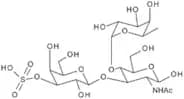
CAS :<p>3'-Sulfated Lewis A sodium salt is a synthetic oligosaccharide that is used as an antigen for the diagnosis of pancreatic cancer. It is conjugated to a monoclonal antibody and binds to the Lewis A epitope on the surface of cells. 3'-Sulfated Lewis A sodium salt has been shown to be useful in bladder cancer, where it can be used as a marker for tumorigenicity. It has also been shown to stimulate selectins and increase sugar residues on cell surfaces, which may lead to increased tumor growth.</p>Formule :C20H34NO18SNaDegré de pureté :Min. 95%Couleur et forme :White PowderMasse moléculaire :631.55 g/mol2-Acetamido-2-deoxy-4-O-(b-D-galactopyranosyl)-6-sulfo-b-D-glucopyranose
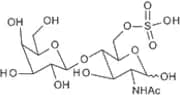
CAS :<p>2-Acetamido-2-deoxy-4-O-(b-D-galactopyranosyl)-6-sulfo-b-D-glucopyranose is a glycosaminoglycan that can be used as an immunomodulator. It has been shown to inhibit the production of tumor necrosis factor alpha (TNFα) in experimental cancer tissues and to stimulate the activity of lymphocytes, which may be due to its ability to regulate camp levels. 2A2D4OSBG also has regulatory effects on monoclonal antibodies and inhibits the immune reaction caused by autoimmune diseases.</p>Formule :C14H25NO14SDegré de pureté :Min. 95%Couleur et forme :White PowderMasse moléculaire :463.41 g/molSialyl Lewis X methyl glycoside sodium salt
CAS :<p>Glycoside of Sialyl Lewis X</p>Formule :C32H54N2O23Degré de pureté :Min. 95%Couleur et forme :White PowderMasse moléculaire :834.77 g/molAcetyl 2-acetamido-4-O-acetyl-6-O-benzoyl-2-deoxy-3-O-(2,3,4,6-tetra-O-benzoyl-b-D-galactopyranosyl)-a-D-thiogalactopyranoside
CAS :<p>Acetyl 2-acetamido-4-O-acetyl-6-O-benzoyl-2-deoxy-3-O-(2,3,4,6-tetra-O-benzoyl bDgalactopyranosyl)-aDthiogalactopyranoside is a modification of the natural carbohydrate. It is manufactured through a custom synthesis and has high purity with an Oligosaccharide content of 99% by weight. This product is an acetylated glycoside that is made from a monosaccharide and methylated with a fluorine atom. Acetyl 2-acetamido 4 O acetyl 6 O benzoyl 2 deoxy 3 O (2,3,4,6 tetra O benzoyl b D galactopyranosyl) a D thiogalactopyranoside is used in the synthesis of complex carbohydrates.</p>Formule :C53H49NO17SDegré de pureté :Min. 95%Masse moléculaire :1,004.02 g/molDi-guluronic acid sodium
CAS :<p>Di-guluronic acid sodium (DGA) is a custom synthesis of an oligosaccharide that has been modified with methylation and glycosylation. It can be used in the production of Oligosaccharides, which are complex carbohydrates. DGA is synthesized by a process called Click chemistry, which includes a modification called fluorination. DGA is also a polysaccharide and a sugar, as well as being high purity and having high molecular weight.</p>Formule :C12H16O13Na2Degré de pureté :Min. 95%Couleur et forme :PowderMasse moléculaire :414.23 g/molMaltoheptaose
CAS :<p>α 1,4-glucoheptasaccharide derived from starch by hydrolysis and chromatography</p>Formule :C42H72O36Degré de pureté :Min. 60%Couleur et forme :White PowderMasse moléculaire :1,153.02 g/mol2-(2,3,6-Tri-O-acetyl-4-O-[(2,3,4,6-tetra-O-acetyl-a-D-glucopyranosyl)]-b-D-glucopyranosyl) thiopseudourea
<p>2-(2,3,6-Tri-O-acetyl-4-O-[(2,3,4,6-tetra-O-acetyl-a-D-glucopyranosyl)]-b-D-glucopyranosyl) thiopseudourea is a glycosylated oligosaccharide that has been modified using methylation and click chemistry. This compound has been used in the synthesis of various complex carbohydrates. The CAS number for this compound is 905835-79-8 and it can be custom synthesized to meet your needs.</p>Formule :C27H38N2O17SDegré de pureté :Min. 95%Masse moléculaire :694.66 g/molCellobionic acid ammonium salt
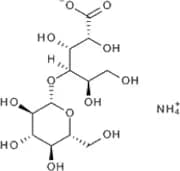
CAS :<p>Cellobionic acid is produced by oxidative enzymes working on cellulose. These compounds have found application in cosmetic antiaging formulations, moisturizers, and peels, and in treatment products to improve hyperpigmentation and acne. The bionic acids such as cellobionic acid offer the benefits of α-hydroxyacids without irritation. They also provide additional antioxidant/chelation, barrier strengthening, and moisturizing effects.</p>Formule :C12H25NO12Degré de pureté :Min. 95%Couleur et forme :Off-White PowderMasse moléculaire :375.33 g/molα1,3-Galactobiosyl β-methyl glycoside
<p>a1,3-Galactobiosyl b-methyl glycoside is a fluorinated saccharide that possesses the same chemical structure as N-acetylgalactosamine. It has been synthesized by click modification with methyl iodide and methyl bromoacetate. The synthesis of this compound was achieved by glycosylation of galactose with 1,3-diiodo-2,2'-bithiopropane followed by methylation of the resulting glycosylation product with methyl bromoacetate to form the desired compound. This carbohydrate can be used in a variety of applications including anti-inflammatory drugs, antibiotics, and cancer treatments.</p>Formule :C13H24O11Degré de pureté :Min. 95%Couleur et forme :White/Off-White SolidMasse moléculaire :356.32 g/molGalacturonan oligosaccharide DP7 sodium, 40% HPAEC-PAD
<p>Please enquire for more information about Galacturonan oligosaccharide DP7 sodium, 40% HPAEC-PAD including the price, delivery time and more detailed product information at the technical inquiry form on this page</p>Formule :C42H51O43Na7Degré de pureté :Min. 95%Masse moléculaire :1,404.76 g/molGD2-Ganglioside
CAS :<p>GD2 (shown as sodium salt) has a core trisaccharide structure (GalNAc-b-1,4-Gal-b-1,4-Glc) with its two sialic acids linked b-2,3/b-2,8 to the inner galactose residue and ceramide linked to position 1 on the reducing terminal glucose residue. GD2 ganglioside is expressed at a low concentration in the central nervous system, nerves, skin melanocytes and stem cells in healthy adults. On the other hand, GD2 is overexpressed in a number of tumors, including: neuroblastoma, melanoma, small cell lung carcinoma and brain tumors. Recently, it has been found in low concentrations on breast cancer stem cells (CSC) that possess: self-renewal properties (division without disrupting the undifferentiated state), and tumor-initiating capabilities. It has been suggested that GD2 ganglioside may be developed as an effective target antigen for CSC immunotherapy (Fleurence, 2017).</p>Formule :C78H138N4O34·xNaDegré de pureté :Min. 95 Area-%Couleur et forme :PowderMasse moléculaire :1,675.94 g/molGalacturonan DP7/DP8 sodium
<p>Mixed DP 7/8 Na galacturonans (α-1,4 galacturonoheptoses and octaoses), are derived from pectin or pectic acid, by enzymatic or partial acid hydrolysis. They are used in galacturonic acid metabolism research as a substrate to identify, differentiate, and characterized endo- and exopolygalacturonase(s), and gluconase(s). The addition of very short fragments of homogalacturonan oligosaccharides, restores development in dark-grown, de-etiolated seedling mutants, suggesting that they are unable to generate de-methylesterified pectin fragments. A model of spatiotemporally separated photoreceptive and signal-responsive cell types has been proposed, that contains overlapping subsets of the regulatory network of light-dependent seedling development.</p>Degré de pureté :Min. 95%Couleur et forme :Powder






![2-(2,3,6-Tri-O-acetyl-4-O-[(2,3,4,6-tetra-O-acetyl-a-D-glucopyranosyl)]-b-D-glucopyranosyl) thiops…](/_next/image/?url=https%3A%2Fstatic.cymitquimica.com%2Fproducts%2F3D%2Fthumb-webp%2FOT10963.webp&w=3840&q=75)