Oligosaccharides
Les oligosaccharides sont des glucides composés d'un petit nombre d'unités monosaccharidiques liées par des liaisons glycosidiques. Ces molécules jouent des rôles importants dans divers processus biologiques, notamment la reconnaissance cellulaire, la signalisation et les réponses immunitaires. Dans cette section, vous trouverez une large sélection d'oligosaccharides essentiels pour la recherche en glycosciences, biochimie et biologie moléculaire. Ces composés sont essentiels pour étudier les structures complexes des glucides, leurs fonctions et leurs interactions avec d'autres biomolécules. Chez CymitQuimica, nous proposons des oligosaccharides de haute qualité pour répondre à vos besoins en recherche et développement, garantissant des résultats précis et fiables dans vos expériences.
Sous-catégories appartenant à la catégorie "Oligosaccharides"
- Aminoéthyl Glycosides, Aminopropyl Glycosides(14 produits)
- Glycanes liant les Asn(33 produits)
- Oligosaccharides biotinées(13 produits)
- Groupes sanguins et antigènes de Lewis(11 produits)
- Oligosaccharides du groupe sanguin(13 produits)
- Cellooligosaccharides(1 produits)
- Cyclodextrines(183 produits)
- Disaccharides(192 produits)
- Oligosaccharides d'épitopes(19 produits)
- Fructooligosaccharides(2 produits)
- Oligosaccharides fonctionnels(554 produits)
- Oligosaccharides fonctionnalisés(1 produits)
- Galactosamine(41 produits)
- Galactoses(261 produits)
- Galb (1-3) GalNAc(21 produits)
- Série Ganglio(11 produits)
- Séries Globo et Isoglobo(17 produits)
- Glucosamine(128 produits)
- Acides glucuroniques(51 produits)
- Glycoprotéines, Glycopeptides(59 produits)
- Glycosaminoglycane(26 produits)
- Oligosaccharides du lait maternel(22 produits)
- O-Glycanes marqués(9 produits)
- Oligosaccharides marqués(36 produits)
- LacNAc(53 produits)
- Séries Lacto et Néolacto(14 produits)
- Lacto-N-biose(10 produits)
- Lactooligosaccharides(7 produits)
- Liaison attachée aux oligosaccharides(19 produits)
- Maltooligosaccharides(6 produits)
- Oligosaccharides du lait(31 produits)
- N-Glycanes(149 produits)
- Glycosides naturels(177 produits)
- Oligosaccharides naturels(103 produits)
- O-Glycane(18 produits)
- Building Blocks d’Oligosaccharides(7 produits)
- Remplacement des oligosaccharides(2 produits)
- Oligosaccharides par composant Sucre(225 produits)
- Oligoses(24 produits)
- Autres Oligosaccharides(14 produits)
- Oligomères de PEG(33 produits)
- Sucres phosphatés(17 produits)
- Sucres protégés(526 produits)
- Réactifs pour la synthèse d'oligosaccharides(254 produits)
- Glycanes de liaison Ser, Thr(9 produits)
- Oligosaccharides sialylés(3 produits)
- Sphingoglycolipides(42 produits)
- Acides aminés de sucre, Peptides de sucre(20 produits)
- Antigènes de sucre(31 produits)
- Building Blocks Sucrés par Oligosaccharides Cibles(225 produits)
- Conjugués de sucre(100 produits)
- Sucres sulfatés(16 produits)
- Tétrasaccharides(34 produits)
- Trisaccharides et autres(95 produits)
- Xylooligosaccharides(5 produits)
Affichez 47 plus de sous-catégories
2278 produits trouvés pour "Oligosaccharides"
Trier par
Degré de pureté (%)
0
100
|
0
|
50
|
90
|
95
|
100
D-Cellohexaose
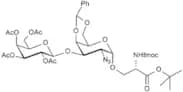
CAS :<p>Substrate for β-glucosidase</p>Formule :C36H62O31Degré de pureté :Min. 95%Couleur et forme :White Off-White PowderMasse moléculaire :990.86 g/mol3-O-(2,3,4,6-Tetra-O-acetyl-b-D-galactopyranosyl)-2-azido-4,6-O-benzylidene-2-deoxy-a-D-galactopyranosyl-Fmoc serine tert-butyl este r
CAS :<p>Methylation of polysaccharides is the process of adding methyl groups to chemical compounds. This process can be achieved by using a variety of reagents. One type of reagent is a methyl donor, which is capable of transferring a methyl group to another molecule. The Methylation Kit contains various reagents that allow for the efficient and specific modification of polysaccharides, including carbohydrates, oligosaccharides, and saccharides. The kit includes two types of reagents: Methyl donors and Methyl acceptors. The kit also contains other additives such as solvents, buffers, and pH indicators. The 3-O-(2,3,4,6-Tetra-O-acetyl-b-D-galactopyranosyl)-2-azido-4,6-O-benzylidene-2-deoxy-a-D-galactopyranosyl Fmoc serine tert but</p>Formule :C49H56N4O18Degré de pureté :Min. 95%Masse moléculaire :988.99 g/molSucrose monopalmitate
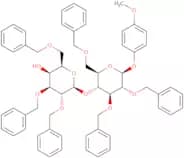
CAS :<p>Sucrose monopalmitate is a fatty acid that is used as a surfactant and emulsifier. It has been shown to have surface-active properties in vitro, which may be due to its ability to interact with the surface of cells. Sucrose monopalmitate is used in diagnostic agents such as active analogues, which are compounds that bind specifically to an analyte or target molecule. These compounds can then be detected by other methods such as radioactive labelling or enzyme-linked immunosorbent assay (ELISA). This product also has been shown to be useful in detergent compositions, including nanoemulsions and solid dispersions.</p>Formule :C28H52O12Degré de pureté :Min. 95%Masse moléculaire :580.71 g/mol4-Methoxyphenyl 4-O-(2,3,6-tri-O-benzyl-b-D-galactopyranosyl)-2,3,6-tri-O-benzyl-b-D-glucopyranoside
CAS :<p>4-Methoxyphenyl 4-O-(2,3,6-tri-O-benzyl-b-D-galactopyranosyl)-2,3,6-tri-O-benzyl-b-D-glucopyranoside is a sugar that is custom synthesized. It is fluorinated and modified with saccharides. The molecular weight of this compound is 582.06 g/mol and the CAS number for it is 15041281.</p>Formule :C61H64O12Degré de pureté :Min. 95%Masse moléculaire :989.15 g/molDNS-SGN
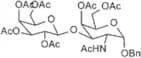
<p>DNS-SGN is a synthetic, high purity, methylated, glycosylated, complex carbohydrate. This product is custom synthesized and has been fluorinated with a click modification. DNS-SGN is CAS Number: 598-02-3.</p>Formule :C100H155N9O66SDegré de pureté :Min. 95%Masse moléculaire :2,571.39 g/molBenzyl 2-acetamido-4,6-di-O-acetyl-3-O-(2,3,4,6-tetra-O-acetyl-b-D-galactosyl)-2-deoxy-a-D-galactopyranoside
CAS :This product is a custom synthesis. It is an acetamido-galactoside with a benzyl 2-acetamido-4,6-di-O-acetyl-3-O-(2,3,4,6-tetra-O-acetyl)-b-D-galactopyranoside moiety. This compound has been modified with fluorination and methylation. The molecular weight of this compound is 328.27 g/mol and the CAS number is 3809-10-7.Formule :C33H43NO17Degré de pureté :Min. 95%Masse moléculaire :725.69 g/molTri-fucosyl-Lewis Y-heptasaccharide-APE, HSA
<p>Tri-fucosyl-Lewis Y-heptasaccharide-APE, HSA is a complex carbohydrate that has been custom synthesized and glycosylated. It was modified with methylation and fluorination to create a high purity product. This complex carbohydrate has a CAS number of 107386-00-6 and is composed of sugar molecules. It is a polysaccharide with the following structure:</p>Degré de pureté :Min. 95%Sulpho Lewisx Na
<p>Sulpho Lewisx Na is a high purity, custom synthesized sugar that has been modified using a click chemistry reaction. It has been fluorinated and glycosylated to produce a complex carbohydrate. Sulpho Lewisx Na is a synthetic oligosaccharide produced with the intention of mimicking the structure of Lewisx in order to study its properties. The CAS number for this compound is 2641-19-2 and it can be found under the name Oligosaccharide, Monosaccharide, saccharide, Carbohydrate on Pubchem CID 1039264.</p>Formule :C20H34NNaO18SDegré de pureté :Min. 95%Masse moléculaire :631.54 g/mol4,6-Di-O-(3,4,6-tri-O-acetyl-2-deoxy-2-phthalimido b-D-glucopyranosyl)-1,3-6-tri-O-benzyl-a-D-mannopyranoside
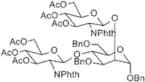
CAS :<p>4,6-Di-O-(3,4,6-tri-O-acetyl-2-deoxy-2-phthalimido b-D-glucopyranosyl)-1,3-6-tri-O-benzyl a -D -mannopyranoside is a carbohydrate that has been modified with fluorine. It is an oligosaccharide composed of three monosaccharides linked by glycosidic bonds. The modification of the carbohydrate with fluorine was achieved through a click chemistry reaction between the 4’ and 6’ position of the glucose moiety. This product is used in custom synthesis and high purity applications.</p>Formule :C67H68N2O24Degré de pureté :Min. 95%Masse moléculaire :1,285.26 g/mol3'-a-Sialyl-N-acetyllactosamine-PAA-biotin
<p>3'-a-Sialyl-N-acetyllactosamine-PAA-biotin is a biotin labelled sialylglycoside</p>Degré de pureté :Min. 95 Area-%Couleur et forme :Off-White Powderb-Lactosyl ureide dihydrate
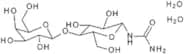
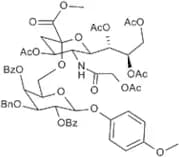
b-Lactosyl ureide dihydrate is a white crystalline powder that is soluble in water. It has a molecular weight of 598.7 and was synthesized by the reaction of b-lactosyl chloride with urea. The compound has been used as a fluoro-protecting group for nucleophilic substitution reactions, and glycosylation reactions.Formule :C13H24N2O11·2H2ODegré de pureté :Min. 95%Couleur et forme :White/Off-White SolidMasse moléculaire :420.37 g/mol4-Methoxyphenyl 2,4-di-O-benzoyl-3-O-benzyl-6-O-[methyl 5-(acetoxyacetamido)-4,7,8,9-tetra-O-acetyl-3,5-dideoxy-D-glycero-alpha-D-ga lacto-2-nonulopyranosylonate]-beta-D-galactopyranoside
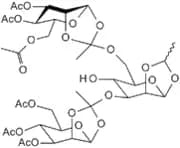
<p>The methylation of a glycosylation is an organic chemistry technique that can be used to modify the chemical structure of a carbohydrate. A glycosylation is the reaction between an alcohol and a sugar, which produces a glycoside. The addition of methyl groups at specific positions on the sugar molecule can lead to improved properties such as increased stability, increased solubility, or increased uptake by cells. This process has been shown to produce compounds with more desirable pharmacological properties than their parent compounds. Click chemistry is a versatile and powerful method for modifying carbohydrates. It involves the use of copper-catalyzed azide-alkyne cycloaddition reactions to form carbon-nitrogen bonds in place of conventional amide linkages in peptides and proteins. Carbohydrates are modified using this method by attaching small molecules such as fluorine atoms onto one or more carbons in the carbohydrate structure. This process can be used to create novel sugars with improved properties including high purity, high stability</p>Formule :C56H61NO23Degré de pureté :Min. 95%Masse moléculaire :1,116.08 g/mol3,6-Di-O-(3,4,6-tri-O-acetyl-b-D-mannopyranosylethylidyne)-1,2-O-ethylidene-b-D-mannopyranose
CAS :<p>3,6-Di-O-(3,4,6-tri-O-acetyl-b-D-mannopyranosylethylidyne)-1,2-O-ethylidene-b-D-mannopyranose is a synthetic glycoside that is used as an intermediate in the production of other compounds. It has been modified with fluorine to give it increased stability. This product is also known as 3,6:3',4',6'-di(1,2:1') ethylidene-.beta.-D-.mannopyranose and has CAS number 230963–26–5.</p>Formule :C37H52O23Degré de pureté :Min. 95%Masse moléculaire :864.79 g/molCellobiuronic acid
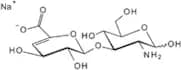
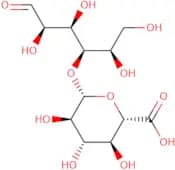
CAS :<p>Cellobiuronic acid is a polysaccharide that contains glucose and uronic acids. It is found in the cell walls of gram-positive bacteria, where it may play an important role in maintaining the structural integrity of the cell wall. Cellobiuronic acid has been shown to be a potent antigen for pneumococcus. Cellobiuronic acid has also been shown to be conjugated with proteins and used as a vaccine adjuvant for inducing antibody responses against pneumococcal antigens. Cellobiuronic acid is synthesized from glucose by bacterial cells, which use it as a carbon source. The biosynthesis of cellobiuronic acid is poorly understood because it does not occur in mammalian cells.</p>Formule :C12H20O12Degré de pureté :Min. 95%Masse moléculaire :356.28 g/mol6-O-[2-Acetamido-2-deoxy-4-O-(b-D-galactopyranosyl)-b-D-glucopyranosyl]-D-galactopyranose
CAS :<p>The 6-O-[2-acetamido-2-deoxy-4-O-(b-D-galactopyranosyl)-b-D-glucopyranosyl]-D-galactopyranose is a disaccharide carbohydrate that can be found in the blood group H. This particular carbohydrate is an example of a sialic acid, which plays an important role in the immune system and other biological processes. Lectins are proteins that bind to carbohydrates and are often used as probes to study glycan structures. Lectin binding assays have been used to characterize this molecule as well as oligosaccharides, glycans, and biohazards.</p>Formule :C20H35NO16Degré de pureté :Min. 95%Couleur et forme :SolidMasse moléculaire :545.49 g/molHeparin disaccharide IV-H
CAS :<p>A modified heparin disaccharide</p>Formule :C12H19NO10Degré de pureté :Min. 95%Masse moléculaire :337.28 g/molMaltotetradecaose
CAS :1,4-glucotetradecaose derived from starch by hydrolysis and chromatographyFormule :C84H142O71Degré de pureté :Min. 95%Masse moléculaire :2,287.98 g/molNA2G1F N-Glycan
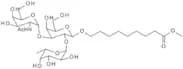
<p>NA2G1F N-glycan is a modified glycopeptide that is synthesized from the monosaccharide chitin. It has been fluorinated to render it resistant to proteolytic degradation and has been glycosylated with sialic acid residues. NA2G1F N-glycan can be used for use in click chemistry, methylation, or glycosylation. The molecular weight of this product is between 5 and 50 kDa, with a purity of > 98%.</p>Formule :C62H104N4O45Degré de pureté :Min. 95%Couleur et forme :PowderMasse moléculaire :1,625.49 g/molBlood Group A trisaccharide-(CH2)8COOMe derivative
CAS :Blood group antigen derivative with spacer armFormule :C30H53NO17Degré de pureté :Min. 95%Masse moléculaire :699.74 g/molDextran 110, MW: 100,000 to 120,000
CAS :<p>Complex glucan (a 1-6) from Leuconostoc spp.; extender in blood transfusions.</p>Couleur et forme :White Powder




![6-O-[2-Acetamido-2-deoxy-4-O-(b-D-galactopyranosyl)-b-D-glucopyranosyl]-D-galactopyranose](/_next/image/?url=https%3A%2Fstatic.cymitquimica.com%2Fproducts%2F3D%2Fthumb-webp%2FOA06816.webp&w=3840&q=75)