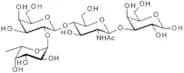
Oligosaccharides
Les oligosaccharides sont des glucides composés d'un petit nombre d'unités monosaccharidiques liées par des liaisons glycosidiques. Ces molécules jouent des rôles importants dans divers processus biologiques, notamment la reconnaissance cellulaire, la signalisation et les réponses immunitaires. Dans cette section, vous trouverez une large sélection d'oligosaccharides essentiels pour la recherche en glycosciences, biochimie et biologie moléculaire. Ces composés sont essentiels pour étudier les structures complexes des glucides, leurs fonctions et leurs interactions avec d'autres biomolécules. Chez CymitQuimica, nous proposons des oligosaccharides de haute qualité pour répondre à vos besoins en recherche et développement, garantissant des résultats précis et fiables dans vos expériences.
Sous-catégories appartenant à la catégorie "Oligosaccharides"
- Aminoéthyl Glycosides, Aminopropyl Glycosides(14 produits)
- Glycanes liant les Asn(33 produits)
- Oligosaccharides biotinées(13 produits)
- Groupes sanguins et antigènes de Lewis(11 produits)
- Oligosaccharides du groupe sanguin(13 produits)
- Cellooligosaccharides(1 produits)
- Cyclodextrines(183 produits)
- Disaccharides(192 produits)
- Oligosaccharides d'épitopes(19 produits)
- Fructooligosaccharides(2 produits)
- Oligosaccharides fonctionnels(554 produits)
- Oligosaccharides fonctionnalisés(1 produits)
- Galactosamine(41 produits)
- Galactoses(261 produits)
- Galb (1-3) GalNAc(21 produits)
- Série Ganglio(11 produits)
- Séries Globo et Isoglobo(17 produits)
- Glucosamine(128 produits)
- Acides glucuroniques(51 produits)
- Glycoprotéines, Glycopeptides(59 produits)
- Glycosaminoglycane(26 produits)
- Oligosaccharides du lait maternel(22 produits)
- O-Glycanes marqués(9 produits)
- Oligosaccharides marqués(36 produits)
- LacNAc(53 produits)
- Séries Lacto et Néolacto(14 produits)
- Lacto-N-biose(10 produits)
- Lactooligosaccharides(7 produits)
- Liaison attachée aux oligosaccharides(19 produits)
- Maltooligosaccharides(6 produits)
- Oligosaccharides du lait(31 produits)
- N-Glycanes(149 produits)
- Glycosides naturels(177 produits)
- Oligosaccharides naturels(103 produits)
- O-Glycane(18 produits)
- Building Blocks d’Oligosaccharides(7 produits)
- Remplacement des oligosaccharides(2 produits)
- Oligosaccharides par composant Sucre(225 produits)
- Oligoses(24 produits)
- Autres Oligosaccharides(14 produits)
- Oligomères de PEG(33 produits)
- Sucres phosphatés(17 produits)
- Sucres protégés(526 produits)
- Réactifs pour la synthèse d'oligosaccharides(254 produits)
- Glycanes de liaison Ser, Thr(9 produits)
- Oligosaccharides sialylés(3 produits)
- Sphingoglycolipides(42 produits)
- Acides aminés de sucre, Peptides de sucre(20 produits)
- Antigènes de sucre(31 produits)
- Building Blocks Sucrés par Oligosaccharides Cibles(225 produits)
- Conjugués de sucre(100 produits)
- Sucres sulfatés(16 produits)
- Tétrasaccharides(34 produits)
- Trisaccharides et autres(95 produits)
- Xylooligosaccharides(5 produits)
Affichez 47 plus de sous-catégories
2278 produits trouvés pour "Oligosaccharides"
Trier par
Degré de pureté (%)
0
100
|
0
|
50
|
90
|
95
|
100
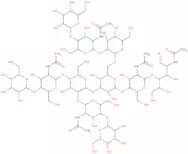
NA3 N-Glycan
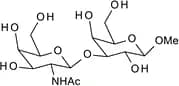
CAS :<p>NA3 N-glycan is a base that forms glycosidic bonds with other molecules. It has been shown to be pharmacologically active in tissues and has a safety profile. NA3 N-glycan is metabolized by the serine protease, which cleaves it from its glycosylated protein. The resulting molecule lacks a reactive group, which prevents it from forming toxic reactions with other molecules. NA3 N-glycan has been used for pharmacokinetic modeling and for mass spectrometric measurements of proteins in human serum and plasma.</p>Formule :C76H127N5O56Degré de pureté :Min. 95%Couleur et forme :Solid.Masse moléculaire :2,006.82 g/molMethyl 3-O-(2-acetamido-2-deoxy-b-D-galactopyranosyl)-b-D-galactopyranoside
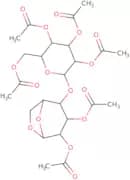
CAS :Methyl 3-O-(2-acetamido-2-deoxy-b-D-galactopyranosyl)-b-D-galactopyranoside is a modified sugar that can be used for synthesis of saccharides, oligosaccharides, and polysaccharides. This product has been custom synthesized to be a high purity compound with CAS No. 130234-66-1. It has been fluorinated and is available in the glycosylation form.Formule :C15H27NO11Degré de pureté :Min. 95%Masse moléculaire :397.36 g/mol2,3,2',3',4',6'-Hexa-O-acetyl-1,6-anhydro-b-D-maltose
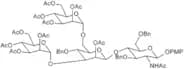
CAS :2,3,2',3',4',6'-Hexa-O-acetyl-1,6-anhydro-b-D-maltose (HAP) is a custom synthesis that can be modified with fluorination, methylation, and monosaccharide. HAP is a synthetic oligosaccharide that is glycosylated and has a saccharide and sugar. HAP has the CAS No. 28868-67-9. This product can be used as an additive in food production or as a pharmaceutical agent.Formule :C24H32O16Degré de pureté :Min. 95%Masse moléculaire :576.5 g/mol4-Methoxyphenyl 2-acetamido-4-O-[2-O-acetyl-3,6-di-O-(2,3,4,6-tetra-O-acetyl-a-D-mannopyranosyl)-4-O-benzyl-b-D-mannopyranosyl]-3,6- di-O-benzyl-2-deoxy-b-D-glucopyranoside
This product is a custom synthesis and modification of a natural product. The chemical name is 4-Methoxyphenyl 2-acetamido-4-O-[2-O-acetyl-3,6-di-O-(2,3,4,6-tetra-O-acetyl-aDmannopyranosyl)-4-ObenzylbDmannopyranosyl]-3,6diOBenzyl2deoxybDglucopyranoside. This molecule has been fluorinated with trifluoromethanesulfonic acid in the presence of polystyrene as an initiator to form the desired compound. The molecular weight of this molecule is 1,895.09 g/mol. This product was synthesized by methylation using methanol and ammonium chloride as reagents in the presence of tetrapropylammonium perruthenate as catalyst for the process.Formule :C72H87NO31Degré de pureté :Min. 95 Area-%Couleur et forme :PowderMasse moléculaire :1,462.45 g/molMan6GlcNAc (I)
CAS :<p>Man6GlcNAc (I) is a synthetic, fluorinated, monosaccharide that can be modified to produce a wide range of products. This product has been shown to have high purity and can be customized for specific applications. It is used in the production of complex carbohydrates with click modification and methylation. Man6GlcNAc (I) is often used as an intermediate in the synthesis of oligosaccharides such as glycosylated proteins or glycans.</p>Formule :C44H75NO36Degré de pureté :Min. 95%Couleur et forme :PowderMasse moléculaire :1,194.05 g/molNGA3F N-Glycan
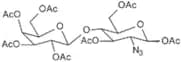
CAS :<p>NGA3F N-Glycan is a custom synthesis product that has been fluorinated, methylated, and modified with a click modification. It is a monosaccharide that can be found in the form of polysaccharides or glycosylations. This product is made of saccharides, which are carbohydrates that have been modified with glycosylation or polysaccharide modifications. NGA3F N-Glycan can be used in a variety of applications such as pharmaceuticals, food additives, and cosmetics.</p>Formule :C64H107N5O45Degré de pureté :Min. 95%Masse moléculaire :1,666.54 g/mol1,3,6-Tri-O-acetyl-4-O-(2,3,4,6-tetra-O-acetyl-b-D-galactopyranosyl)-2-azido-2-deoxy-D-glucopyranose
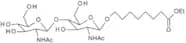
<p>1,3,6-Tri-O-acetyl-4-O-(2,3,4,6-tetra-O-acetyl-b-D-galactopyranosyl)-2-azido-2-deoxy--D--glucopyranose is a modification of a natural sugar. It is an oligosaccharide that is composed of one monosaccharide and two disaccharides. The triacetate group on the first saccharide provides protection against hydrolysis and methylation reactions. This compound has been shown to be synthesized chemically in high purity and with high yield.</p>Formule :C26H35N3O17Degré de pureté :Min. 95%Masse moléculaire :661.57 g/mol8-Ethoxycarbonylheptyl N,N'-di-O-acetyl-b-chitobioside
8-Ethoxycarbonylheptyl N,N'-di-O-acetyl-b-chitobioside is a custom synthesis of an oligosaccharide. It is a complex carbohydrate that is composed of saccharides and has a CAS number. 8-Ethoxycarbonylheptyl N,N'-di-O-acetyl-b-chitobioside is modified with methylation, glycosylation and click modification. This product is also fluorinated. 8-Ethoxycarbonylheptyl N,N'-di-O-acetyl-b-chitobioside has high purity and can be used as a sugar in the synthesis of other compounds.Formule :C26H46N2O13Degré de pureté :Min. 95%Masse moléculaire :594.65 g/molD-Raffinose undecaacetate
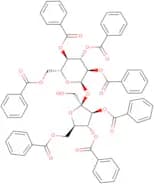
CAS :<p>D-Raffinose undecaacetate is a sweetener that is used in some chewing gum and other foods. It is a sucrose ester with the chemical formula C12H24O11. D-Raffinose undecaacetate has been shown to increase the release of insulin, which may be due to its effects on glucose uptake or modulation of taste receptors on the tongue. It has also been shown to have an anti-inflammatory effect, which may be due to its interactions with the bitter taste receptors present in tissues such as the small intestine and liver.</p>Formule :C40H54O27Degré de pureté :Min. 95%Masse moléculaire :966.84 g/mol2,3,4,6,3',4',6'-Hepta-O-benzoylsucrose
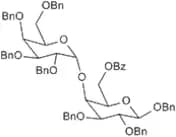
CAS :<p>2,3,4,6,3',4',6'-Hepta-O-benzoylsucrose (HBS) is a custom synthesis and modification of sucrose. The sugar is modified with 2,3,4,6-tetra-O-benzoyl groups at the 6′ position on the fructose unit and 3′ position on the glucose unit. HBS has been used in a click chemistry reaction as an acceptor for azide moieties.</p>Formule :C61H50O18Degré de pureté :Min. 95%Couleur et forme :PowderMasse moléculaire :1,071.04 g/molBenzyl 4-O-(2,3,4,6-tetra-O-benzyl-a-D-galactopyranosyl)-2,3-di-O-benzyl-6-O-benzoyl-b-D-galactopyranoside
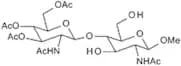
Benzyl 4-O-(2,3,4,6-tetra-O-benzyl-a-D-galactopyranosyl)-2,3-di-0benzyl 6-O-benzoyl-b-D-galactopyranoside is a synthetic carbohydrate that belongs to the class of oligosaccharides. It has been modified by fluorination and methylation. This compound is also glycosylated and click modified.Formule :C68H68O12Degré de pureté :Min. 95%Masse moléculaire :1,077.26 g/molMethyl 2-acetamido-4-O-(2-acetamido-3,4,6-tri-O-acetyl-2-deoxy-b-D-glucopyranosyl)-2-deoxy-b-D-glucopyranoside
CAS :<p>Methyl 2-acetamido-4-O-(2-acetamido-3,4,6-tri-O-acetyl-2-deoxy-b-D-glucopyranosyl)-2-deoxy-b-D-glucopyranoside is a custom synthesis that is fluorinated and methylated to create an acetal. The monosaccharide is a custom synthesis that has been modified with click chemistry. This oligosaccharide is found in glycosylation reactions and can be used for the synthesis of polysaccharides. Methyl 2 acetamido 4 O-(2 acetamido 3,4,6 tri O acetyl 2 deoxy b D glucopyranosyl) 2 deoxy b D glucopyranoside has CAS Number 97242 82 5.</p>Formule :C23H36N2O14Degré de pureté :Min. 95%Masse moléculaire :564.54 g/molk-Carratriose disulfate disodium salt
<p>k-carrageenan derived trisaccharide disulfate</p>Formule :C18H30O21S2•2NaDegré de pureté :Min. 95%Couleur et forme :White PowderMasse moléculaire :692.51 g/molMonofucosyl-para-lacto-N-neohexaose IV
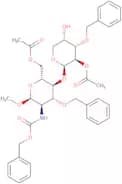
CAS :<p>Monofucosyl-para-lacto-N-neohexaose IV is a monofucosylated glycan consisting of a single pyranose ring. It is a synthetic oligosaccharide that has been modified with Click chemistry to introduce an alkyne group at the reducing end. The alkyne group can be further modified by nucleophilic substitution reactions, such as fluorination, or glycosylation. Monofucosyl-para-lacto-N-neohexaose IV is used in the synthesis of complex carbohydrates.</p>Formule :C46H78N2O35Degré de pureté :Min. 95%Masse moléculaire :1,219.1 g/molMethyl 6-O-acetyl-3-O-benzyl-N-Cbz-2-deoxy-4-O-(methyl-2-O-acetyl-3-O-benzyl-a-L-idopyranuronosyl)-a-D-glucopyranosaminide,
CAS :Methyl 6-O-acetyl-3-O-benzyl-N-Cbz-2-deoxy-4-O-(methyl-2-O-acetyl-3-O-benzyl)-aLidopyranuronosyl)-aDglucopyranosaminide is a carbohydrate that belongs to the class of saccharides. It is a synthetic oligosaccharide that is made up of a monosaccharide, fructose, and 2 disaccharides, maltose and glucuronic acid. This product has been modified by fluorination, methylation, glycosylation, and click chemistry.Degré de pureté :Min. 95%N-Allyloxycarbonyl-b-lactosamine
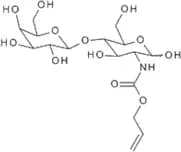
CAS :<p>The linker N-Allyloxycarbonyl-b-lactosamine (NALB) is a bifunctional molecule that can be used to form triplexes with DNA. The NALB has been shown to inhibit the growth of gram-negative bacteria such as Escherichia coli and Haemophilus influenzae by binding to the bacterial cell wall and disrupting its permeability. The linker is synthesized by solid phase synthesis. This process involves the stepwise addition of building blocks in a sequence that is predetermined. The residues are usually protected with protecting groups, which are then removed at the end of the synthesis process.</p>Formule :C16H27NO12Degré de pureté :Min. 95%Masse moléculaire :425.38 g/mol4-O-Acetyl-3,6-di-O-(3,4,6-tri-O-acetyl-1,2-ethylidene-b-D-mannopyranosyl)-1,2-ethylidene-b-D-mannopyranose
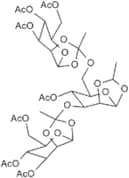
CAS :<p>Methylation of 4-O-acetyl-3,6-di-O-(3,4,6-tri-O-acetyl-1,2-ethylidene bDmannopyranosyl)-1,2-ethylidene bDmannopyranose with methyl iodide and potassium carbonate in the presence of sodium hydroxide leads to the formation of 4-O-acetyl 3,6 di O-(3,4,6 tri O acetyl 1 , 2 ethylene b D mannopyranosyl)-1 , 2 ethylene b D mannopyranose. This compound is a polysaccharide that is similar to cellulose. It is used in the synthesis of complex carbohydrates.</p>Formule :C38H52O25Degré de pureté :Min. 95%Masse moléculaire :908.8 g/molMethyl 3-O-(b-D-galactopyranosyl)-b-D-galactopyranoside
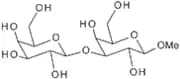
CAS :<p>Methyl 3-O-(b-D-galactopyranosyl)-b-D-galactopyranoside is a disaccharide that is the residue of 6-fluoro-3-indoxyl beta-D-galactopyranoside. This product is a glycoside of methyl 3,6,3',6'-tetraacetate and b-D-galactose.</p>Formule :C13H24O11Degré de pureté :Min. 95%Masse moléculaire :356.32 g/molHeparin disaccharide III-H disodium salt
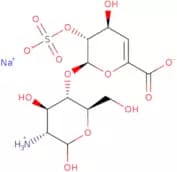
CAS :Heparin is a polysaccharide consisting of repeating units of glucosamine and glucuronic acid that has been shown to have anti-coagulant, antithrombotic, and anti-inflammatory properties. Heparin disaccharide III-H disodium salt is a heparin disaccharide that has been modified by the addition of sodium ions. This heparin disaccharide has been shown to inhibit the proliferation of leukaemia cells in vitro, which may be due to its inhibition of DNA synthesis or cell cycle progression. The mechanism by which this heparin disaccharide inhibits cell growth is not yet known. Research into this mechanism could lead to new treatments for cancer and other diseases.Formule :C12H18NNaO13SDegré de pureté :Min. 95%Masse moléculaire :439.33 g/molBlood group H tetraose type II
CAS :<p>Core antigen fragment in ABO blood group system</p>Formule :C26H45NO20Degré de pureté :Min. 95%Couleur et forme :PowderMasse moléculaire :691.63 g/mol