


Composés polycycliques
Sous-catégories appartenant à la catégorie "Composés polycycliques"
- Acridines(98 produits)
- Anthraquinones(533 produits)
- Acides anthraquinonesulfoniques(16 produits)
- Azobenzènes(270 produits)
- Azonaphtalènes(98 produits)
- Azoxybenzènes(12 produits)
- Azulènes(11 produits)
- Benzimidazoles(1.476 produits)
- Benzodioxanes(27 produits)
- Benzofuranes(928 produits)
- Benzothiophènes(701 produits)
- Benzotriazoles(438 produits)
- Binaphthyls(133 produits)
- Carbazoles(464 produits)
- Chromanes, Chromenes(480 produits)
- Coumarines(1.124 produits)
- Cyclophanes(11 produits)
- Fluorènes et Fluorénones(384 produits)
- Imidazopyridines(10 produits)
- Indans(118 produits)
- Indazoles(2.038 produits)
- Indenes(22 produits)
- Indoles(3.986 produits)
- Indolines(119 produits)
- Isatines(234 produits)
- Isobenzofuranes(17 produits)
- Phtalimides N-substitués(153 produits)
- Naphtalènes(2.438 produits)
- Naphtyridine(17 produits)
- Naphtoquinone(2 produits)
- Perylènes(36 produits)
- Phénazines(25 produits)
- Phtalazines(33 produits)
- Phtalimide(153 produits)
- Hydrocarbures aromatiques polycycliques (HAP)(285 produits)
- Polyphénol(270 produits)
- Ptéridines(52 produits)
- Pyrènes(87 produits)
- Quinuclidine(1 produits)
- Tétracènes(7 produits)
4575 produits trouvés pour "Composés polycycliques"
4-Bromoisoindoline hydrochloride
CAS :4-Bromoisoindoline hydrochloride (BII) is a chemical compound that can be used as a building block for making other chemicals. It can also be used to make research chemicals or as a reaction component in the synthesis of other compounds. It has been shown to be an effective reagent and is useful for the production of fine chemicals with high purity.
Formule :C8H9BrClNDegré de pureté :Min. 95%Couleur et forme :PowderMasse moléculaire :234.52 g/mol2-Amino-6-chloropurine
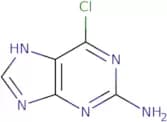
CAS :2-Amino-6-chloropurine is a nucleophilic substituent that is used in the synthesis of 2-amino-6-chloropurine. It reacts with hydroxyl groups to form a palladium-catalyzed coupling reaction solution, which is then treated with hydrochloric acid and trifluoroacetic acid. The product is purified by crystallization and recrystallization. This compound has potent antitumor activity against carcinoma cell lines, but it has not been shown to have any effect against Mycobacterium tuberculosis.
Formule :C5H4ClN5Degré de pureté :Min. 95%Couleur et forme :Off-White PowderMasse moléculaire :169.57 g/mol5-Chloro-8-hydroxyquinoline
CAS :5-Chloro-8-hydroxyquinoline (5-CQ) is a quinoline derivative that has been used as an anticancer agent. It binds to DNA and inhibits the synthesis of RNA and proteins, leading to cell death. 5-CQ has been shown to be cytotoxic against skin cells in vitro by inhibiting mitochondrial oxidative phosphorylation and decreasing the mitochondrial membrane potential. This compound also has genotoxic effects on cultured choroidal neovascularization cells through the inhibition of DNA synthesis.
5-CQ binds to DNA via hydrogen bonds with nitrogen atoms in the purine ring of nucleobases. The overall geometry is that of a distorted octahedron with two faces, each containing six nitrogens in square planar coordination geometry. The binding constants are low for purines but high for pyrimidines, which is why 5-CQ preferentially targets purine rich regions of the genome.Formule :C9H6ClNODegré de pureté :Min. 95%Couleur et forme :Green To Grey SolidMasse moléculaire :179.6 g/mol3,4,7,8-Tetramethyl-1,10-phenanthroline
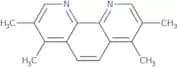
CAS :Metal-chelating agent
Formule :C16H16N2Degré de pureté :Min. 98 Area-%Couleur et forme :White PowderMasse moléculaire :236.31 g/mol5-(4,4,5,5-Tetramethyl-1,3,2-dioxaborolan-2-yl)indoline
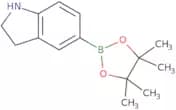
CAS :Please enquire for more information about 5-(4,4,5,5-Tetramethyl-1,3,2-dioxaborolan-2-yl)indoline including the price, delivery time and more detailed product information at the technical inquiry form on this page
Degré de pureté :Min. 95%5-Fmoc-amino-10,11-dihydro-5H-dibenzo[a,d]-cycloheptenyl-2-oxyacetyl-DL-Nle-4- methyl-benzhydrylamide resin
Please enquire for more information about 5-Fmoc-amino-10,11-dihydro-5H-dibenzo[a,d]-cycloheptenyl-2-oxyacetyl-DL-Nle-4- methyl-benzhydrylamide resin including the price, delivery time and more detailed product information at the technical inquiry form on this page
Degré de pureté :Min. 95%Quinoline-4-carboxylic acid
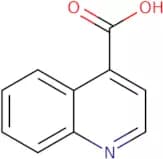
CAS :Quinoline-4-carboxylic acid is a natural compound that is derived from the amino acid tryptophan. It has been shown to have antiinflammatory activity and to be an inhibitor of prostaglandin synthesis. Quinoline-4-carboxylic acid inhibits the growth of carcinoma cells in culture by inducing apoptosis, which is mediated by inhibition of protein synthesis. Quinoline-4-carboxylic acid also has pharmacokinetic properties, including a low volume of distribution, low clearance rate and high bioavailability.
Formule :C10H7NO2Degré de pureté :Min. 97 Area-%Masse moléculaire :173.17 g/molRef: 3D-FQ31508
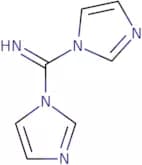
Produit arrêté1,1'-Carbonimidoylbis-1H-imidazole
CAS :1,1'-Carbonimidoylbis-1H-imidazole is a ligand that binds to amines and isosteres. It can be activated with electrophilic reagents to form an activated linker. This ligand has been shown to inhibit the growth of xenograft tumor cells in mice by binding to functional groups on the cell surface. This drug also has been shown to bind to the receptor for advanced glycation end products (RAGE) and inhibit its function. 1,1'-Carbonimidoylbis-1H-imidazole has also been evaluated as a cancer therapeutic agent in animal models.
Formule :C7H7N5Degré de pureté :Min. 95%Couleur et forme :White PowderMasse moléculaire :161.16 g/molRef: 3D-FC45505
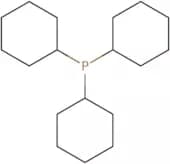
Produit arrêtéTricyclohexylphosphine
CAS :Tricyclohexylphosphine is a compound that is used in organic synthesis to form stable complexes with reactive functional groups such as trifluoroacetic acid, glycol ethers, and sodium carbonate. The reaction solution of these compounds forms a complex with copper chloride and fluorescence probe, which can be analyzed by x-ray crystallography. The reaction mechanism of this compound involves coordination geometry and hydroxyl group. Its basic structure is a trivalent phosphorus atom coordinated to three ligands. Structural analysis of this compound has been done using kinetic data and the results have indicated that the reaction proceeds through an SN2-like mechanism.
Formule :C18H33PDegré de pureté :Min. 95%Couleur et forme :White PowderMasse moléculaire :280.43 g/molRef: 3D-FT31331
Produit arrêté6-Bromo-pyrazolo[1,5-a]pyrimidine
CAS :6-Bromo-pyrazolo[1,5-a]pyrimidine is a bone morphogenetic protein (BMP) inhibitor. It has been shown to be a potent inhibitor of the tyrosine kinase activity of BMP receptors and may be useful for the development of new strategies for the treatment of osteoporosis. 6-Bromo-pyrazolo[1,5-a]pyrimidine is also an effective inhibitor of the proliferation and survival of cancer cells. It inhibits cell growth by interfering with cellular signaling pathways that regulate these processes. 6-Bromo-pyrazolo[1,5-a]pyrimidine was also found to inhibit the production of bone morphogenetic protein 2 (BMP2) in mouse calvaria cells without affecting other bone metabolism markers such as alkaline phosphatase or osteocalcin.
Formule :C6H4BrN3Degré de pureté :Min. 95%Couleur et forme :PowderMasse moléculaire :198.02 g/molRef: 3D-FB140359
Produit arrêté6-Bromoindazole
CAS :6-Bromoindazole is a hydrogen bond inhibitor that has potential neuroprotective effects. It inhibits the enzyme DNA Gyrase, which is necessary for bacterial replication, and has antibacterial properties. 6-Bromoindazole interacts with the receptor tyrosine kinase axitinib and inhibits its activity. This interaction may be responsible for its neuroprotective effects.
Formule :C7H5BrN2Degré de pureté :Min. 95%Masse moléculaire :197.03 g/mol2,2,4-Trimethyl-1,2-dihydroquinoline
CAS :2,2,4-Trimethyl-1,2-dihydroquinoline is a chemical compound with the formula C8H10N2. It is a white solid that is insoluble in water but soluble in nonpolar solvents such as benzene, toluene and hexane. 2,2,4-Trimethyl-1,2-dihydroquinoline has been shown to induce liver lesions in rats at doses of 1.25 g/kg/day. It also reacts with hydrogen fluoride to form calcium stearate. This compound is also used as a precursor for the synthesis of diazonium salts and has been shown to be carcinogenic in animal studies.
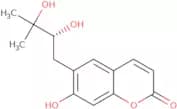
Formule :C12H15NDegré de pureté :Min. 95%Couleur et forme :Clear Viscous LiquidMasse moléculaire :173.25 g/mol(+)-Peucedanol
CAS :(+)-Peucedanol is a sesquiterpene compound, which is a type of natural organic compound composed of three isoprene units resulting in a 15-carbon backbone. It is derived from various species within the plant genus Peucedanum, known for their rich content of bioactive compounds. The stereoisomerism indicated by the "(+)" suggests a specific three-dimensional configuration that may influence its biological activity.
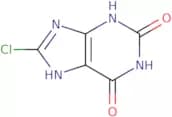
Formule :C14H16O5Degré de pureté :Min. 95%Masse moléculaire :264.27 g/mol8-Chloro-3,7-dihydro-1H-purine-2,6-dione
CAS :8-Chloro-3,7-dihydro-1H-purine-2,6-dione is a reactive molecule that binds to the active site of bacterial cyclic nucleotide phosphodiesterases and inhibits their activity. This inhibition prevents the breakdown of cAMP and cGMP, which are important second messengers in eukaryotic cells. 8-Chloro-3,7-dihydro-1H-purine-2,6-dione is also a potent inhibitor of protein synthesis and has been used in research studies on wheat leaves.
Formule :C5H3N4O2ClDegré de pureté :Min. 95%Couleur et forme :PowderMasse moléculaire :186.56 g/mol5-[(1-Methylindole-3-yl)carbonyl]-4,5,6,7-tetrahydro-1H-bezimidazole
CAS :Produit contrôlé5-[(1-Methylindole-3-yl)carbonyl]-4,5,6,7-tetrahydro-1H-bezimidazole is a reactive heterocyclic compound. It is a carboxylic acid and an amide with a peptic and cephalalgic effect. The symptoms of 5-[(1-methylindole-3-yl)carbonyl]-4,5,6,7-tetrahydro-1H-bezimidazole are hemicrania and amnesia. It has been expressed in the calf thymus DNA.
Formule :C17H17N3ODegré de pureté :Min. 95%Masse moléculaire :279.34 g/mol



![5-Fmoc-amino-10,11-dihydro-5H-dibenzo[a,d]-cycloheptenyl-2-oxyacetyl-DL-Nle-4- methyl-benzhydrylam…](/_next/image/?url=https%3A%2Fstatic.cymitquimica.com%2Fproducts%2F3D%2Fthumb-webp%2FFT111711.webp&w=3840&q=75)
![6-Bromo-pyrazolo[1,5-a]pyrimidine](/_next/image/?url=https%3A%2Fstatic.cymitquimica.com%2Fproducts%2F3D%2Fthumb-webp%2FFB140359.webp&w=3840&q=75)


![5-[(1-Methylindole-3-yl)carbonyl]-4,5,6,7-tetrahydro-1H-bezimidazole](/_next/image/?url=https%3A%2Fstatic.cymitquimica.com%2Fproducts%2F3D%2Fthumb-webp%2FFM148522.webp&w=3840&q=75)