Ligands organométalliques
Sous-catégories appartenant à la catégorie "Ligands organométalliques"
- Ligands de Buchwald(22 produits)
- DPEN(4 produits)
- DPHEN(4 produits)
- JOSIPHOS(4 produits)
- Phosphine(497 produits)
- Porphyrines(75 produits)
2889 produits trouvés pour "Ligands organométalliques"
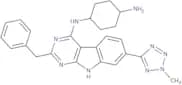
UM171
CAS :UM171 is a small-molecule compound, which is derived from synthetic chemical processes with properties that enable the expansion of human hematopoietic stem cells (HSCs) in vitro. It acts by targeting and modulating specific cellular pathways to enhance the self-renewal and proliferation of HSCs without inducing differentiation.
The primary application of UM171 lies in the field of regenerative medicine and transplantation. By facilitating the expansion of HSCs, UM171 holds significant potential in improving the outcomes of bone marrow and cord blood transplants. This is particularly relevant in contexts where donor cell availability is limited or where augmenting the engraftment potential of HSCs is critical. The ability to expand HSCs ex vivo opens avenues for improved treatment of hematological disorders, potentially allowing for more effective and accessible transplant therapies. Researchers are exploring its utility in diverse experimental setups, aiming to translate this compound's capabilities into clinical settings to enhance patient outcomes in hematopoietic recovery and therapy.Formule :C25H27N9Degré de pureté :Min. 95%Couleur et forme :PowderMasse moléculaire :453.54 g/molSLF
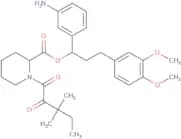
CAS :SLF-100 is an enzymatic solution, which is derived from a consortium of beneficial microorganisms. This product functions by breaking down organic matter and releasing bound nutrients within the soil, thus enhancing nutrient availability and promoting plant health. The action of SLF-100 is mediated primarily by its enzymatic components, which include cellulase, amylase, and protease, among others. These enzymes work synergistically to degrade complex organic compounds, facilitating the release of macro and micronutrients.
Formule :C30H40N2O6Degré de pureté :Min. 95%Masse moléculaire :524.6 g/mol4,5-Bis(4-methoxyphenyl)-1,3-dihydroimidazol-2-one
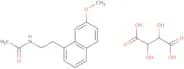
CAS :4,5-Bis(4-methoxyphenyl)-1,3-dihydroimidazol-2-one is a selective estrogen receptor modulator (SERM), which is a synthetic compound designed to bind with high affinity and selectivity to estrogen receptors. Derived from chemical synthesis, it incorporates structural elements that enable specific interactions with estrogen receptor subtypes.Formule :C17H16N2O3Degré de pureté :Min. 95%Masse moléculaire :296.32 g/molAgomelatine (L(+)-tartaric acid)
CAS :Produit contrôléAgomelatine (L(+)-tartaric acid) is a synthetic antidepressant, which is derived from chemical synthesis. It acts primarily by serving as an agonist at melatonin MT1 and MT2 receptors and as an antagonist at 5-HT2C serotonin receptors. This dual mechanism of action is particularly significant as it helps regulate sleep-wake cycles and mood by re-establishing normal circadian rhythms.
Formule :C19H23NO8Degré de pureté :Min. 95%Masse moléculaire :393.4 g/molMots-C
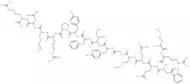
CAS :Mots-C is a mitochondrial-derived peptide, which is encoded by the small open reading frame found within the mitochondrial 12S rRNA. This peptide functions by interacting with the cellular metabolic pathways to enhance mitochondrial bioenergetics and overall cellular metabolism. Mechanistically, Mots-C modulates the folate–methionine cycle, directly impacting glucose regulation and energy utilization, and consequently facilitating cellular adaptation to metabolic stress.
Formule :C101H152N28O22S2Degré de pureté :Min. 95%Masse moléculaire :2,174.6 g/molp-((4-((1-Oxotetradecyl)amino)phenyl)methyl)-phosphonic acid
CAS :P-((4-((1-Oxotetradecyl)amino)phenyl)methyl)-phosphonic acid is a synthetic compound, which is a specialized reagent used primarily in chemical research. It is derived from the modification of phosphonic acid with an aryl amide and a long-chain fatty acid substituent on the phenyl group. This structural configuration imparts the compound with unique physicochemical properties that make it suitable for various scientific studies.
Formule :C21H36NO4PDegré de pureté :Min. 95%Masse moléculaire :397.5 g/molD-Threonic acid lithium salt
CAS :D-Threonic acid lithium salt is a cell signaling molecule that belongs to the class of ligands. It has been used as a research tool in pharmacology and protein interaction studies. D-Threonic acid lithium salt can activate ion channels, which are cellular membrane proteins that allow ions to flow in or out of cells. D-Threonic acid lithium salt also interacts with receptors, which are proteins on the surface of cells that receive chemical signals from outside the cells. Receptors can be either agonists or antagonists. D-Threonic acid lithium salt is a ligand for receptor tyrosine kinase, which is involved in cell growth and differentiation.
Formule :C4H8O5·LiDegré de pureté :Min. 95%Ozagrel HCl - Bio-X ™
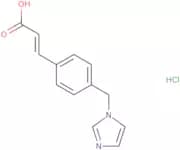
CAS :Ozagrel is an antiplatelet agent that is also a thromboxane A2 synthetase inhibitor. It is used for the treatment of bronchial asthma and cerebral ischemia. It blocks platelet aggregation and reduces hypersensitivity of bronchial muscles.Formule :C13H12N2O2·HClDegré de pureté :Min. 95%Couleur et forme :PowderMasse moléculaire :264.71 g/mol(4bS,8aS,9S,10S)-10-(Acetyloxy)-3,9-bis(benzoyloxy)-4b,5,6,7,8,8a,9,10-octahydro-4b,8,8-trimethyl-2-(1-methylethyl)-1,4-phenanthrene dione
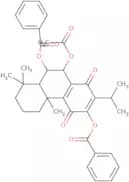
CAS :(4bS,8aS,9S,10S)-10-(Acetyloxy)-3,9-bis(benzoyloxy)-4b,5,6,7,8,8a,9,10-octahydro-4b,8,8-trimethyl-2-(1-methylethyl)-1,4-phenanthrene dione is a potent chemokine molecule that is an agonist of the CXCR2 receptor. It has been shown to inhibit cancer stem cells and chemoattractant production in colon carcinoma cells. This compound selectively targets the translation of lamiaceae mRNA and induces apoptosis in colon carcinoma cells.
Formule :C36H38O8Degré de pureté :Min. 95%Masse moléculaire :598.7 g/mol