Composés organosiliciés
Dans cette section, vous trouverez un grand nombre de composés organosiliciés. Les composés organosiliciés sont caractérisés par des atomes de carbone liés à des atomes de silicium. D'autres composés non métalliques peuvent également être présents. Ces composés sont largement utilisés en synthèse organique, en science des matériaux et en pharmaceutique en raison de leurs propriétés chimiques uniques. Chez CymitQuimica, nous offrons une large gamme de composés organosiliciés de haute qualité pour soutenir vos recherches et projets industriels.
Sous-catégories appartenant à la catégorie "Composés organosiliciés"
4325 produits trouvés pour "Composés organosiliciés"
Trier par
Degré de pureté (%)
0
100
|
0
|
50
|
90
|
95
|
100
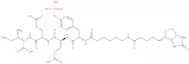
Biotinyl-ε-aminocaproyl-Tyr(PO3H2)-Glu-Glu-Ile-OH
CAS :<p>Please enquire for more information about Biotinyl-epsilon-aminocaproyl-Tyr(PO3H2)-Glu-Glu-Ile-OH including the price, delivery time and more detailed product information at the technical inquiry form on this page</p>Formule :C41H62N7O16PSDegré de pureté :Min. 95%Masse moléculaire :972.01 g/molMethylboronic acid pinacol ester
CAS :<p>Methylboronic acid pinacol ester is an orally administered compound that inhibits the activity of peptidases and imidazole derivatives. It is used as a medicinal preparation for the treatment of cancer and other diseases. Methylboronic acid pinacol ester has been shown to inhibit the growth of bacteria, including Gram-positive bacteria such as methicillin-resistant Staphylococcus aureus (MRSA) and Clostridium perfringens. This compound also has an inhibitory effect on hydroxyl group metabolism, which may be related to its anti-inflammatory properties.</p>Formule :C7H15BO2Degré de pureté :Min. 95%Couleur et forme :Colourless liquid.Masse moléculaire :142 g/mol2,2,2-Trifluoro-1-(3-Trimethylsilylphenyl)Ethanone
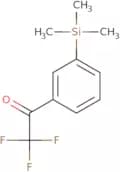
CAS :<p>2,2,2-Trifluoro-1-(3-trimethylsilylphenyl)ethanone is a chemical that can be used as an acetylcholinesterase inhibitor. This agent is designed to inhibit the enzyme that breaks down acetylcholine, which is responsible for transmitting nerve impulses and controlling muscle contractions. The activity of 2,2,2-Trifluoro-1-(3-trimethylsilylphenyl)ethanone is reversible by hydrolysis and it has a low bioavailability due to its high lipophilicity. Acetylcholinesterase inhibitors are mainly used for the treatment of inflammatory diseases such as rheumatoid arthritis. br> The pharmacodynamics of 2,2,2-Trifluoro-1-(3-trimethylsilylphenyl)ethanone are not well understood. This drug also has side effect profiles</p>Formule :C11H13F3OSiDegré de pureté :Min. 95%Masse moléculaire :246.3 g/mol4-Mercaptophenylboronic acid
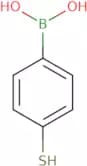
CAS :<p>4-Mercaptophenylboronicacid is a boronic acid that has been used to synthesize gold nanoparticles with antimicrobial properties. Boronic acids are able to form hydrogen bonds with biological molecules such as proteins and DNA, which allows them to be used for immobilization of biomolecules. This compound is also used as a reagent for the synthesis of disulfide bonds in proteins and peptides. 4-Mercaptophenylboronicacid can be used to prepare samples for electrochemical impedance spectroscopy (EIS) and colorimetric analysis.</p>Formule :C6H7BO2SDegré de pureté :Min. 95%Masse moléculaire :154 g/mol2-Methylpyridine-4-boronic acid
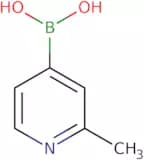
CAS :<p>2-Methylpyridine-4-boronic acid is a reactive molecule that has been used in post-column derivatization and vivo studies. It has been shown to be reactive with mass spectrometric analysis, cancer assays, proteomics, and tumorigenic sample preparation. It also has been shown to have a molecular target of the cytochrome P450 reductase (CPR), which is involved in the metabolism of drugs and other xenobiotics. 2-Methylpyridine-4-boronic acid binds to CPR and inhibits its enzymatic activity, thereby affecting the metabolism of xenobiotics.</p>Formule :C6H8BNO2Degré de pureté :Min. 95%Couleur et forme :White PowderMasse moléculaire :136.94 g/mol(2-Chlorophenyl)boronic acid
CAS :<p>2-Chlorophenylboronic acid is a diphenyl ether that can be used as a building block for the synthesis of benzodiazepine receptor ligands. It has been shown to be an efficient nucleophile, leading to the formation of carbonyl groups in the presence of halides. 2-Chlorophenylboronic acid has also been shown to inhibit p38 kinase activity and may be useful for anticancer therapy.</p>Formule :C6H6BClO2Degré de pureté :Min. 95%Masse moléculaire :156.37 g/mol(4-(Methoxycarbonyl)-3-Methylphenyl)boronic acid
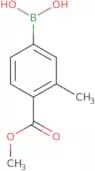
CAS :<p>Please enquire for more information about (4-(Methoxycarbonyl)-3-Methylphenyl)boronic acid including the price, delivery time and more detailed product information at the technical inquiry form on this page</p>Formule :C9H11BO4Degré de pureté :Min. 95%Masse moléculaire :193.99 g/mol3-Pyridineboronic acid
CAS :<p>3-Pyridineboronic acid is an antimicrobial agent that is used to treat bacterial and fungal infections. 3-Pyridineboronic acid is a prodrug that is metabolized to its active form, pyridinium boronate. This drug has been shown to be effective in the treatment of hypoxic tumors in mice, which are resistant to other anticancer drugs. 3-Pyridineboronic acid also has acidic properties and can be used as an antiseptic for the treatment of skin and eye infections. It can also be used as a hydrogen bonding partner when combined with halides, such as chloride or bromide ions. The drug binds to human serum proteins and forms an acidic complex that prevents bacterial growth by inhibiting protein synthesis. 3-Pyridineboronic acid also inhibits prostate cancer cells by competitively inhibiting the enzyme 4-pyridinylboronic acid reductase (4PBAR).</p>Formule :C5H6BNO2Degré de pureté :Min. 95%Masse moléculaire :122.92 g/molH-Arg-ε-aminocaproyl-Arg-ε-aminocaproyl-Arg-ε-aminocaproyl-Arg-ε-aminocaproyl-Arg-ε-aminocaproyl-Arg-e psilon-aminocaproyl-Arg-OH trifluoroacetate salt
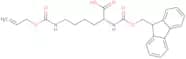
CAS :<p>Please enquire for more information about H-Arg-epsilon-aminocaproyl-Arg-epsilon-aminocaproyl-Arg-epsilon-aminocaproyl-Arg-epsilon-aminocaproyl-Arg-epsilon-aminocaproyl-Arg-e psilon-aminocaproyl-Arg-OH trifluoroacetate salt including the price, delivery time and more detailed product information at the technical inquiry form on this page</p>Formule :C78H152N34O14Degré de pureté :Min. 95%Masse moléculaire :1,790.26 g/molN-α-Fmoc-Nε-allyloxycarbonyl-D-lysine
CAS :<p>N-alpha-Fmoc-Nepsilon-allyloxycarbonyl-D-lysine is a medicament that is modified with an amino group at the alpha position. It is synthesized by modification of the chain with a ganirelix acetate. N-alpha-Fmoc-Nepsilon-allyloxycarbonyl-D-lysine can be used to produce ganirelix, which inhibits the release of follicle stimulating hormone (FSH). The chemical synthesis of this drug has been shown to be successful in large scale production, and it has been shown to be effective in treating patients with prostate cancer. Impurities in this drug have been found and treated by removing the methyl ester group from the lysine residue.</p>Formule :C25H28N2O6Degré de pureté :Min. 95%Masse moléculaire :452.5 g/mol4-Hydroxyphenylboronic acid
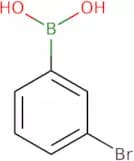
CAS :<p>4-Hydroxyphenylboronic acid is a potential anticancer agent that has been studied in vitro and in vivo. It has been shown to inhibit the activity of p-glycoprotein, which is a protein that pumps drugs out of cells, and it is also an inhibitor of lipid kinase. 4-Hydroxyphenylboronic acid binds to the ATP binding site of the enzyme and forms covalent bonds with Lys residues on the enzyme, inhibiting its function. The compound can be detected at low concentrations using fluorescence or chemiluminescence techniques. This compound may have therapeutic benefits for antimicrobial agents as well as for cancer treatment.</p>Formule :C6H7BO3Degré de pureté :Min. 95%Couleur et forme :White PowderMasse moléculaire :137.93 g/mol3-Bromophenyl boronic acid
CAS :<p>3-Bromophenyl boronic acid is a group P2 molecule with functional groups of vibrational and cross-coupling. It has been shown to inhibit the activity of aryl boronic acids, which are commonly used in analytical methods. 3-Bromophenyl boronic acid is also capable of inhibiting the production of alizarin, which is a dye that is used for staining biological tissue. The molecular modeling study revealed that this molecule has an atomic orbital with electron density distribution around the central carbon atom. This distribution indicates that it is more stable than other molecules with similar structures.</p>Formule :C6H6BBrO2Degré de pureté :Min. 95%Couleur et forme :PowderMasse moléculaire :200.83 g/mol(Chlorodifluoromethyl)trimethylsilane
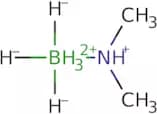
CAS :<p>(Chlorodifluoromethyl)trimethylsilane is a chlorinating agent that is used for the transfer of chlorine to organic compounds. The activated chlorides are converted to aldehydes, which are then reacted with terminal alkynes in the presence of sodium carbonate to produce (chlorodifluoromethyl)trimethylsilanes. This reaction produces an organosilicon compound that has been shown to inhibit certain enzymes, such as lipases and proteases. Chlorodifluoromethyl)trimethylsilane also has bioisosteres, or structural analogs, with other halogens. It can be prepared by irradiation of chlorodichloromethane at room temperature in the presence of a catalyst.</p>Formule :C4H9ClF2SiDegré de pureté :Min. 95%Couleur et forme :Colorless PowderMasse moléculaire :158.65 g/molBorane dimethylamine complex
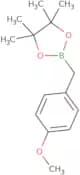
CAS :<p>Please enquire for more information about Borane dimethylamine complex including the price, delivery time and more detailed product information at the technical inquiry form on this page</p>Formule :C2H10BNDegré de pureté :Min. 95%Couleur et forme :White Clear LiquidMasse moléculaire :58.92 g/mol4-Methoxybenzylboronic acid pinacolester
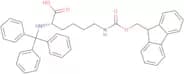
CAS :<p>Please enquire for more information about 4-Methoxybenzylboronic acid pinacolester including the price, delivery time and more detailed product information at the technical inquiry form on this page</p>Formule :C14H21BO3Degré de pureté :Min. 95%Masse moléculaire :248.13 g/molN-α-Trityl-Nε-Fmoc-L-lysine
CAS :<p>N-alpha-Trityl-Nepsilon-Fmoc-L-lysine is a pentapeptide that is used in peptides. It has been shown to have cytotoxicity and permeability, as well as being biologically active. N-alpha-Trityl-Nepsilon-Fmoc-L-lysine has also been used in solid phase synthesis of peptides. This pentapeptide can be synthesized using the Miyaura cross coupling reaction with an ether or Suzuki cross coupling reaction. N-alpha-Trityl-Nepsilon-Fmoc-L-lysine is a bicyclic molecule that can be synthesized on a solid phase.</p>Formule :C40H38N2O4Degré de pureté :Min. 95%Masse moléculaire :610.74 g/mol[2-fluoro-4-(trifluoromethyl)phenyl]boronic Acid
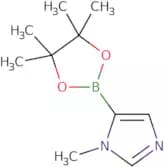
CAS :<p>2-Fluoro-4-(trifluoromethyl)phenylboronic acid is a boron compound that can be used to synthesize a variety of target products. 2-Fluoro-4-(trifluoromethyl)phenylboronic acid occurs in the form of an oil and is an impurity in the target product, phenylboronic acid. This impurity can be removed by reacting with lithium benzotrifluoride. Lithiated 2-fluoro-4-(trifluoromethyl)phenylboronic acid is then reacted with phenylboronic acid to give lithiated phenylboronic ester in high yield. The lithiation reaction can be carried out under alkaline conditions or under a condition where the reactants are dissolved in water.</p>Formule :C7H5BF4O2Degré de pureté :Min. 95%Masse moléculaire :207.92 g/mol1-Methyl-1H-imidazole-5-boronic acid pinacol ester
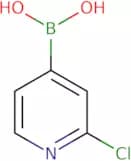
CAS :<p>Please enquire for more information about 1-Methyl-1H-imidazole-5-boronic acid pinacol ester including the price, delivery time and more detailed product information at the technical inquiry form on this page</p>Formule :C10H17BN2O2Degré de pureté :Min. 95%Masse moléculaire :208.07 g/mol2-Chloropyridine-4-boronic acid
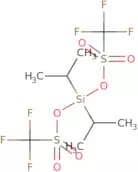
CAS :<p>2-Chloropyridine-4-boronic acid is a nicotinic acetylcholine receptor antagonist that has been shown to be effective against trypanosomiasis. It blocks the binding of acetylcholine to its receptor, which prevents the propagation of an action potential in the postsynaptic cell. 2-Chloropyridine-4-boronic acid inhibits the enzymes cyclooxygenase and prostaglandin synthase, which are involved in inflammation. 2-Chloropyridine-4-boronic acid is potent and selective for nicotinic acetylcholine receptors, but it also binds to other sites on the enzyme. The molecular modeling studies have shown that this compound has a pharmacophore that can be used as a guide for drug design.</p>Formule :C5H5BClNO2Degré de pureté :Min. 95%Masse moléculaire :157.36 g/molDiisopropylsilyl Bis(Trifluoromethanesulfonate)
CAS :<p>Diisopropylsilyl bis(trifluoromethanesulfonate) is a bifunctional reagent that can be used to prepare the trifluoromethanesulfonic acid. It reacts with an alcohol in the presence of base to generate an ester, and then hydrolyzes the ester in the presence of water to generate the desired acid. Diisopropylsilyl bis(trifluoromethanesulfonate) is pale yellow and soluble in argon, nitrogen, and solvents such as ethyl acetate.</p>Formule :C8H14F6O6S2SiDegré de pureté :Min. 95%Masse moléculaire :412.4 g/mol







![[2-fluoro-4-(trifluoromethyl)phenyl]boronic Acid](/_next/image/?url=https%3A%2Fstatic.cymitquimica.com%2Fproducts%2F3D%2Fthumb-webp%2FFF105416.webp&w=3840&q=75)