Composés organosiliciés
Dans cette section, vous trouverez un grand nombre de composés organosiliciés. Les composés organosiliciés sont caractérisés par des atomes de carbone liés à des atomes de silicium. D'autres composés non métalliques peuvent également être présents. Ces composés sont largement utilisés en synthèse organique, en science des matériaux et en pharmaceutique en raison de leurs propriétés chimiques uniques. Chez CymitQuimica, nous offrons une large gamme de composés organosiliciés de haute qualité pour soutenir vos recherches et projets industriels.
Sous-catégories appartenant à la catégorie "Composés organosiliciés"
4325 produits trouvés pour "Composés organosiliciés"
Trier par
Degré de pureté (%)
0
100
|
0
|
50
|
90
|
95
|
100
H-Arg-ε-aminocaproyl-Arg-ε-aminocaproyl-Arg-ε-aminocaproyl-Arg-ε-aminocaproyl-Arg-ε-aminocaproyl-Arg-e psilon-aminocaproyl-Arg-OH trifluoroacetate salt
CAS :<p>Please enquire for more information about H-Arg-epsilon-aminocaproyl-Arg-epsilon-aminocaproyl-Arg-epsilon-aminocaproyl-Arg-epsilon-aminocaproyl-Arg-epsilon-aminocaproyl-Arg-e psilon-aminocaproyl-Arg-OH trifluoroacetate salt including the price, delivery time and more detailed product information at the technical inquiry form on this page</p>Formule :C78H152N34O14Degré de pureté :Min. 95%Masse moléculaire :1,790.26 g/molN-(2-Aminoethyl)-3-(trimethoxysilyl)propylamine
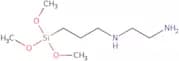
CAS :<p>N-(2-Aminoethyl)-3-(trimethoxysilyl)propylamine (NAP) is a cationic surfactant that is used as a fluorescent probe to study the binding of proteins to cell surface integrin receptors. The adsorption mechanism is based on the interaction between the hydrophobic parts of the protein and the hydrophobic parts of NAP. This interaction leads to an increase in the concentration of NAP at the interface and thus an increase in fluorescence. NAP has been shown to bind human serum albumin, fatty acids, and monoclonal antibodies with high affinity. It also has been shown to bind to plasma proteins through hydrogen bonding. The optimum concentration for NAP adsorption is 1mM.</p>Formule :C8H22N2O3SiDegré de pureté :Min. 95%Masse moléculaire :222.36 g/molBenzopyrazine-6-boronic acidHCl
CAS :<p>Please enquire for more information about Benzopyrazine-6-boronic acidHCl including the price, delivery time and more detailed product information at the technical inquiry form on this page</p>Formule :C8H8BClN2O2Degré de pureté :Min. 95%Masse moléculaire :210.43 g/molHexamethylcyclotrisiloxane
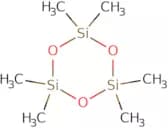
CAS :<p>Used for preparation of graft and block polymers</p>Formule :C6H18O3Si3Degré de pureté :Min. 98%Couleur et forme :White PowderMasse moléculaire :222.46 g/mol(R)-(+)-2-Methyl-CBS-oxazaborolidine
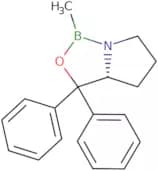
CAS :<p>(R)-(+)-2-Methyl-CBS-oxazaborolidine is a dpp-iv inhibitor that is a β-unsaturated ketone. It has been shown to inhibit the enzyme histone lysine demethylase, which may be involved in the regulation of bone mass. This compound also has a pharmacokinetic profile that is characterized by high oral bioavailability, low plasma protein binding, and rapid metabolism by liver enzymes. The reaction mechanism for this compound is based on the formation of an enolate carbanion. (R)-(+)-2-Methyl-CBS-oxazaborolidine can be synthesized with high stereoselectivity and yields from reactions with simple starting materials. This synthetic route also has a number of advantages over other methods: it does not require any protecting groups, it does not use toxic solvents such as dichloromethane or chloroform, and it can be performed in anhydrous conditions</p>Formule :C18H20BNODegré de pureté :Min. 95%Couleur et forme :SolidMasse moléculaire :277.17 g/molTetrakis(4-Fluorophenyl)-Borate Sodium (1:1)
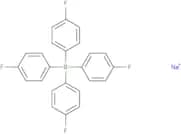
CAS :<p>Tetrakis(4-fluorophenyl)borate sodium (1:1) is a solid that is soluble in organic solvents. It has been used as an adsorbent for nuclear waste and organic molecules. Tetrakis(4-fluorophenyl)borate sodium (1:1) has been shown to adsorb hydrophobic molecules such as polycyclic aromatic hydrocarbons, which are difficult to remove from the environment. Tetrakis(4-fluorophenyl)borate sodium (1:1) can be prepared by reacting tetraphenylborate with 4-fluoroboric acid. This reaction produces a mixture of products, of which tetrakis(4-fluorophenyl)borate sodium (1:1) is the most common. Tetrakis(4-fluorophenyl)borate sodium (1:1), like other borate salts, is used in zeolites to</p>Formule :C24H16BF4NaDegré de pureté :Min. 95%Masse moléculaire :414.18 g/mol3-Pyridylboronic acid pinacol ester
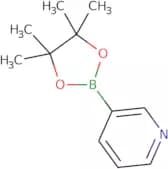
CAS :<p>3-Pyridylboronic acid pinacol ester is a versatile reagent that can be used in the synthesis of polymers with reactive functionalities. This compound is a crosslinker, which means that it reacts with two or more other molecules to form a covalent bond. 3-Pyridylboronic acid pinacol ester has been shown to react with ring-opening methacrylate monomers and expand their polymer backbone, which leads to an increase in the number of reactive groups on the chain. The introduction of 3-pyridylboronic acid pinacol ester can also introduce fluorescent units into polymers for use as probes for biological systems. There are many possible applications for this versatile reagent, including its use in the synthesis of imidazopyridine ligands.</p>Formule :C11H16BNO2Degré de pureté :Min. 95%Couleur et forme :PowderMasse moléculaire :205.06 g/molFITC-epsilonAhx-Antennapedia Homeobox (43-58) amide trifluoroacetate salt
CAS :<p>Please enquire for more information about FITC-epsilonAhx-Antennapedia Homeobox (43-58) amide trifluoroacetate salt including the price, delivery time and more detailed product information at the technical inquiry form on this page</p>Formule :C131H191N37O25S2Degré de pureté :Min. 95%Masse moléculaire :2,748.28 g/mol3-Pyridineboronic acid
CAS :<p>3-Pyridineboronic acid is an antimicrobial agent that is used to treat bacterial and fungal infections. 3-Pyridineboronic acid is a prodrug that is metabolized to its active form, pyridinium boronate. This drug has been shown to be effective in the treatment of hypoxic tumors in mice, which are resistant to other anticancer drugs. 3-Pyridineboronic acid also has acidic properties and can be used as an antiseptic for the treatment of skin and eye infections. It can also be used as a hydrogen bonding partner when combined with halides, such as chloride or bromide ions. The drug binds to human serum proteins and forms an acidic complex that prevents bacterial growth by inhibiting protein synthesis. 3-Pyridineboronic acid also inhibits prostate cancer cells by competitively inhibiting the enzyme 4-pyridinylboronic acid reductase (4PBAR).</p>Formule :C5H6BNO2Degré de pureté :Min. 95%Masse moléculaire :122.92 g/mol3-Cyano-2-methylphenylboronic acid
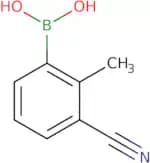
CAS :<p>3-Cyano-2-methylphenylboronic acid is a high quality compound that can be used as a reagent, intermediate, or building block in the synthesis of complex compounds. This chemical is also useful as a speciality chemical and research chemical. 3-Cyano-2-methylphenylboronic acid has versatile uses in organic synthesis due to its versatility in reactions and building blocks.</p>Formule :C8H8BNO2Degré de pureté :Min. 95%Couleur et forme :PowderMasse moléculaire :160.97 g/mol4-Methoxybenzylboronic acid pinacolester
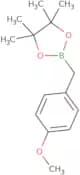
CAS :<p>Please enquire for more information about 4-Methoxybenzylboronic acid pinacolester including the price, delivery time and more detailed product information at the technical inquiry form on this page</p>Formule :C14H21BO3Degré de pureté :Min. 95%Masse moléculaire :248.13 g/molN-α-Trityl-Nε-Fmoc-L-lysine
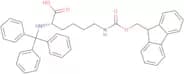
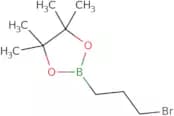
CAS :<p>N-alpha-Trityl-Nepsilon-Fmoc-L-lysine is a pentapeptide that is used in peptides. It has been shown to have cytotoxicity and permeability, as well as being biologically active. N-alpha-Trityl-Nepsilon-Fmoc-L-lysine has also been used in solid phase synthesis of peptides. This pentapeptide can be synthesized using the Miyaura cross coupling reaction with an ether or Suzuki cross coupling reaction. N-alpha-Trityl-Nepsilon-Fmoc-L-lysine is a bicyclic molecule that can be synthesized on a solid phase.</p>Formule :C40H38N2O4Degré de pureté :Min. 95%Masse moléculaire :610.74 g/mol3-Bromopropylboronic acid pinacol ester
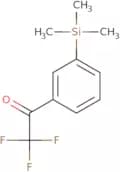
CAS :<p>Please enquire for more information about 3-Bromopropylboronic acid pinacol ester including the price, delivery time and more detailed product information at the technical inquiry form on this page</p>Formule :C9H18BBrO2Degré de pureté :Min. 95%Masse moléculaire :248.95 g/mol2,2,2-Trifluoro-1-(3-Trimethylsilylphenyl)Ethanone
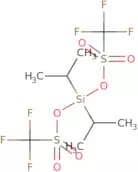
CAS :<p>2,2,2-Trifluoro-1-(3-trimethylsilylphenyl)ethanone is a chemical that can be used as an acetylcholinesterase inhibitor. This agent is designed to inhibit the enzyme that breaks down acetylcholine, which is responsible for transmitting nerve impulses and controlling muscle contractions. The activity of 2,2,2-Trifluoro-1-(3-trimethylsilylphenyl)ethanone is reversible by hydrolysis and it has a low bioavailability due to its high lipophilicity. Acetylcholinesterase inhibitors are mainly used for the treatment of inflammatory diseases such as rheumatoid arthritis. br> The pharmacodynamics of 2,2,2-Trifluoro-1-(3-trimethylsilylphenyl)ethanone are not well understood. This drug also has side effect profiles</p>Formule :C11H13F3OSiDegré de pureté :Min. 95%Masse moléculaire :246.3 g/molDiisopropylsilyl Bis(Trifluoromethanesulfonate)
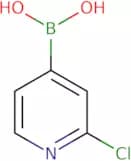
CAS :<p>Diisopropylsilyl bis(trifluoromethanesulfonate) is a bifunctional reagent that can be used to prepare the trifluoromethanesulfonic acid. It reacts with an alcohol in the presence of base to generate an ester, and then hydrolyzes the ester in the presence of water to generate the desired acid. Diisopropylsilyl bis(trifluoromethanesulfonate) is pale yellow and soluble in argon, nitrogen, and solvents such as ethyl acetate.</p>Formule :C8H14F6O6S2SiDegré de pureté :Min. 95%Masse moléculaire :412.4 g/mol2-Chloropyridine-4-boronic acid
CAS :<p>2-Chloropyridine-4-boronic acid is a nicotinic acetylcholine receptor antagonist that has been shown to be effective against trypanosomiasis. It blocks the binding of acetylcholine to its receptor, which prevents the propagation of an action potential in the postsynaptic cell. 2-Chloropyridine-4-boronic acid inhibits the enzymes cyclooxygenase and prostaglandin synthase, which are involved in inflammation. 2-Chloropyridine-4-boronic acid is potent and selective for nicotinic acetylcholine receptors, but it also binds to other sites on the enzyme. The molecular modeling studies have shown that this compound has a pharmacophore that can be used as a guide for drug design.</p>Formule :C5H5BClNO2Degré de pureté :Min. 95%Masse moléculaire :157.36 g/molCyclopenten-1-ylboronic acid
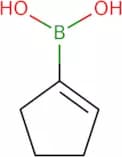
CAS :<p>Cyclopenten-1-ylboronic acid is a chemical compound that is used in the synthesis of pharmaceuticals. It has been shown to be effective against some viruses, including Hepatitis C virus, and also against some infectious diseases such as malaria. Cyclopenten-1-ylboronic acid binds to cannabinoid receptors and may have therapeutic potential for metabolic disorders such as obesity and diabetes. The diastereomer of this chemical compound may be used as an ophthalmic drug because it has been shown to be a potent vasoconstrictor. The ring structure is similar to other drugs that are used for the treatment of Parkinson's disease, Alzheimer's disease, and epilepsy. Cyclopenten-1-ylboronic acid has two enantiomers, which means that they are mirror images of each other. One enantiomer is more potent than the other one and is more likely to bind with cannabinoid receptors and inhibit viral replication.</p>Formule :C5H9BO2Degré de pureté :Min. 95%Masse moléculaire :111.93 g/molBiotinyl-ε-aminocaproyl-Tyr(PO3H2)-Glu-Glu-Ile-OH
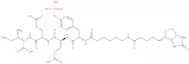
CAS :<p>Please enquire for more information about Biotinyl-epsilon-aminocaproyl-Tyr(PO3H2)-Glu-Glu-Ile-OH including the price, delivery time and more detailed product information at the technical inquiry form on this page</p>Formule :C41H62N7O16PSDegré de pureté :Min. 95%Masse moléculaire :972.01 g/molLatanoprost tris(triethylsilyl) ether
CAS :<p>Please enquire for more information about Latanoprost tris(triethylsilyl) ether including the price, delivery time and more detailed product information at the technical inquiry form on this page</p>Formule :C44H82O5Si3Degré de pureté :Min. 95%Masse moléculaire :775.38 g/mol(2-Chlorophenyl)boronic acid
CAS :<p>2-Chlorophenylboronic acid is a diphenyl ether that can be used as a building block for the synthesis of benzodiazepine receptor ligands. It has been shown to be an efficient nucleophile, leading to the formation of carbonyl groups in the presence of halides. 2-Chlorophenylboronic acid has also been shown to inhibit p38 kinase activity and may be useful for anticancer therapy.</p>Formule :C6H6BClO2Degré de pureté :Min. 95%Masse moléculaire :156.37 g/mol