Composés deutérés
4238 produits trouvés pour "Composés deutérés"
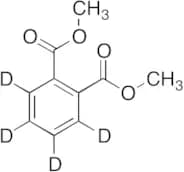
Dimethyl phthalate-3,4,5,6-d4
CAS :Produit contrôléApplications Dimethyl phthalate-3,4,5,6-d4
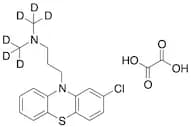
Formule :C102H4H6O4Couleur et forme :YellowMasse moléculaire :198.21Chlorpromazine-d6 Oxalate (N,N-dimethyl-d6)
CAS :Produit contrôléApplications Chlorpromazine-d6 Oxalate (N,N-dimethyl-d6) (CAS# 1276197-23-9) is a useful isotopically labeled research compound.
Formule :C17D6H13ClN2S·C2H2O4Couleur et forme :Off-WhiteMasse moléculaire :414.93Bromoacetic-2-13C Acid
CAS :Produit contrôléApplications Bromoacetic-2-13C Acid is the isotope labelled analog of Bromoacetic Acid (B679075); a relatively strong alkylating agent as well as a versatile building block used very commonly in organic synthesis. Bromoacetic acid has been shown to reversibly inhibit human erythrocyte carbonic anhydrase B.
Not a dangerous good if item is equal to or less than 1g/ml and there is less than 100g/ml in the package
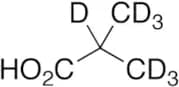
References Song, C. et al.: J. Org. Synth., 74, 8980 (2009); Kramer, S.P. et al.: J. Nat. Cancer Inst., 31, 297 (1963); Whitney, P.L. et al.: Eur. J. Biochem., 16, 126 (1970)Formule :C13CH3BrO2Couleur et forme :NeatMasse moléculaire :139.94Isobutyric-d7 Acid
CAS :Produit contrôléApplications Isotope labelled analogue of Isobutyric Acid, a carboxylic acid found in vanilla. Isobutryic Acid was used as an intermediate in the synthesis of novel inhibitors of signal transducer and activators of transcription 3 signaling pathway.
Not a dangerous good if item is equal to or less than 1g/ml and there is less than 100g/ml in the package
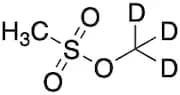
References Zhang, M.M., et al.: Euro. J. Med. Chem., 62, 301 (2013);Formule :C42H7HO2Couleur et forme :NeatMasse moléculaire :95.15Methyl-d3 Methanesulfonate
CAS :Produit contrôléApplications Methyl-d3 Methanesulfonate (CAS# 91419-94-2) is a useful isotopically labeled research compound.
Formule :C2D3H3O3SCouleur et forme :NeatMasse moléculaire :113.151Mecoprop-d3
CAS :Produit contrôléApplications Labelled Mecoprop (M203052). Herbicide.
Not a dangerous good if item is equal to or less than 1g/ml and there is less than 100g/ml in the package
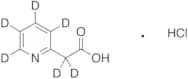
References Gagne, F., et al.: Environ. Res., 103, 238 (2007), LaChapelle, A., et al.: Reprod. Toxicol., 23, 20 (2007),Formule :C102H3H8ClO3Couleur et forme :NeatMasse moléculaire :217.662-Pyridylacetic Acid-d6 Hydrochloride (d5 Major)
CAS :Produit contrôléStability Unstable in Solution, Hygroscopic
Applications Used in nucleophilic substitution.
References Genicot, C., et al.: Bioorg. Med. Chem. Lett., 13, 437 (2003),Formule :C72H6HNO2·ClHCouleur et forme :NeatMasse moléculaire :179.63Ethylbenzene-13C6
CAS :Produit contrôléApplications Ethylbenzene-13C6 is the labeled form of Ethylbenzene (E899745), which is used in the industrial production of stryrene trough various organic processes.
References Weiss, W. et al.: Prog. Surf. Sci., 70, 1 (2002); Cavani, F. et al.: App. Catal. A., 133, 219 (1995);Formule :C6C2H10Couleur et forme :NeatMasse moléculaire :112.121Cyclopentanone-2,2,5,5-d4
CAS :Produit contrôléApplications Cyclopentanone-2,2,5,5-d4 (CAS# 3997-89-5) is a useful isotopically labeled research compound.
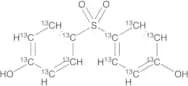
Formule :C5H4D4OCouleur et forme :NeatMasse moléculaire :88.14Bis(4-hydroxyphenyl) Sulfone -13C12
CAS :Produit contrôléApplications Bis(4-hydroxyphenyl) Sulfone is commonly used as a reactant in epoxy reactions and is also used as a latent thermal catalyst for epoxy resin.
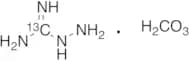
References Fu, J.W., et al.: Adv. Mat. Rsch., 266, 1022 (2011); Li, J.X., et al.: Polymers. Adv. Tech., 23, 803 (2012);Formule :C12H10O4SCouleur et forme :White To Light PinkMasse moléculaire :262.18Aminoguanidine-13C Bicarbonate
CAS :Produit contrôléApplications Aminoguanidine-13C Bicarbonate is a compound useful in organic synthesis.
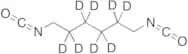
Formule :CCH8N4O3Couleur et forme :NeatMasse moléculaire :137.11,6-Diisocyanatohexane-d8
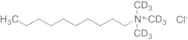
CAS :Produit contrôléFormule :C8D8H4N2O2Couleur et forme :NeatMasse moléculaire :176.242n-Decyltrimethylammonium-d9 Chloride
CAS :Produit contrôléApplications n-Decyltrimethylammonium Chloride is an isotope labelled quaternary ammonium salt used to study ionic interactions of detergents with lipid membranes.
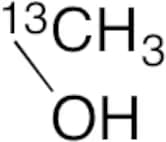
References Beck, A., et al.: J. Phy. Chem., 48, 15862 (2010);Formule :C13H21D9ClNCouleur et forme :NeatMasse moléculaire :244.89Methanol-13C
CAS :Produit contrôléStability Volatile
Applications Assignments of far-IR (FIR) laser lines have been found for optically pumped Methanol-13C.
Not a dangerous good if item is equal to or less than 1g/ml and there is less than 100g/ml in the package
References Moraes, J.C.S., et. al.: J. Mol. Spec., 177, 302 (1996)Formule :CH4OCouleur et forme :NeatMasse moléculaire :33.03Diquat-d4 Dibromide
CAS :Produit contrôléApplications Contact herbicide used also to produce desiccation and defoliation.
Not a dangerous good if item is equal to or less than 1g/ml and there is less than 100g/ml in the package
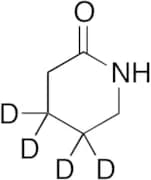
References Brian, et al.: Nature, 181, 446 (1958), Gaines, T.B., et al.: Fundam. Appl. Toxicol., 7, 299 (1986),Formule :C12D4H8N2·2BrCouleur et forme :Beige To GreyMasse moléculaire :348.07δ-Valerolactam-d4
CAS :Produit contrôléApplications δ-Valerolactam-d4 is a labeled analog of δ-Valerolactam (V091440), which is a useful synthetic intermediate. It is an intermediate used to synthesize Cenicriviroc (C256550), an experimental drug candidate for the treatment of HIV infection. It is also a starting material for a new route to hexahydrojulolidines, using intramolecular 1,4-cycloaddition.
References Potts, K., et al. J. Org. Chem., 58, 5040 (1993); Klibanov, O., et al.: Curr. Opinion Invest. Drugs, 11, 940 (2010);Formule :C5H5D4NOCouleur et forme :NeatMasse moléculaire :103.16Omethoate-d3
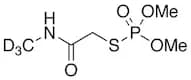
CAS :Produit contrôléApplications Labelled insecticidal, acaricidal, and fungicidal combinations of carboxamides and other pesticides.
Not a dangerous good if item is equal to or less than 1g/ml and there is less than 100g/ml in the package
References Dugo, G., et al.: Food Chem., 16, 435 (2005), Caldas, E., et al.: Toxicology, 222, 132 (2006), Cabras, P., et al.: J. Agric. Food Chem., 45, 2244 (1997), Wilkinson, C., et al.: Regul. Toxicol. Pharmacol., 31, 30 (2000),Formule :C5H9D3NO4PSCouleur et forme :Yellowish OilyMasse moléculaire :216.21Bis(2-butoxyethyl) 2-Hydroxyethyl-d4 Phosphate Triester
CAS :Produit contrôléApplications Bis(2-butoxyethyl) 2-Hydroxyethyl-d4 Phosphate Triester is a labeled form of Bis(2-butoxyethyl) 2-Hydroxyethyl Phosphate Triester (B415190), which is a metabolite of Tris(2-butyloxyethyl)phosphate (T875030), an organophosphate, that is used in the preparation of flame retardant, such as viscose fiber.
References Wang, Y., et al.: Fangzhi Xuebao, 33, 16 (2012); Xiaoshan, L. et al.: Aquatic Toxicology, 114, 173 (2012);Formule :C14D4H27O7PCouleur et forme :Colourless OilyMasse moléculaire :346.392,3-Butanedione-d6
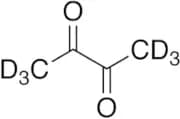
CAS :Produit contrôléApplications Labelled 2,3-Butanedione (B690030). 2,3-Butanedione (Diacetyl), the molecule implicated in the disease known as popcorn lung, has now been implicated in amyloid-β peptide toxicity associated with Alzheimer’s disease. Diacetyl accelerates amyloid-β aggregation-a hallmark of Alzheimer’s disease. These preliminary finding raise the possibility of long-term neurological toxicity mediated by DA.
Not a dangerous good if item is equal to or less than 1g/ml and there is less than 100g/ml in the package
References Wang, J., et al.: Exp. Neurol., 158, 328 (1999); Brown, M., et al.: Cell, 100, 391 (2000); Heinitz, K., et al.: J. Neurochem., 98, 1930 (2006); Brody, D., et al.: Science, 321, 1221 (2008); More, S., et al.: J. Med. Chem., 52, 4650 (2009);Formule :C42H6O2Couleur et forme :YellowMasse moléculaire :92.132-Chlorobenzoic Acid-d4
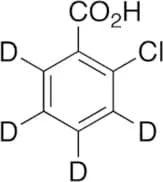
CAS :Produit contrôléApplications The toxicity of halogenated benzoic acids was found to be directly related to the compound's hydrophobicity. Toxicity and quantitative structure-activity relationships of benzoic acids to Pseudokirchneriella subcapitata. This is the labelled analog.
References Moore, D., et al.: Environ. Toxicol. Chem., 16, 794 (1997), Zhao, Y., et al.: Sci. Total Environ., 216, 205 (1998), Fiorentino, A., et al.: J. Agric.Food Chem., 51, 1005 (2003),Formule :C7D4HClO2Couleur et forme :NeatMasse moléculaire :160.59