Composés deutérés
Les composés deutérés sont des molécules organiques dans lesquelles un ou plusieurs atomes d'hydrogène sont remplacés par du deutérium, un isotope stable de l'hydrogène. Ces composés sont essentiels dans divers domaines scientifiques, notamment la spectroscopie RMN, la spectrométrie de masse et les études cinétiques d'isotopes. Les composés deutérés améliorent la clarté et la précision des signaux dans les analyses en réduisant le bruit de fond et en offrant des perspectives uniques sur les mécanismes réactionnels et les structures moléculaires. Chez CymitQuimica, vous trouverez une large gamme de composés deutérés spécialement conçus pour soutenir vos recherches en chimie analytique et en études moléculaires.
4233 produits trouvés pour "Composés deutérés"
Trier par
Degré de pureté (%)
0
100
|
0
|
50
|
90
|
95
|
100
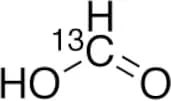
Formic Acid-13C
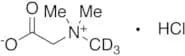
CAS :Produit contrôlé<p>Applications Labelled Formic Acid is used to improve NMR profiling of amino metabolites in biofluids.<br> Not a dangerous good if item is equal to or less than 1g/ml and there is less than 100g/ml in the package<br>References Ye, T. et al.: Anal. Chem., 82, 2303 (2010); Gowda, G.A., Anal. Chem., 82, 8983 (2010);<br></p>Formule :CH2O2Couleur et forme :NeatMasse moléculaire :47.02Betaine-d3 Hydrochloride
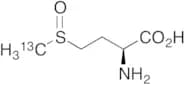
CAS :Produit contrôlé<p>Applications Betaine-d3 Hydrochloride is a useful gastric acidifier.<br>References Wilcken, D.E., et al.: N. Engl. J. Med., 309, 448 (1983),<br></p>Formule :C52H3H9NO2·ClCouleur et forme :White To Off-WhiteMasse moléculaire :156.63L-Methionine Sulfoxide,13C
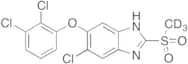
CAS :Produit contrôlé<p>Applications L-Methionine Sulfoxide 13C1 is a labelled analogue of L-Methionine Sulfoxide ( M260450). L-Methionine Sulfoxide ( M260450) an intermediate in the synthesis of the acyclic amino carboxylic acid L-Methionine sulfoximine.<br>References Lee, B., et al.: J. Biol. Chem., 283, 28361 (2008), Nordqvist, A., et al.: Bioorg. Med. Chem., 16, 5501 (2008);Balog, E., et al.: Biochem., 48, 3005 (2009);<br></p>Formule :CC4H11NO3SCouleur et forme :White To Off-WhiteMasse moléculaire :166.203Triclabendazole Sulfone-D3
CAS :Produit contrôlé<p>Applications Triclabendazole Sulfone-D3 is a stable isotopically labelled metabolite of Triclabendazole (T774175), an anthelmintic.<br>References Wolff, K., et al.: Vet. Parasitol., 13, 145 (1983)<br></p>Formule :C14D3H6Cl3N2O3SCouleur et forme :NeatMasse moléculaire :394.68Adipic Acid-13C6
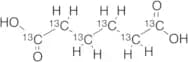
CAS :<p>Applications Adipic Acid-13C6 is labelled Adipic Acid (A291590) which is primarily used in the synthesis of nylon. It has been used as a reagent in the solid-state polymerization of nylon analogs.<br>References Kim, Y. et al.: Ind. Eng. Chem. Res., 51, 15801 (2012)<br></p>Formule :C6H10O4Couleur et forme :NeatMasse moléculaire :152.1Isopropanol-d7
CAS :Produit contrôlé<p>Applications A deuterated alcohol used in the study of lignite liquefaction.<br> Not a dangerous good if item is equal to or less than 1g/ml and there is less than 100g/ml in the package<br>References Kuznetov, P.N. et al.: Fuel, 70, 559 (1991);<br></p>Formule :C32H7HOCouleur et forme :ColourlessMasse moléculaire :67.14N-Nitrosopiperidine-d10
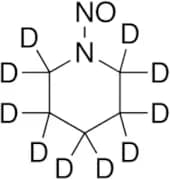
CAS :Produit contrôlé<p>Applications Labelled N-Nitrosopiperidine (N545370). A carcinogenic nitrosocompound.<br> Not a dangerous good if item is equal to or less than 1g/ml and there is less than 100g/ml in the package<br>References Bos, J., et al.: Cancer Res., 49, 4682 (1989), Wong, H., et al.: Carcinogenesis, 24, 291 (2003), Gonzalez-Mancebo, S., et al.: Mutat. Res., 558, 45 (2004), Gonzalez, M., et al.: Bioorg. Med. Chem., 13, 601 (2005),<br></p>Formule :C52H10N2OCouleur et forme :Colourless To YellowMasse moléculaire :124.212-Toluidine-13C6
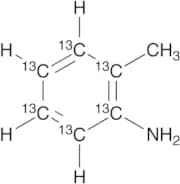
CAS :Produit contrôlé<p>Applications Isotope labelled 2-Toluidine (T536205) is a carcinogenic and toxic aromatic amine and is a potential bladder cancer risk, surmised from urine assessment and analysis (1). It is contained in hair dye, henna and dyed hair samples (2,3). Possible mutagen (4). Drinking water contaminant candidate list 3 (CCL 3) compound as per United States Environmental Protection Agency (EPA), environmental, and food contaminants.<br> Not a dangerous good if item is equal to or less than 1g/ml and there is less than 100g/ml in the package<br>References 1. El-Bayoumy, K. et al.: Cancer Res. 1986 Dec;46(12 Pt 1):6064-7.2. Turesky R. et al.: Chem. Res. Toxicol. 2003 Sep;16(9):1162-73.3. Andrew, A. et al.: Int. J. Cancer. 2004 Apr 20;109(4):581-6.4. Kirkland, D. et al.: Mutat. Res. 2005 Dec 30;588(2):88-105.<br></p>Formule :CC6H9NCouleur et forme :Red BrownMasse moléculaire :113.11Sodium Formate (13C, 99%; D, 98%)
CAS :Produit contrôlé<p>Applications Sodium Formate (13c, 99%; D, 98%) (cas# 1215684-17-5) is a useful research chemical.<br></p>Formule :CDNaO2Degré de pureté :98%Couleur et forme :NeatMasse moléculaire :70.006Chrysene-d12
CAS :Produit contrôlé<p>Applications Labelled Chrysene (C428000). Chrysene occurs in coal tar. Is formed during distillation of coal, in very small amount during distillation or pyrolysis of many fats and oils. Chrysene is one of the basic polycyclic aromatic hydrocarbon (PAH) which is toxic environmental pollutant and consistently exposed to sunlight. However, little information is available on its photogenotoxicity. The objective of the present study was to analyze the effects of Chrysene, under environmental intensity of UVB (0.6 mW/cm2) in human skin epidermal cell line (HaCaT).<br> Not a dangerous good if item is equal to or less than 1g/ml and there is less than 100g/ml in the package<br>References Anderson, D., et al.: Mutat. Res., 307, 261 (1994), Diamond, S., et al.: Environ. Toxicol. Chem., 25, 3015 (2006), Fotakis, G., et al.: Toxicol. Lett., 160, 171 (2006),<br></p>Formule :C182H12Couleur et forme :White To Off-WhiteMasse moléculaire :240.36Chloroform-13C
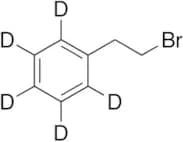
CAS :Produit contrôlé<p>Applications Chloroform-13C is a ubiquitous trichlorinated organohalide solvent. It is used in the preparation of stable isotope-labeled precursors for the synthesis of capsaicinoids, capsinoids and capsiconinoids.<br>References Kobata, K., et al.: Biosci., Biotechnol., Biochem., 75, 1611 (2011)<br></p>Formule :CHCl3Couleur et forme :NeatMasse moléculaire :120.37(2-Bromoethyl)benzene-d5
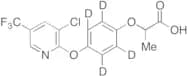
CAS :Produit contrôlé<p>Applications Isotope labelled (2-Bromoethyl)benzene is an intermediate widely used in organic synthesis.<br>References Suzuki, T., et al.: J. Med. Chem., 55, 9562 (2012); Mohanazadeh, F., et al.: Lett. Org. Chem., 9, 598 (2012);<br></p>Formule :C8D5H4BrCouleur et forme :NeatMasse moléculaire :190.09(±)-Haloxyfop-d4
CAS :Produit contrôlé<p>Applications (±)-Haloxyfop-d4 is the labeled analogue of (±)-Haloxyfop (H104040) a herbicide.<br>References Manalil, S., et. al.: Weed Sci., 59, 210 (2011);<br></p>Formule :C152H4H7ClF3NO4Couleur et forme :NeatMasse moléculaire :365.72Adenosine-5',5''-d2
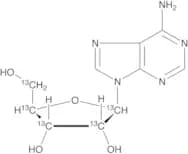
CAS :Produit contrôlé<p>Applications Labelled analogue of Adenosine (A280400), a purine nucleoside that plays an important role in various biochemical processes.<br>References Long, X., et al.: J. Pharmacol. Exper. Ther., 335, 781 (2010); Ham, M., et al.: J. Pharmacol. Exper. Ther., 335, 607 (2010)<br></p>Formule :C10H11D2N5O4Couleur et forme :White SolidMasse moléculaire :269.26Adenosine-13C5
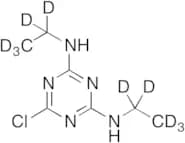
CAS :<p>Stability Hygroscopic<br>Applications Labelled nucleotide.<br>References Long, X., et al.: J. Pharmacol. Exper. Ther., 335, 781 (2010), Ham, M., et al.: J. Pharmacol. Exper. Ther., 335, 607 (2010),<br></p>Formule :C513C5H13N5O4Couleur et forme :White To Off-WhiteMasse moléculaire :272.20Simazine-d10
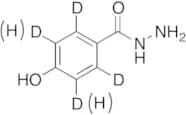
CAS :Produit contrôlé<p>Applications Simazine-d10 is the isotope labelled analog of Simazine (S465900); a selective pre-emergence herbicide.<br> Not a dangerous good if item is equal to or less than 1g/ml and there is less than 100g/ml in the package<br>References Bailey, G.W., et al.: Residue Rev., 10, 97 (1965); Chun, O., et al.: Food Chem. Toxicol., 41, 1063 (2003); Berrada, H., et al.: Food Control., 21, 36 (2010)<br></p>Formule :C72H10H2ClN5Couleur et forme :NeatMasse moléculaire :211.724-Hydroxybenzhydrazide-d4 (Major)
CAS :Produit contrôlé<p>Applications 4-Hydroxybenzhydrazide-d4 Major is labelled 4-Hydroxybenzhydrazide which works as an indicator in the determination of carbohydrates. Tissue (liver) bounded 4-Hydroxybenzhydrazide, the acid-hydrolyzable side chain of Nifuroxazide (N458500) can be used as a marker to monitor it’s use as an antibiotic in chicken.<br>References Lever, M., et al.: Anal. Biochem., 139, 205 (1984); Rocco, M., et al.: Anal. Biochem., 377, 251 (2008); Gao, F., et al.: J. Sci. Food Agr., 93, 2172 (2013)<br></p>Formule :C7H4D4N2O2Couleur et forme :NeatMasse moléculaire :156.18(±)-Albuterol-d3 (3-Hydroxymethyl-d2; α-d1)
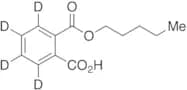
CAS :Produit contrôlé<p>Stability Hygroscopic<br>Applications (±)-Albuterol-d3 (3-hydroxymethyl-d2; alpha-d1) (CAS# 1219798-60-3) is a useful isotopically labeled research compound.<br></p>Formule :C132H3H18NO3Couleur et forme :Off-WhiteMasse moléculaire :242.33Monopentyl Phthalate-d4
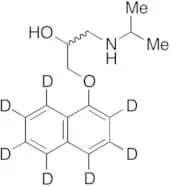
CAS :Produit contrôlé<p>Applications A labelled metabolite of Di-n-pentyl phthalate (DPP), used mainly as a plasticizer in nitrocellulose.<br>References Schmid, P., et al.: Xenobiotica, 1985, 15, 251 (1985), Nativelle, C., et al.: Food Chem. Toxicol., 37, 905 (1999), Howdeshell, K., et al.: Toxicol. Sci., 105, 153 (2008),<br></p>Formule :C13D4H12O4Couleur et forme :White To Off-WhiteMasse moléculaire :240.12997rac-Propranolol-d7
CAS :Produit contrôlé<p>Stability Hygroscopic<br>Applications rac-Propranolol-d7, is the labeled analogue of Propranolol (P831800), a β−Adrenergic blocker. Antihypertensive; antianginal; antiarrhythmic (class II).<br>References Bond, et al.: Nature, 213, 721 (1967), Hansteen, V., et al.: Br. Med. J., 284, 155 (1982), Diamond, S., et al.: J. Clin. Pharmacol., 28, 193 (1988),<br></p>Formule :C162H7H14NO2Couleur et forme :NeatMasse moléculaire :266.39