Nicotine et dérivés de nicotine
La nicotine et ses dérivés sont des alcaloïdes que l'on trouve couramment dans les plantes de tabac. Ces composés agissent comme des stimulants chez les mammifères, affectant la neurotransmission en agissant sur les récepteurs nicotiniques de l'acétylcholine. La nicotine et ses dérivés ont une large gamme d'effets biologiques, ce qui les rend importants pour la recherche en neurobiologie, en études sur l'addiction et en pharmacologie. CymitQuimica propose divers dérivés de la nicotine pour soutenir ce domaine de recherche.
279 produits trouvés pour "Nicotine et dérivés de nicotine"
Trier par
Degré de pureté (%)
0
100
|
0
|
50
|
90
|
95
|
100
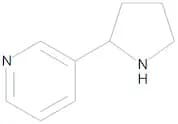
(R,S)-Nornicotine (1 mg/mL in Methanol)
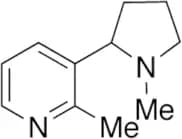
CAS :Produit contrôléFormule :C9H12N2Couleur et forme :ColourlessMasse moléculaire :148.20(+/-)-2-Methylnicotine
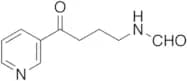
CAS :Produit contrôlé<p>Applications A metabolite of Nicotine.<br> Not a dangerous good if item is equal to or less than 1g/ml and there is less than 100g/ml in the package<br></p>Formule :C11H16N2Couleur et forme :NeatMasse moléculaire :176.263-(4-Formylaminobutyryl)pyridine
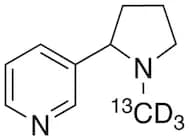
CAS :<p>Applications 3-(4-Formylaminobutyryl)pyridine (cas# 887355-56-8) is a compound useful in organic synthesis.<br></p>Formule :C10H12N2O2Couleur et forme :NeatMasse moléculaire :192.21rac-Nicotine-13CD3
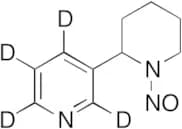
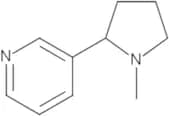
CAS :Produit contrôlé<p>Applications Labelled rac-Nicotine (N412420). Nicotine is an alkaloid isolated from plants. Nicotine is an active stimulant, having both addictive and carcinogenic properties. Nicotine can be absorbed through the alimentary canal, respiratory tract and intact skin. Nicotine is used in the treatment of smoking withdrawal syndrome. Nicotine has been used as an anthelmintic.<br> Not a dangerous good if item is equal to or less than 1g/ml and there is less than 100g/ml in the package<br>References Guillen, M., et al.: J. Agric. Food Chem., 53, 1093 (2005), Alburges, M., et al.: Eur. J. Pharmacol., 573, 124 (2007), Roy, K., et al.: Eur. J. Med. Chem., 44, 1941 (2009),<br></p>Formule :CC92H3H11N2Couleur et forme :NeatMasse moléculaire :166.24(R,S)-N-Nitroso Anabasine-d4 (1 mg/mL in Methanol)
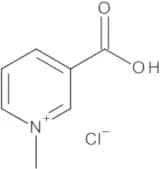
CAS :Produit contrôléFormule :C102H4H9N3OCouleur et forme :Single SolutionMasse moléculaire :195.25Trigonelline Chloride
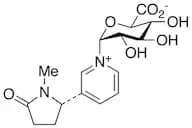
CAS :<p>Applications Trigonelline (chloride) is an alkaloid found in plants and coffee. Trigonelline is a product of niacin metabolism that is excreted in urine.<br></p>Formule :C7H8NO2·ClCouleur et forme :NeatMasse moléculaire :173.60Cotinine N-α-D-Glucuronide
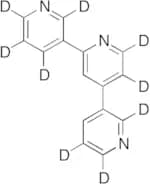
Produit contrôlé<p>Stability Hygroscopic<br>Applications A major metabolite of Nicotine in humans. Carcinogen.<br>References Benowitz, N., et al.: Clin. Pharmacol. Ther., 56, 483 (1994), Nakajima, M., et al.: Drug Metab. Dispos., 24, 1212 (1996), Messina, E., et al.: J. Pharmacol. Exp. Ther., 282, 1608 (1997), Oscarson, M., et al.: Hum. Mutat., 20, 275 (2002),<br></p>Formule :C16H20N2O7Couleur et forme :NeatMasse moléculaire :352.34Nicotelline-d9 (Major)
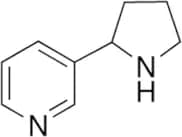
CAS :Produit contrôlé<p>Applications Isotope labelled Nicotelline is a Nicotine (N412420) related metabolite with potential as an inhibitor of human cytochrome P-450 2A6.<br> Not a dangerous good if item is equal to or less than 1g/ml and there is less than 100g/ml in the package<br>References Denton, T. et al.: Biochem. Pharm., 67, 751 (2004); Gorrod, J. et al.: Anal. Det. Nic. Rel. Comp. Metab., 69, (1999);<br></p>Formule :C15H2D9N3Couleur et forme :NeatMasse moléculaire :242.15(R,S)-Nornicotine
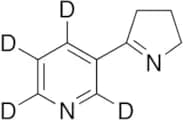
CAS :Produit contrôlé<p>Impurity Nicotine USP Related Compound F (3-(pyrrolidine-2-yl)pyridine)<br>Stability Light Sensitive<br>Applications (RS)-Nornicotine is a tobacco alkaloid and the major Nicotine (N412420) metabolite in brain. Nornicotine appears to activate different nAChR subtypes, has a better pharmacokinetic profile, and produces less toxicity than Nicotine. Nornicotine shows a significant analgesic activity. Nicotine USP Related Compound F (3-(pyrrolidine-2-yl)pyridine).<br>References Hecht, S., et al.: Carcinogenesis, 9, 875 (1988), Rivenson, A., et al.: Cancer Res., 48, 6912 (1988), Hoffmann, D., et al.: Chem. Res. Toxicol., 14, 767 (2001), Kool, J., et al.: J. Med. Chem., 49, 3287 (2006), Kool, J., et al.: Drug Metab. Dispos., 35, 640 (2007),<br></p>Formule :C9H12N2Couleur et forme :Colourless To Light YellowMasse moléculaire :148.20Myosmine-2,4,5,6-d4
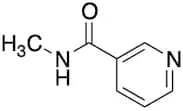
CAS :Produit contrôlé<p>Stability Hygroscopic, Moisture Sensitive, Temperature Sensitive<br>Applications Labelled Myosmine (M835000). Myosmine is an alkaloid found in tobacco. Myosmine has been suspected to be a tobacco-independent carcinogenic source.<br></p>Formule :C92H4H6N2Couleur et forme :BrownMasse moléculaire :150.21N-Methylnicotinamide
CAS :<p>Applications N-Methylnicotinamide is a metabolite of Nicotinamide (N407750), which is a water-soluble vitamin B, incorporated within nicotinamide cofactors such as NADH and NADPH. N-Methylnicotinamide is commonly found in the human urine and is used as a biomarker to study diseases such as liver cirrhosis and type 2 diabetes.<br>References Pumpo, R., et al.: Am. J. Gastroenterol., 96, 1183 (2001); Sharma, M., et al.: J. Chem. Pharm. Res., 2, 416 (2010); Al-Nadaf, A., et al.: Bioorg. Medi. Chem., 18, 3088 (2010); Connor, S., et al.: Mol. Biosyst., 6, 909 (2010);<br></p>Formule :C7H8N2OCouleur et forme :NeatMasse moléculaire :136.15rac-Nicotine-d3 N-β-D-Glucuronide
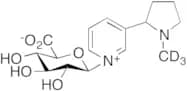
Produit contrôlé<p>Applications rac-Nicotine-d3 N-β-D-Glucuronide is a labelled racemic analogue of Nicotine N-β-D-Glucuronide (N424575), a Nicotine (N412420) metabolite in rat brain. Nicotine N-β-D-Glucuronide is used as a Nicotine biomarker in rat brain.<br>References Alexandrov, K., et al.: Toxicol. Lett., 198, 63 (2010), Huang, L., et al.: J. Neurochem., 109, 826 (2009), Quik, M., et al.: Biochem. Pharmacol., 78, 677 (2009), Weems, J., et al.: Chem. Res. Toxicol., 23, 696 (2010),<br></p>Formule :C16H19D3N2O6Couleur et forme :NeatMasse moléculaire :341.37o-Nicotine
CAS :Produit contrôlé<p>Applications o-Nicotine is a Nicotine analog (N412420). o-Nicotine has high affinity for nicotinic receptor, and its ability to elicit neurotransmitter secretions make it a good candidate for treating cholinergic neurodegenerative diseases.<br> Not a dangerous good if item is equal to or less than 1g/ml and there is less than 100g/ml in the package<br>References Romano, C., et al.: Psychopharmacol., 74, 310 (1981), Wang, D., et al.: Drug Dev. Res., 45, 10 (1998),<br></p>Formule :C10H14N2Couleur et forme :NeatMasse moléculaire :162.23S-(-)-Cotinine
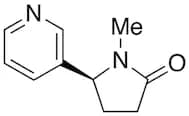
CAS :Produit contrôlé<p>Stability Hygroscopic<br>Applications S-(-)-Cotinine is a major metabolite of Nicotine (N412450) in humans. It is a carcinogen.This compound is a contaminant of emerging concern (CECs)<br>References Thompson, J.A., et al.: J. Chromatog., 231, 53 (1982); Seeman, J.I., et al.: J. Org. Chem., 51, 1548 (1986); Nakajima, M., et al.: Drug Metab. Dispos., 24, 1212 (1996)<br></p>Formule :C10H12N2OCouleur et forme :NeatMasse moléculaire :176.22Nicotelline
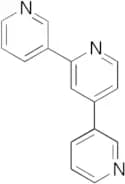
CAS :Produit contrôlé<p>Applications Nicotelline is a Nicotine (N412420) related metabolite with potential as an inhibitor of human cytochrome P-450 2A6.<br> Not a dangerous good if item is equal to or less than 1g/ml and there is less than 100g/ml in the package<br>References Denton, T. et al.: Biochem. Pharm., 67, 751 (2004); Gorrod, J. et al.: Anal. Det. Nic. Rel. Comp. Metab., 69, (1999);<br></p>Formule :C15H11N3Couleur et forme :NeatMasse moléculaire :233.27(R,S)-Norcotinine
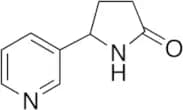
CAS :Produit contrôlé<p>Stability Hygroscopic<br>Applications A metabolite of (+/-)-Cotinine.<br>References Morselli, P.L., et al.: J. Med. Chem., 10, 1033 (1967),<br></p>Formule :C9H10N2OCouleur et forme :White To Light BrownMasse moléculaire :162.19Nicotine Benzoate
CAS :Produit contrôléFormule :C10H14N2·C7H6O2Couleur et forme :NeatMasse moléculaire :284.353(S)-Anabasine (>98%)
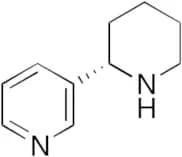
CAS :Produit contrôlé<p>Applications (S)-Anabasine is a nicotinic receptor agonist.<br> Not a dangerous good if item is equal to or less than 1g/ml and there is less than 100g/ml in the package<br>References Keeler, R., et al.: Clin. Toxicol., 12, 49 (1978); Aceto, M., et al.: J. Med. Chem., 22, 17 (1979); Brand, J., et al.: J. Chem. Ecol., 19, 1315 (1993)<br></p>Formule :C10H14N2Degré de pureté :>98%Couleur et forme :NeatMasse moléculaire :162.23