Produits biochimiques et réactifs
Les biochimiques et réactifs sont des substances fondamentales pour la recherche et le développement dans des domaines tels que la biotechnologie, la biologie moléculaire, la pharmacologie et la médecine. Ces produits sont essentiels pour une variété d'applications, y compris la synthèse de composés, l'analyse d'échantillons biologiques, la recherche sur les processus métaboliques et la production de médicaments. Chez CymitQuimica, nous proposons une large sélection de biochimiques et réactifs de haute qualité et pureté, adaptés à divers besoins scientifiques et industriels. Notre catalogue comprend des enzymes, des anticorps, des acides nucléiques, des acides aminés et de nombreux autres produits, tous conçus pour soutenir les chercheurs et les professionnels dans leurs projets de recherche et développement, garantissant des résultats fiables et reproductibles.
Sous-catégories appartenant à la catégorie "Produits biochimiques et réactifs"
- Biomolécules(99.197 produits)
- Par Biological Target(100.313 produits)
- Par usage/effets pharmacologiques(6.790 produits)
- Cryoconservation et composés associés aux cryoconservateurs(21 produits)
- Désinfectants, additifs pour les fluides pour bains chauffants et composés apparentés(28 produits)
- Hormones(346 produits)
- Biologie végétale(6.835 produits)
- Métabolites secondaires(14.348 produits)
130603 produits trouvés pour "Produits biochimiques et réactifs"
Trier par
Degré de pureté (%)
0
100
|
0
|
50
|
90
|
95
|
100
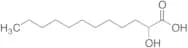
(±)-2-Hydroxydodecanoic Acid
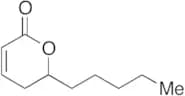
CAS :Produit contrôlé<p>Applications (8Z,11Z,14Z)-8,11,14-Heptadecatrienoic Acid, is a naturally occurring hydroxylated fatty acid that is found in Acinetobacter species. It acts as a partial agonist of free fatty acid receptor 1 (FFAR1/GPR40) and GPR84 receptors in vitro. It also inhibits bovine hepatic ligase (Ki = 4.4 μM) and mouse kidney mitochondrial medium-chain acyl-CoA synthetase by 48% at a concentration of 40 μM.<br>References Moss, C.W., et al.: J. Clin. Microbiol. 26(3), 484-492 (1988).; Kaspersen, M.H., et al.: Med. Chem. Commun. 8(6), 1360-1365 (2017).<br></p>Formule :C12H24O3Couleur et forme :NeatMasse moléculaire :216.32(±)-Massoilactone
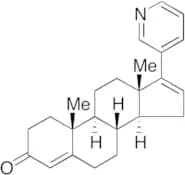
CAS :Produit contrôléFormule :C10H16O2Couleur et forme :NeatMasse moléculaire :168.2317-(3-Pyridinyl)-androsta-4,16-dien-3-one
CAS :Produit contrôléFormule :C24H29NOCouleur et forme :NeatMasse moléculaire :347.49Tetrahydro 11-Deoxycorticosterone
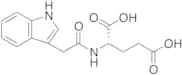
CAS :Produit contrôlé<p>Applications Tetrahydro 11-Deoxycorticosterone is a metabolite of 11-Deoxycorticosterone (DOC) (D232590).<br>References Fedele, E., et al.: J. Neurochem., 75, 782 (2000), Adkins, C., et al.: J. Biol. Chem., 276, 38934 (2001), Erceg, S., et al.: Brain Res., 1036, 115 (2005),<br></p>Formule :C21H34O3Couleur et forme :White To Off-WhiteMasse moléculaire :334.49Indole-3-acetyl-L-glutamic Acid
CAS :Produit contrôlé<p>Applications Indole-3-acetyl-L-glutamic Acid is an indole-3-acetyl-amino acid conjugate involved in regulatory mechanisms for the control of auxin activity during physiological and pathophysiological responses.<br>References Ostrowski, M., et al.: J Plant Physiol, 191, 63-72 (2016)<br></p>Formule :C15H16N2O5Couleur et forme :NeatMasse moléculaire :304.3Pyrimido[1,2-a]purin-10(1H)-one
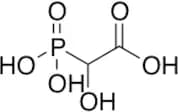
CAS :Produit contrôlé<p>Applications M1G is a secondary DNA damage product arising from primary reactive oxygen species (ROS) damage to membrane lipids or deoxyribose. It is a guanine adduct formed by reaction of malondialdehyde with DNA.<br>References Ham, A., et al.: Chem. Res. Toxicol., 13, 1243 (2000), Sharma, R., et al.: Clin. Cancer Res., 7, 1452 (2001), Jeong, Y., et al.: Chem. Res. Toxicol., 18, 51 (2005),<br></p>Formule :C8H5N5OCouleur et forme :NeatMasse moléculaire :187.16Hydroxyphosphonoacetic Acid - 50% in water
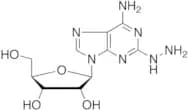
CAS :Produit contrôléFormule :C2H5O6PCouleur et forme :Single SolutionMasse moléculaire :156.0312-Hydrazino Adenosine
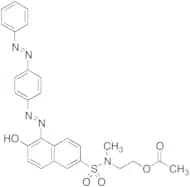
CAS :Produit contrôlé<p>Stability Moisture Sensitive<br>Applications A useful synthetic intermediate for making potent and selective coronary vasodilators.<br>References Niiya, K., et al.: J. Med. Chem., 35, 4557 (1992)<br></p>Formule :C10H15N7O4Couleur et forme :NeatMasse moléculaire :297.27Disperse Red 151 (>90%)
CAS :Produit contrôléFormule :C27H25N5O5SDegré de pureté :>90%Couleur et forme :NeatMasse moléculaire :531.58(3β)-7-Dehydro Cholesterol-d7
CAS :Produit contrôlé<p>Stability Light Sensitive<br>Applications A labelled vitamin precursor.<br></p>Formule :C272H7H37OCouleur et forme :NeatMasse moléculaire :391.68D-Serine
CAS :Produit contrôlé<p>Applications A proteinogenic amino acids involved in the biosynthesis of purines and pyrimidines. Inhibitor of serine palmitoyltransferase. A neuromodulator.<br>References Junjaud, G. et al.: J. Neurochem., 98, 1159 (2006); Hanada, K. et al.: FEBS Lett., 474, 63 (2000); Pollegionni, L. et al.: Cell. Mol. Life Sci., 67, 2387 (2010);<br></p>Formule :C3H7NO3Couleur et forme :NeatMasse moléculaire :105.09N-Benzyl-L-tyrosine
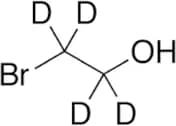
CAS :Produit contrôlé<p>Applications Protected L-Tyrosine (T899975), an amino acid, used by cells to synthesize proteins. L-Tyrosine is biologically converted from L-phenylalanine and is in turn is converted to L-DOPA and further converted into the neurotransmitters: dopamine, norepinephrine, and epinephrine.<br>References Rasmussen D.D. et al.: J. Clin. Endocrinol. Metab., 57, 760 (1983); Bagchi, S.P. et al.: Biochem. Pharmacol., 26, 900 (1977)<br></p>Formule :C16H17NO3Couleur et forme :NeatMasse moléculaire :271.322-Bromoethanol-d4
CAS :Produit contrôlé<p>Applications Isotope labelled 2-Bromoethanol is an widely used intermediate in organic synthesis.<br> Not a dangerous good if item is equal to or less than 1g/ml and there is less than 100g/ml in the package<br>References Tian, Z., et al.: Int. J. Quant. Chem., 111, 631 (2011); Thayer, F.K., et al.: Org. Syntheses., 6, (1926);<br></p>Formule :C22H4HBrOCouleur et forme :NeatMasse moléculaire :128.99Phosphoglycolic Acid
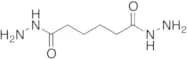
CAS :Produit contrôlé<p>Applications Phosphoglycolic Acid is used in studies pertaining to biological and metabolic processes. It can be used in the study of human apurinic/apyrimidinic endonuclease (Ape) and its role in double strand break repair. It also has been seen to complex with cPEPCK (cytosolic phosphoenolpyruvate carboxykinase) during the study of its inhibition by various substrate analogues.<br>References Suh, D. et al.: Nucl. Acids Res., 25, 2495 (1997); Stiffin, R. et al.: Biochem., 47, 2099 (2008);<br></p>Formule :C2H5O6PCouleur et forme :Off-White To Light YellowMasse moléculaire :156.03Adipic Acid Dihydrazide
CAS :<p>Applications Adipic Acid Dihydrazide is used to functionalize magnetic nanoparticles for gylcopeptitde enrichment and identification. Adipic Acid Dihydrazide can also be used as a chain extension for liquid rubber.<br>References Cao, Q., et. al.: Analyst, 139, 603 (2014); Cutts, E.: Chem. Industry, 7, 280 (1974)<br></p>Formule :C6H14N4O2Couleur et forme :NeatMasse moléculaire :174.2Glycerol 1,3-Dipalmitate
CAS :<p>Applications A glycidol fatty acid esters in edible oils. An acyl acceptor for the unspecific bifunctional wax ester synthase/acyl-CoA:Diacylglycerol acyltransferase.<br>References Masukawa, Y. et al.: J. Am. Oil. Chem. Soc., 88, 15 (2011); Kalscheuer, R. et al.: Eur. J. Lipid. Sci. Tech., 105, 578 (2003)<br></p>Formule :C35H68O5Couleur et forme :NeatMasse moléculaire :568.91Boric Acid, Pinacol Ester
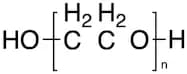
CAS :Produit contrôlé<p>Applications Boric Acid, Pinacol Ester was a useful reagent in the study of hydrogen peroxide inducible DNA croslsinking agents as anticancer prodrugs.<br>References Kuang, Y., et al.: J. Am. Chem. Soc., 133, 19278 (2011);<br></p>Formule :C6H13BO3Couleur et forme :NeatMasse moléculaire :143.977Poly(ethylene Glycol) ~20000
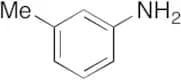
CAS :Produit contrôlé<p>Stability Hygroscopic<br>Applications Poly(ethylene Glycol) molecules of an average molecular mass of 20000. Poly(ethylene Glycol) is used in various applications from industrial chemistry to biological chemistry. Recent research has shown PEG maintains the ability to aid the spinal cord injury recovery process, helping the nerve impulse conduction process in animals. In rats, it has been shown to aid in the repair of severed sciatic axons, helping with nerve damage recovery. It is industrially produced as a lubricating substance for various surfaces to reduce friction. PEG is also used in the preparation of vesicle transport systems in with application towards diagnostic procedures or drug delivery methods.<br>References Borgens, R. et al.: J. Neurosci. Res., 66, 1179 (2001); Stavisky, R. et al.: Neurosci. Lett., 376, 98 (2005); Nalam, P. et al.: Tribiol. Lett., 37, 541 (2010); Steinmetz, N. et al.: J. Am. Chem. Soc., 131, 17093 (2009); Li, X. et al.: J. Am. Chem. Soc., 133, 11147 (2011); Li, L. et al.: Int. J. Pharm., 447, 192 (2013);<br></p>Formule :H2O(C2H4O)nCouleur et forme :Off-WhiteMasse moléculaire :62.07m-Toluidine
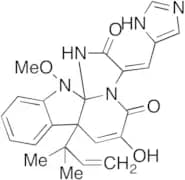
CAS :Produit contrôlé<p>Applications m-Toluidine is a reagent that is used in the synthesis of torsemide and its derivatives which are used as a diuretic.<br> Not a dangerous good if item is equal to or less than 1g/ml and there is less than 100g/ml in the package<br>References Lesne, M., et al.: In. J. Clin. Pharmacol. Ther. Toxicol., 20, 382 (1982), Brater, D.C., et al.: Clin. Pharmacol. Ther., 42, 187 (1987),<br></p>Formule :C7H9NCouleur et forme :Yellow To BrownMasse moléculaire :107.15Meleagrin
CAS :Produit contrôlé<p>Applications Meleagrin is a is an antibiotic derived from the deep ocean and is identified as an inhibitor of the bacterial enoyl-acyl carrier protein reductase. (Fabl). Inhibits the growth of S. aureus, E.coli, and S.pneumoniae<br>References Shang, Z. et al.: Chin. J. Ocean. Limn., 30, 305 (2012);<br></p>Formule :C23H23N5O4Couleur et forme :Light YellowMasse moléculaire :433.46


![Pyrimido[1,2-a]purin-10(1H)-one](/_next/image/?url=https%3A%2Fstatic.cymitquimica.com%2Fproducts%2FTR%2Fthumb-webp%2FP997400.webp&w=3840&q=75)