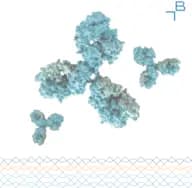
Anticorps d'immunologie
2585 produits trouvés pour "Anticorps d'immunologie"
MOG (35-55) amide Mouse, Rat
Myelin oligodendrocyte glycoprotein (MOG) is a member of the immunoglobulin (Ig) protein superfamily and is expressed exclusively in the central nervous system (CNS) on the surface of myelin sheaths and oligodendrocyte processes. MOG is expressed at the onset of myelination, and therefore is a potential marker for oligodendrocyte maturation.MOG contains an extracellular domain, a transmembrane domain, a cytoplasmic loop, a membrane-associated region and a cytoplasmic tail. MOG may function as a cell surface receptor or cell adhesion molecule. Fifteen different alternatively spliced isoforms have been detected in humans. These are present either on the cell surface, the endoplasmic reticulum in the endocytic system, or in secreted form.The secreted form of MOG may trigger autoimmunity if released into the cerebrospinal fluid and periphery. MOG is thought to be a key target for auto-antibodies and cell-mediated immune responses in inflammatory demyelinating diseases such as multiple sclerosis (MS) and is therefore widely studied in this field.The MOG (35-55) fragment is the most potent auto-antigenic region of MOG, and the most effective at inducing experimental autoimmune/allergic encephalomyelitis (EAE), an animal model that resembles MS. This peptide has an uncharged C-terminal amide, an acid form is also available in our catalogue.
Couleur et forme :PowderMasse moléculaire :2,579.3 g/molGP33 (1-9)
Peptide derived from GP33, an epitope of the lymphocytic choriomeningitis virus (LCMV) which produces a CD8+ cytotoxic T lymphocyte response.
Masse moléculaire :973.16 g/molAIP-I
Auto-inducing peptide (AIP) is a cyclic thiolactone quorum sensing peptide from Staphylococcus aureus which is responsible for activating the agr response. AIP is released from the bacteria and its extracellular concentration is then sensed by a two-component system on the bacterial surface, AgrC and AgrA. AgrC is the membrane histidine kinase receptor and AgrA is a response regulator- upon binding of AIP, AgrC phosphorylates AgrA.AIP accumulates during growth activating an AgrC and AgrA cascade when it reaches a critical signal level. This cascade activates P2 and P3 promoters which autoactivate the agr system and upregulate RNAIII transcription. RNAIII regulates the expression of virulence factors including toxins, super-antigens, and exo-enzymes. Extensive research to identify AIP:AgrC inhibitors aims to find therapeutics against pathogens.AgrD is the precursor peptide of AIP, and AgrB is an integral membrane endopeptidase essential to biosynthesize AIP. This AIP system is conserved among many Gram-positive bacteria. S. aureus strains are categorized into four groups (I-IV) according to their AIP signal and cognate extracellular receptor, AgrC. AIP-I has the characteristic five-residue thiolactone ring with a short N-terminal extension. AIP-I has been used to generate a biosensor for the detection of S. aureus in nanomolar range for use in hospital settings.
Formule :C43H60N8O13S2Couleur et forme :PowderMasse moléculaire :961.11 g/mol[Ala144]-PLP (139-151)
[Ala144]-PLP (139-151) is the Ala 144 form of Proteolipid protein (PLP), an epitope of immunodominant encephalitogenic PLP and is involved in promoting encephalomyelitis.
Couleur et forme :PowderMasse moléculaire :1,405.6 g/mol2-Furoyl-LIGRL-amide
PAR2 plays a particular role in protecting the gastric mucosa mediated by capsaicin-sensitive sensory neurons. PAR2 also serves to aid in gut smooth muscle motility- colon inflammation pathway- hyperalgesia and is also anti-inflammatory in other circumstances.Development of selective agonists for PAR2 are crucial for research. (2-Furoyl)-LIGRL-amide is a far more potent agonist than the native PAR2 activating peptide SLIGRL-NH2. In mice, oral administration conferred cytoprotection from gastrointestinal lesions. However, it was inhibited by capsaicin pre-treatment.
Masse moléculaire :663.4 g/molBAT3 (340-347), human
BAT3 (340-347) human is derived from BAT3, the human leukocyte antigen B-associated transcript 3 which associates with TIM-3 in T lymphocytes and recruits a Src family kinase.
Masse moléculaire :838.4 g/molAAV8 capsid protein
This peptide represents part of the capsid protein, which forms the shell, of adeno-associated virus 8 (AAV8). This peptide has high major histocompatibility (MHC) affinity, and the MHC restriction has been identified as a H-2 Dd binder. This epitope can therefore simulate CD8+ T cells and can elicit a robust response from interferon γ (IFN-γ), a cytokine critical for innate immunity and adaptive immunity against viral, and some bacterial and protozoal infections.CD8+ T cells (often called cytotoxic T lymphocytes, or CTLs) are generated in the thymus and express the dimeric co-receptor, CD8, on their surface. CD8+ T cells can recognise peptides presented by MHC class I molecules, which are found on all nucleated cells. CD8+ T cells are important for defence against intracellular pathogens, including viruses and bacteria, and for tumour surveillance, however, they can also contribute to excessive immune responses that leads to immune-mediated damage.AAV8 is a non-disease causing virus that can infect humans and can integrate into the host cell genome. Gene therapy vectors have been created using AAV8 which can persist in an extrachromosomal state without integrating into the genome of the host cell and show promise in recent human clinical trials.
Masse moléculaire :855.4 g/molgp96-II
Heat shock protein gp96 inhibitor which binds to and antagonizes gp96 mediated lipopolysaccharide (LPS) induced cytokine production. Anti-inflammatory in a number of in vivo and in vitro models.
Masse moléculaire :4,461.6 g/molPMX 53
PMX 53 is a potent antagonist of CD88, a G protein-coupled receptor for C5a (complement protein). C5a is a protein fragment released from cleavage of complement component C5 by protease C5-convertase into C5a and C5b fragments. C5a, the other cleavage product of C5, acts as a highly inflammatory peptide, encouraging complement activation, formation of the MAC, attraction of innate immune cells, and histamine release involved in allergic responses. The origin of C5 is in the hepatocyte, but its synthesis can also be found in macrophages, where it may cause local increase of C5a. C5a is a chemotactic agent and an anaphylatoxin- it is essential in the innate immunity but it is also linked with the adaptive immunity. The increased production of C5a is connected with a number of inflammatory diseases.By antagonising the C5a receptor, PMX can be used to modulate inflammatory responses, obesity, development and cancers.
Couleur et forme :PowderMasse moléculaire :895.5 g/molOVA (323 - 339) amide
Ova (323-339) is an epitope of interest from egg white albumen, which is widely used in allergy research. Ovalbumin is a glycoprotein that is sufficiently large and complex to be mildly immunogenic. It has been demonstrated that ovalbumin contains B-cell epitopes which are recognized by specific IgE antibodies, and CD4 T cell epitopes restricted by the MHC I-Ad molecule in mice and by HLA-D molecule in human.OVA (323-339) can be used to study binding of class II MHC-peptide and T-cell activation in PBMCs by ELISPOT assays. This method quantifies peptide-epitope specificity and IFN-γ releasing effector cells. It has been shown that OVA (323-339) was responsible for 25-35% of T-cell response of isolated BALB/c mouse. An investigation has demonstrated that OVA and OVA (323-339) induced similar lung inflammation and a Th2-like dominant immune response in mouse model.
Masse moléculaire :1,771.9 g/molAIP-IV
Staphylococcus aureus is a major human pathogen that utilizes autoinducing peptide (AIP) signals to regulate virulence. Methods to intercept bacterial quorum sensing (QS) aim to find novel anti-virulence treatments.Auto-inducing peptide (AIP) is a cyclic thiolactone quorum sensing peptide from Staphylococcus aureus which is responsible for activating the agr response. AIP is released from the bacteria and its extracellular concentration is then sensed by a two-component system on the bacterial surface, AgrC and AgrA. AgrC is the membrane histidine kinase receptor and AgrA is a response regulator- upon binding of AIP, AgrC phosphorylates AgrA.AIP accumulates during growth activating an AgrC and AgrA cascade when it reaches a critical signal level. This cascade activates P2 and P3 promoters which autoactivate the agr system and upregulate RNAIII transcription. RNAIII regulates the expression of virulence factors including toxins, super-antigens, and exo-enzymes. Extensive research to identify AIP:AgrC inhibitors aims to find therapeutics against pathogens.AgrD is the precursor peptide of AIP, and AgrB is an integral membrane endopeptidase essential to biosynthesize AIP. This AIP system is conserved among many Gram-positive bacteria. S. aureus strains are categorized into four groups (I-IV) according to their AIP signal and cognate extracellular receptor, AgrC. Each group is associated with a certain disease profile, S. aureus group-IV strains have been associated with generalized exfoliative syndromes and osteoarticular infections. AIP-IV has been used to develop antibodies and an effective ELISA help detect AIP-IV levels in the nanomolar range. This can be implemented to identify S. aureus type IV infections in patient samples.
Degré de pureté :Min. 95%Couleur et forme :PowderMasse moléculaire :1,008.4 g/molProtein A antibody (rhodamine)
Protein A antibody (rhodamine) was raised in goat using Protein A [Staphylococcus aureus] as the immunogen.Human IgG2
Human IgG2 is an immunoglobulin that plays a crucial role in the immune system. It is involved in various processes, including binding to pathogens and activating immune cells such as macrophages. Human IgG2 has been shown to have a high affinity for mesenchymal stem cells, making it an excellent tool for studying their behavior and functions. In addition, Human IgG2 has been found to modulate the activity of TGF-beta, a key cytokine involved in cell growth and differentiation. This interaction can have significant implications in various biological processes, including wound healing and tissue regeneration. Furthermore, Human IgG2 has been extensively used as a diagnostic agent in Life Sciences research. Its ability to bind specifically to target molecules, such as epidermal growth factor (EGF) or collagen, makes it an invaluable tool for identifying and quantifying these substances in biological samples. Monoclonal antibodies derived from Human IgG2 have also shown promising results as therapeutic agents. For
Degré de pureté :>95% By Sds-PageHuman IgA protein
The 6-Fluoro-3-indoxyl-beta-D-galactopyranoside is a powerful antituberculosis drug from the rifamycin class. It is specifically designed to combat tuberculosis infections by targeting the active compounds in mycobacterium. This bactericidal drug exhibits its potent activity by binding to DNA-dependent RNA polymerase, preventing transcription and replication. Its effectiveness has been demonstrated through rigorous testing using the patch-clamp technique on human erythrocytes. The drug undergoes various metabolic transformations, including hydrolysis by esterases or glucuronidases, oxidation by cytochrome P450 enzymes, reduction by glutathione reductase, or conjugation with glucuronic acid. Additionally, it specifically binds to markers expressed at high levels in Mycobacterium tuberculosis strains and inhibits their growth in culture. Tilmicosin is a macrolide antibiotic widely used in veterinary medicine to treat respiratory disorders caused by bacteria such as Clostr
Degré de pureté :>95% By Sds-PageMouse IgG (Fc)
Mouse IgG (Fc) is a glycoprotein that plays a crucial role in various Life Sciences applications, particularly in immunoassays. It is one of the Immunoglobulins and belongs to the class of Purified Immunoglobulins. Mouse IgG (Fc) is commonly used in research as a primary antibody or as a control in experiments involving monoclonal antibodies.Degré de pureté :Single Arc Observed By IepGoat IgG (Fc)
Goat IgG (Fc) is a purified immunoglobulin that has various characteristics and applications in the field of life sciences. This antibody is known for its anti-MERTK activity, which makes it a valuable tool for studying the role of MERTK in different biological processes. Additionally, Goat IgG (Fc) has been shown to interact with colony-stimulating factors, steroids, glucagon, transferrin, and other molecules involved in cellular signaling pathways.Degré de pureté :Min. 95%Mouse IgG
Mouse IgG is a monoclonal antibody that is used in various applications in the field of Life Sciences. It is commonly used as a control or reference antibody in experiments involving carbamazepine, ketamine, or other drugs. Mouse IgG can be used as an electrode coating to enhance signal detection and reduce background noise. It contains excipients that ensure stability and long shelf life. This antibody specifically targets and binds to a family kinase inhibitor, making it useful for studying the regulation of kinase activity. Additionally, Mouse IgG has cytotoxic properties, making it suitable for use in cytotoxicity assays or targeted therapy research. Immunoglobulins, such as Mouse IgG, play a crucial role in the immune system by recognizing and neutralizing foreign substances like botulinum toxins. This antibody can be used for botulinum toxin detection or as a therapeutic agent against botulism. Mouse IgG is also used as a natriuretic globulin in studies related to cardiovascularDegré de pureté :≥90% By Sds-Page.Mouse IgG
Mouse IgG is a purified immunoglobulin that is widely used in life sciences research. It is a monoclonal antibody that specifically targets and binds to various antigens, making it a valuable tool for studying protein interactions and cellular processes. Mouse IgG can be used in techniques such as immunohistochemistry, Western blotting, and flow cytometry. This antibody has shown efficacy in detecting and quantifying specific proteins of interest, including actin filaments and activated multidrug transporters. Additionally, Mouse IgG can be utilized to investigate autoimmune diseases by detecting autoantibodies in patient samples. Its high specificity and sensitivity make Mouse IgG an essential component in many research studies and diagnostic applications.
Degré de pureté :Min. 95%Carboxypeptidase Y antibody
Carboxypeptidase Y antibody was raised in rabbit using Carboxypeptidase Y [Baker’s Yeast] as the immunogen.Degré de pureté :Min. 95%

![[Ala144]-PLP (139-151)](/_next/image/?url=https%3A%2Fstatic.cymitquimica.com%2Fproducts%2F3D%2Fthumb-webp%2FCRB1000329.webp&w=3840&q=75)