Hydrazines
1359 produits trouvés pour "Hydrazines"
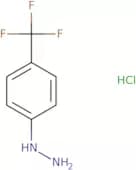
4-Trifluoromethylphenyl hydrazine hydrochloride
CAS :4-Trifluoromethylphenyl hydrazine hydrochloride is a fluorescent probe that can be used for the detection of hypoxia. It has been shown to be effective in detecting solid tumors, multiphase environments, and imaging. 4-Trifluoromethylphenyl hydrazine hydrochloride is an advanced probe that can be used to diagnose hypoxia. It binds to nitroreductase enzyme, which is found in tumor cells, and emits fluorescence when it reacts with oxygen. This reaction can be detected using a spectrophotometer or fluorimeter. The environment provides the necessary conditions for this reaction to take place, including low oxygen levels.Formule :C7H7F3N2HClDegré de pureté :Min. 95.0%Couleur et forme :PowderMasse moléculaire :212.6 g/molN,N'-Dimethylhydrazine dihydrochloride
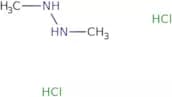
CAS :Produit contrôléN,N'-Dimethylhydrazine dihydrochloride (DMHD) is a nonsteroidal anti-inflammatory drug that inhibits the production of prostaglandins by blocking cyclooxygenase-2 (COX-2). It works by inhibiting tumor growth and inducing apoptosis. DMHD has been shown to inhibit angiogenesis and induce apoptosis in liver cells. DMHD also inhibits the mitochondrial membrane potential, which is important for regulating cell function. The molecular docking analysis has shown that DMHD binds to COX-2 protein with high affinity and specificity. DMHD also inhibits fatty acid synthesis, which may be due to its inhibition of mitochondrial beta-oxidation enzymes. DMHD has been shown to have toxic effects on colon cells in rats. This agent can cause damage to the colon lining through a number of mechanisms, including causing DNA damage and increasing oxidative stress.
Formule :C2H8N2Degré de pureté :Min. 95%Masse moléculaire :60.1 g/molHydrazine Monohydrobromide
CAS :Produit contrôléHydrazine monohydrobromide is a reactive chemical that is soluble in water and organic solvents. It is a white crystalline solid that exists as polymorphic forms, and has a molecular weight of 121.06. Hydrazine monohydrobromide is an important precursor for the production of other compounds, such as hydrazine sulfate and hydrazine nitrate. It also acts as a pharmacological agent, used to treat heart disease. Hydrazine monohydrobromide reacts with an inorganic acid to produce hydrogen gas and an organic solution containing the reaction products of nitrogen atoms and hydrogen atoms. These particles can be found on metal surfaces such as copper or silver, where they form morphogenetic proteins due to their ability to catalyze reactions.
Formule :H4N2·HBrDegré de pureté :Min. 95%Masse moléculaire :112.96 g/molPhenyl Hydrazine
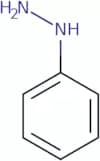
CAS :Phenyl hydrazine is a chemical reagent that is used in biological studies. It is an antimicrobial agent that has been shown to inhibit the growth of Gram-positive and Gram-negative bacteria, including Mycobacterium tuberculosis, Staphylococcus aureus and Klebsiella pneumoniae. Phenylhydrazine can be used as an iron chelator in wastewater treatment, where it removes excess iron from water. The optimum concentration of phenylhydrazine can be determined by using fluorescence probes to measure the cell nuclei of mammalian cells. Phenylhydrazine is also used in electrochemical impedance spectroscopy to measure the oxidative injury of human serum.
Formule :C6H8N2Degré de pureté :Min. 95%Couleur et forme :Colourless To Yellow To Light Brown LiquidMasse moléculaire :108.14 g/molHydrazine sulfate
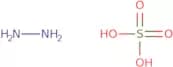
CAS :Produit contrôléHydrazine sulfate is a chemical compound that contains hydrazine and sulfate groups. Hydrazine sulfate is an intermediate in the synthesis of hydrazine, which is a colorless, flammable liquid with a pungent odor. Hydrazine sulfate has been used as an agent to treat liver diseases and cancer. It also has been used to control phosphorus levels in wastewater treatment plants. The carcinogenic effects of hydrazine sulfate are related to its ability to inhibit energy metabolism in cells. Hydrazine sulfate can be used for the treatment of solid tumours that are resistant to other anti-cancer drugs such as doxorubicin or vincristine. Hydrazine sulfate is an acidic, anhydrous solid that can be dissolved in water producing a solution with pH less than 7.
Formule :H4N2·H2SO4Degré de pureté :Min. 95%Masse moléculaire :130.12 g/molHydrazine sulfate-15N2
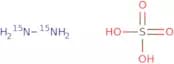
CAS :Produit contrôléHydrazine sulfate-15N2 is a trimethylsilylated hydrazine sulfate. It is used as an intermediate for the synthesis of N-trimethylsilylhydrazines and other trimethylsilylhydrazines. The compound can also be used to prepare glutamine as it reacts with dl-glutamine to form hydroxylamine, which then reacts with hydrogen sulfide to form glutathione. Hydrazine sulfate-15N2 is mainly used as a catalyst in the production of nitric acid from ammonia and oxygen gas.
Formule :H4N2·H2O4SDegré de pureté :Min. 95%Couleur et forme :PowderMasse moléculaire :132.11 g/molRef: 3D-FH166902
Produit arrêté7-Chloro-2-hydrazino-5-phenyl-3H-1,4-benzodiazepine
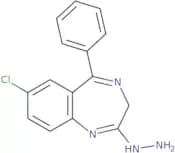
CAS :Produit contrôlé7-Chloro-2-hydrazino-5-phenyl-3H-1,4-benzodiazepine is a metabolically stable benzodiazepine that binds to the benzodiazepine receptor. It has been shown to have a higher affinity for this receptor than alprazolam and other related compounds. 7-Chloro-2-hydrazino-5-phenyl-3H-1,4-benzodiazepine has been used as an active ingredient in a number of pesticide products that are used against termites and ants. This compound has also been found to be an effective insecticide against mosquitoes. 7C2HDBZ has been shown to be stable in the environment and is not readily degraded by hydrolysis or pyrolysis.
Formule :C15H13ClN4Degré de pureté :Min. 95%Masse moléculaire :284.74 g/mol2-Hydroxyethyl hydrazine
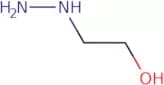
CAS :2-Hydroxyethyl hydrazine is a plant hormone that is synthesized from ethanolamine and hydrazine. It has a pyrazole ring, which acts as the central heterocyclic structure in this molecule. 2-Hydroxyethyl hydrazine is relatively stable in water, but it will decompose at higher temperatures. The ph optimum for 2-hydroxyethyl hydrazine is between 4 and 8. This compound can be found in model systems such as plants and fungi. The x-ray data indicates that 2-hydroxyethyl hydrazine has coordination geometry of D2O2 (2 molecules) with a bond length of 1.8 Å. Synthesis methods for this chemical include hydrochloric acid, inorganic acid, or oxidation by sodium hypochlorite. Pharmacological agents that activate this chemical include activation energies of 100 to 250 kilocalories per mole (kcal/mol).
Formule :C2H8N2ODegré de pureté :Min. 97.0 Area-%Couleur et forme :Colorless Clear LiquidMasse moléculaire :76.1 g/molRef: 3D-FH07794
Produit arrêté2-Ethylphenylhydrazine hydrochloride
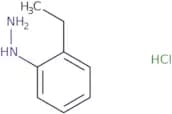
CAS :2-Ethylphenylhydrazine hydrochloride is a diazonium salt that catalyzes the reaction of nitrite with acetonitrile to produce an organic solvent. This organic solvent can be used in the production of various products, such as anti-inflammatory drugs, which are generally made from organic solvents. 2-Ethylphenylhydrazine hydrochloride is not a non-steroidal drug, but it does have anti-inflammatory properties. The impurities in this product are mainly hydrochloric acid and 2-ethylphenol.
Formule :C8H12N2•HClDegré de pureté :Min. 95%Masse moléculaire :172.66 g/molRef: 3D-FE139265
Produit arrêté