Silanes
Sous-catégories appartenant à la catégorie "Silanes"
1235 produits trouvés pour "Silanes"
n-OCTADECYLMETHYLDICHLOROSILANE
CAS :Alkyl Silane - Conventional Surface Bonding
Aliphatic, fluorinated aliphatic or substituted aromatic hydrocarbon substituents are the hydrophobic entities which enable silanes to induce surface hydrophobicity. The organic substitution of the silane must be non-polar. The hydrophobic effect of the organic substitution can be related to the free energy of transfer of hydrocarbon molecules from an aqueous phase to a homogeneous hydrocarbon phase. A successful hydrophobic coating must eliminate or mitigate hydrogen bonding and shield polar surfaces from interaction with water by creating a non-polar interphase. Although silane and silicone derived coatings are in general the most hydrophobic, they maintain a high degree of permeability to water vapor. This allows coatings to breathe and reduce deterioration at the coating interface associated with entrapped water. Since ions are not transported through non-polar silane and silicone coatings, they offer protection to composite structures ranging from pigmented coatings to rebar reinforced concrete. A selection guide for hydrophobic silanes can be found on pages 22-31 of the Hydrophobicity, Hydrophilicity and Silane Surface Modification brochure.
n-Octadecylmethyldichlorosilane; Dichloromethyl-n-octadecylsilane; Methyldichlorosilyloctadecane; Dichloromethylsilyloctadecane
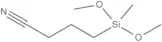
Contains 5-10% C18 isomersViscosity: 7 cStFormule :C19H40Cl2SiDegré de pureté :97% including isomersCouleur et forme :Straw LiquidMasse moléculaire :367.523-CYANOPROPYLMETHYLDIMETHOXYSILANE
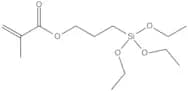
CAS :Formule :C7H15NO2SiDegré de pureté :97%Couleur et forme :Straw LiquidMasse moléculaire :173.29METHACRYLOXYPROPYLTRIETHOXYSILANE
CAS :Methacrylate Functional Trialkoxy Silane
Silane coupling agents have the ability to form a durable bond between organic and inorganic materials to generate desired heterogeneous environments or to incorporate the bulk properties of different phases into a uniform composite structure. The general formula has two classes of functionality. The hydrolyzable group forms stable condensation products with siliceous surfaces and other oxides such as those of aluminum, zirconium, tin, titanium, and nickel. The organofunctional group alters the wetting or adhesion characteristics of the substrate, utilizes the substrate to catalyze chemical transformations at the heterogeneous interface, orders the interfacial region, or modifies its partition characteristics, and significantly effects the covalent bond between organic and inorganic materials.
Methacryloxypropyltriethoxysilane
Coupling agent for radical cure polymer systems and UV cure systemsUsed in microparticle surface modificationComonomer for free-radical polymerizaitonInhibited with MEHQFormule :C13H26O5SiDegré de pureté :97%Couleur et forme :Straw LiquidMasse moléculaire :290.43METHYLTRICHLOROSILANE, 98% CYLINDER
CAS :Alkyl Silane - Conventional Surface Bonding
Aliphatic, fluorinated aliphatic or substituted aromatic hydrocarbon substituents are the hydrophobic entities which enable silanes to induce surface hydrophobicity. The organic substitution of the silane must be non-polar. The hydrophobic effect of the organic substitution can be related to the free energy of transfer of hydrocarbon molecules from an aqueous phase to a homogeneous hydrocarbon phase. A successful hydrophobic coating must eliminate or mitigate hydrogen bonding and shield polar surfaces from interaction with water by creating a non-polar interphase. Although silane and silicone derived coatings are in general the most hydrophobic, they maintain a high degree of permeability to water vapor. This allows coatings to breathe and reduce deterioration at the coating interface associated with entrapped water. Since ions are not transported through non-polar silane and silicone coatings, they offer protection to composite structures ranging from pigmented coatings to rebar reinforced concrete. A selection guide for hydrophobic silanes can be found on pages 22-31 of the Hydrophobicity, Hydrophilicity and Silane Surface Modification brochure.
Methyltrichlorosilane; Trichloromethylsilane; Trichlorosilylmethane
Viscosity: 0.46 cStΔHvap: 31.0 kJ/molSurface tension: 20.3 mN/mIonization potential: 11.36 eVSpecific heat: 0.92 J/g/°Vapor pressure, 13.5 °C: 100 mmCritical temperature: 243 °CCritical pressure: 39 atmCoefficient of thermal expansion: 1.3 x 10⁻³Fundamental builing-block for silicone resinsForms silicon carbide by pyrolysisIn a synergistic fashion with boron trifluoride etherate catalyzes the crossed imino aldehyde pinacol couplingHigher purity grade available, SIM6520.1Formule :CH3Cl3SiDegré de pureté :98%Couleur et forme :Straw LiquidMasse moléculaire :149.48n-PROPYLDIMETHYLCHLOROSILANE
CAS :Alkyl Silane - Conventional Surface Bonding
Aliphatic, fluorinated aliphatic or substituted aromatic hydrocarbon substituents are the hydrophobic entities which enable silanes to induce surface hydrophobicity. The organic substitution of the silane must be non-polar. The hydrophobic effect of the organic substitution can be related to the free energy of transfer of hydrocarbon molecules from an aqueous phase to a homogeneous hydrocarbon phase. A successful hydrophobic coating must eliminate or mitigate hydrogen bonding and shield polar surfaces from interaction with water by creating a non-polar interphase. Although silane and silicone derived coatings are in general the most hydrophobic, they maintain a high degree of permeability to water vapor. This allows coatings to breathe and reduce deterioration at the coating interface associated with entrapped water. Since ions are not transported through non-polar silane and silicone coatings, they offer protection to composite structures ranging from pigmented coatings to rebar reinforced concrete. A selection guide for hydrophobic silanes can be found on pages 22-31 of the Hydrophobicity, Hydrophilicity and Silane Surface Modification brochure.
n-Propyldimethylchlorosilane; Chlorodimethyl-n-propylsilaneFormule :C5H13ClSiDegré de pureté :97%Couleur et forme :Straw LiquidMasse moléculaire :136.7PHENYLSILANE
CAS :Mono-substituted Silane Reducing Agent
Organosilanes are hydrocarbon-like and possess the ability to serve as both ionic and free-radical reducing agents. These reagents and their reaction by-products are safer and more easily handled and disposed than many other reducing agents. The metallic nature of silicon and its low electronegativity relative to hydrogen lead to polarization of the Si-H bond yielding a hydridic hydrogen and a milder reducing agent compared to aluminum-, boron-, and other metal-based hydrides. A summary of some key silane reductions are presented in Table 1 of the Silicon-Based Reducing Agents brochure.
Trihydridosilane
Silyl Hydrides are a distinct class of silanes that behave and react very differently than conventional silane coupling agents. They react with the liberation of byproduct hydrogen. Silyl hydrides can react with hydroxylic surfaces under both non-catalyzed and catalyzed conditions by a dehydrogenative coupling mechanism. Trihydridosilanes react with a variety of pure metal surfaces including gold, titanium, zirconium and amorphous silicon, by a dissociative adsorption mechanism. The reactions generally take place at room temperature and can be conducted in the vapor phase or with the pure silane or solutions of the silane in aprotic solvents. Deposition should not be conducted in water, alcohol or protic solvents.
Phenylsilane; Silylbenzene
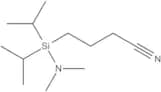
ΔHvap: 34.8 kJ/molEmployed in the reduction of esters to ethersReduces α,β-unsaturated ketones to saturated ketones in the presence of tri-n-butyltin hydrideReduces tin amides to tin hydridesUsed in the tin-catalyzed reduction of nitroalkanes to alkanesReduces α-halo ketones in presence of Mo(0)Adds to norbornene with high eeReducing reagent in radical reductionsYields ISiH3 on treatments with HI in presence of AlI3Extensive review of silicon based reducing agents: Larson, G.; Fry, J. L. "Ionic and Organometallic-Catalyzed Organosilane Reductions", Wipf, P., Ed.; Wiley, 2007Formule :C6H8SiDegré de pureté :97%Couleur et forme :LiquidMasse moléculaire :108.213-CYANOPROPYLDIISOPROPYL(DIMETHYLAMINO)SILANE
CAS :Formule :C12H26N2SiDegré de pureté :97%Couleur et forme :Straw LiquidMasse moléculaire :226.44BIS(DIMETHYLAMINO)DIMETHYLSILANE
CAS :Bridging Silicon-Based Blocking Agent
Used as a protecting group for reactive hydrogens in alcohols, amines, thiols, and carboxylic acids. Organosilanes are hydrogen-like, can be introduced in high yield, and can be removed under selective conditions. They are stable over a wide range of reaction conditions and can be removed in the presence of other functional groups, including other protecting groups. The tolerance of silylated alcohols to chemical transformations summary is presented in Table 1 of the Silicon-Based Blocking Agents brochure.
ALD Material
Atomic layer deposition (ALD) is a chemically self-limiting deposition technique that is based on the sequential use of a gaseous chemical process. A thin film (as fine as -0.1 Å per cycle) results from repeating the deposition sequence as many times as needed to reach a certain thickness. The major characteristic of the films is the resulting conformality and the controlled deposition manner. Precursor selection is key in ALD processes, namely finding molecules which will have enough reactivity to produce the desired films yet are stable enough to be handled and safely delivered to the reaction chamber.
Alkyl Silane - Conventional Surface Bonding
Aliphatic, fluorinated aliphatic or substituted aromatic hydrocarbon substituents are the hydrophobic entities which enable silanes to induce surface hydrophobicity. The organic substitution of the silane must be non-polar. The hydrophobic effect of the organic substitution can be related to the free energy of transfer of hydrocarbon molecules from an aqueous phase to a homogeneous hydrocarbon phase. A successful hydrophobic coating must eliminate or mitigate hydrogen bonding and shield polar surfaces from interaction with water by creating a non-polar interphase. Although silane and silicone derived coatings are in general the most hydrophobic, they maintain a high degree of permeability to water vapor. This allows coatings to breathe and reduce deterioration at the coating interface associated with entrapped water. Since ions are not transported through non-polar silane and silicone coatings, they offer protection to composite structures ranging from pigmented coatings to rebar reinforced concrete. A selection guide for hydrophobic silanes can be found on pages 22-31 of the Hydrophobicity, Hydrophilicity and Silane Surface Modification brochure.
Bis(Dimethylamino)dimethylsilane; Dimethylbis(dimethylamino)silane; Hexamethylsilanediamine; DMS
More reactive than SIB4120.0Couples silanol terminated siloxanesReacted with diols, diamines, and treatment for glassSummary of selective deprotection conditions is provided in Table 7 through Table 20 of the Silicon-Based Blocking Agents brochureFormule :C6H18N2SiDegré de pureté :97%Couleur et forme :Straw LiquidMasse moléculaire :146.31VINYLMETHYLDICHLOROSILANE
CAS :Alkenylsilane Cross-Coupling Agent
The cross-coupling reaction is a highly useful methodology for the formation of carbon-carbon bonds. It involves two reagents, with one typically being a suitable organometallic reagent - the nucleophile - and the other a suitable organic substrate, normally an unsaturated halide, tosylate or similar - the electrophile.
Vinylmethyldichlorosilane; Dichlorovinylmethylsilane; Methylvinyldichlorosilane; Dichloroethenylmethylsilane
Viscosity: 0.70 cStΔHvap: 33.9 kJ/molCritical temperature: 272 °CCoefficient of thermal expansion: 1.4 x 10⁻³Reacts to vinylate aryl halides under NaOH-moderated conditionsUsed as a tether in synthesis of C-glycosidesExtensive review of silicon based cross-coupling agents: Denmark, S. E. et al. "Organic Reactions, Volume 75" Denmark, S. E. ed., John Wiley and Sons, 233, 2011Formule :C3H6Cl2SiDegré de pureté :97%Couleur et forme :Straw Amber LiquidMasse moléculaire :141.07TETRACHLOROSILANE, 99.99+%
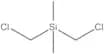
CAS :Formule :Cl4SnDegré de pureté :99.99%Couleur et forme :Straw LiquidMasse moléculaire :169.9BIS(CHLOROMETHYL)DIMETHYLSILANE
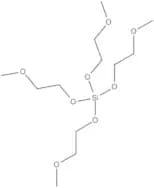
CAS :Formule :C4H10Cl2SiDegré de pureté :97%Couleur et forme :Straw LiquidMasse moléculaire :157.11TETRAKIS(METHOXYETHOXY)SILANE, tech
CAS :Formule :C12H28O8SiDegré de pureté :95%Couleur et forme :LiquidMasse moléculaire :328.43TETRAMETHYLSILANE, 99+%
CAS :Tetramethylsilane; 4MS; TMS
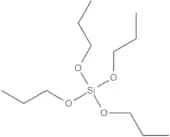
NMR gradeViscosity: 0.4 cSt?Hcomb: 3,851 kJ/mol?Hform: -232 kJ/mol?Hvap: 26.8 kJ/mol?Hfus: 6.7 kJ/molPhotoionization threshold: 8.1 eVCe: 1.838 x 10⁻³Vapor pressure, 20 °C: 589 mmCritical temperature: 185 °CCritical pressure: 33 atmHeat capacity: 195.2 Jmol-1K-1Dielectric constant: 1.92Intermediate for ?-SiC:H thin films by PECVDFormule :C4H12SiDegré de pureté :99%Couleur et forme :Straw LiquidMasse moléculaire :88.22TETRA-n-PROPOXYSILANE
CAS :Formule :C12H28O4SiDegré de pureté :97%Couleur et forme :LiquidMasse moléculaire :264.44DIMETHOXYSILYLMETHYLPROPYL MODIFIED (POLYETHYLENIMINE), 50% in isopropanol
CAS :dimethoxysilylmethylpropyl modified (polyethylenimine)
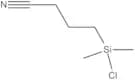
Polyamino hydrophilic dialkoxysilanePrimer for brassViscosity: 100-200 cSt~20% of nitrogens substituted50% in isopropanolCouleur et forme :Straw Yellow Amber LiquidMasse moléculaire :1500-18003-CYANOPROPYLDIMETHYLCHLOROSILANE
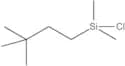
CAS :Formule :C6H12ClNSiDegré de pureté :97%Couleur et forme :Straw Amber LiquidMasse moléculaire :161.71(3,3-DIMETHYLBUTYL)DIMETHYLCHLOROSILANE
CAS :Trialkylsilyl Blocking Agent
Used as a protecting group for reactive hydrogens in alcohols, amines, thiols, and carboxylic acids. Organosilanes are hydrogen-like, can be introduced in high yield, and can be removed under selective conditions. They are stable over a wide range of reaction conditions and can be removed in the presence of other functional groups, including other protecting groups. The tolerance of silylated alcohols to chemical transformations summary is presented in Table 1 of the Silicon-Based Blocking Agents brochure.
Alkyl Silane - Conventional Surface Bonding
Aliphatic, fluorinated aliphatic or substituted aromatic hydrocarbon substituents are the hydrophobic entities which enable silanes to induce surface hydrophobicity. The organic substitution of the silane must be non-polar. The hydrophobic effect of the organic substitution can be related to the free energy of transfer of hydrocarbon molecules from an aqueous phase to a homogeneous hydrocarbon phase. A successful hydrophobic coating must eliminate or mitigate hydrogen bonding and shield polar surfaces from interaction with water by creating a non-polar interphase. Although silane and silicone derived coatings are in general the most hydrophobic, they maintain a high degree of permeability to water vapor. This allows coatings to breathe and reduce deterioration at the coating interface associated with entrapped water. Since ions are not transported through non-polar silane and silicone coatings, they offer protection to composite structures ranging from pigmented coatings to rebar reinforced concrete. A selection guide for hydrophobic silanes can be found on pages 22-31 of the Hydrophobicity, Hydrophilicity and Silane Surface Modification brochure.
3,3-Dimethylbutyldimethylchlorosilane; Neohexyldimethylchlorosilane
Sterically hindered neohexylchlorosilane protecting groupBlocking agent, forms bonded phases for HPLCSummary of selective deprotection conditions is provided in Table 7 through Table 20 of the Silicon-Based Blocking Agents brochureFormule :C8H19ClSiDegré de pureté :97%Couleur et forme :Straw LiquidMasse moléculaire :178.78METHYLTRIETHOXYSILANE, 99+%
CAS :Formule :C7H18O3SiDegré de pureté :99+%Couleur et forme :LiquidMasse moléculaire :178.3N-(2-AMINOETHYL)-11-AMINOUNDECYLTRIMETHOXYSILANE
CAS :N-(2-Aminoethyl)-11-aminoundecyltrimethoxysilane
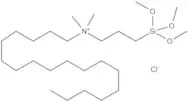
Diamino functional trialkoxy silanePrimary amine and an internal secondary amineUsed in microparticle surface modificationCoupling agent with extended spacer-group for remote substrate binding in UV cure and epoxy systemsLong chain analog of SIA0591.1Formule :C16H38N2O3SiDegré de pureté :97%Couleur et forme :Straw LiquidMasse moléculaire :334.57OCTADECYLDIMETHYL(3-TRIMETHOXYSILYLPROPYL)AMMONIUM CHLORIDE, 60% in methanol
CAS :Quaternary Amino Functional Trialkoxy Silane
Silane coupling agents have the ability to form a durable bond between organic and inorganic materials to generate desired heterogeneous environments or to incorporate the bulk properties of different phases into a uniform composite structure. The general formula has two classes of functionality. The hydrolyzable group forms stable condensation products with siliceous surfaces and other oxides such as those of aluminum, zirconium, tin, titanium, and nickel. The organofunctional group alters the wetting or adhesion characteristics of the substrate, utilizes the substrate to catalyze chemical transformations at the heterogeneous interface, orders the interfacial region, or modifies its partition characteristics, and significantly effects the covalent bond between organic and inorganic materials.
Octadecyldimethyl(3-trimethoxysilylpropyl)ammonium chloride; (trimethoxysilylpropyl)octadecyldimethylammonium chloride; dimethyloctadecyl[3-(trimethoxysilyl)propyl]ammonium chloride
Employed as a glass lubricantOrients liquid crystalsProvides an antistatic surface coatingDispersion/coupling agent for high density magnetic recording media60% in methanolContains 3-5% Cl(CH2)3Si(OMe)3Formule :C26H58ClNO3SiCouleur et forme :Straw LiquidMasse moléculaire :496.29