


Silanes
Sous-catégories appartenant à la catégorie "Silanes"
1234 produits trouvés pour "Silanes"
TRIS(3-TRIMETHOXYSILYLPROPYL)ISOCYANURATE, tech
CAS :Tris(3-trimethoxysilylpropyl)isocyanurate; 1,3,5-tris[3-(trimethoxysilyl)propyl]-1,3,5-triazine-2,4,6(1h,3h,5h)-trione
Masked isocyanate functional trialkoxy silaneViscosity: 150-350 cStCoupling agent for polyimides to silicon metalAdhesion promoter for hotmelt adhesivesForms periodic mesoporous silicasFormule :C21H45N3O12Si3Degré de pureté :95% functional actives (contains analogous compounds)Couleur et forme :Straw LiquidMasse moléculaire :615.863-[HYDROXY(POLYETHYLENEOXY)PROPYL]HEPTAMETHYLTRISILOXANE, 90%
CAS :PEGylated Silicone, Trisiloxane (550-650 g/mol)
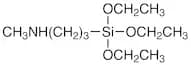
PEO, PEG, Hydroxyl terminated trisiloxane utilized for hydrophilic surface modificationPEGylation reagentViscosity: 35 cStFormule :HO(CH2CH2O)6-9(CH2)3(CH3)[OSi(CH3)3]2SiDegré de pureté :90%Couleur et forme :LiquidMasse moléculaire :550-650N-Methyl-3-(triethoxysilyl)propan-1-amine
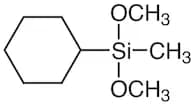
CAS :Formule :C10H25NO3SiDegré de pureté :>97.0%(GC)(T)Couleur et forme :Colorless to Light yellow clear liquidMasse moléculaire :235.40Cyclohexyl(dimethoxy)methylsilane
CAS :Formule :C9H20O2SiDegré de pureté :>98.0%(GC)Couleur et forme :Colorless to Almost colorless clear liquidMasse moléculaire :188.342-Propynyl [3-(Triethoxysilyl)propyl]carbamate
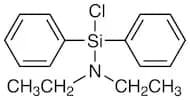
CAS :Formule :C13H25NO5SiDegré de pureté :>90.0%(GC)Couleur et forme :Colorless to Yellow clear liquidMasse moléculaire :303.431-Chloro-N,N-diethyl-1,1-diphenylsilanamine
CAS :Formule :C16H20ClNSiDegré de pureté :>95.0%(T)Couleur et forme :Colorless to Light yellow clear liquidMasse moléculaire :289.88Chlorodimethyl[3-(2,3,4,5,6-pentafluorophenyl)propyl]silane
CAS :Formule :C11H12ClF5SiDegré de pureté :>95.0%(GC)Couleur et forme :Colorless to Light yellow clear liquid to cloudy liquidMasse moléculaire :302.742,5-Bis[(trimethylsilyl)ethynyl]thiophene
CAS :Formule :C14H20SSi2Degré de pureté :>96.0%(GC)Couleur et forme :Light yellow to Yellow to Orange powder to crystalMasse moléculaire :276.541-Methyl-3-[3-(trimethoxysilyl)propyl]-1H-imidazol-3-ium Chloride
CAS :Formule :C10H21ClN2O3SiDegré de pureté :>95.0%(T)(HPLC)Couleur et forme :Colorless to Light yellow to Light orange clear liquidMasse moléculaire :280.82[3-(Trimethoxysilyl)propyl]succinic Anhydride
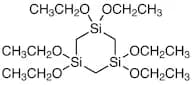
CAS :Formule :C10H18O6SiDegré de pureté :>95.0%(T)Couleur et forme :Colorless to Light yellow clear liquidMasse moléculaire :262.331,1,3,3,5,5-Hexaethoxy-1,3,5-trisilacyclohexane
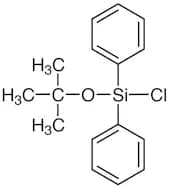
CAS :Formule :C15H36O6Si3Degré de pureté :>90.0%(GC)Couleur et forme :Colorless to Almost colorless clear liquidMasse moléculaire :396.70tert-Butoxydiphenylchlorosilane (stabilized with CaCO3)
CAS :Formule :C16H19ClOSiDegré de pureté :>95.0%(GC)Couleur et forme :Colorless to Almost colorless clear liquidMasse moléculaire :290.86Diethyl(methyl)silane
CAS :Formule :C5H14SiDegré de pureté :>98.0%(GC)Couleur et forme :White to Light yellow powder to crystalMasse moléculaire :102.252-[Methoxy(polyethyleneoxy)6-9propyl]trimethoxysilane
CAS :S25235 - 2-[Methoxy(polyethyleneoxy)6-9propyl]trimethoxysilane
Formule :(C2H4O2)nC7H18O3SiDegré de pureté :90%Couleur et forme :LiquidMasse moléculaire :459-591Aminopropyl terminated polydimethylsiloxane cSt 4,000-6,000
CAS :DMS-A35 - Aminopropyl terminated polydimethylsiloxane cSt 4,000-6,000
Couleur et forme :Liquid, ClearMasse moléculaire :0.0Silanol terminated polydimethylsiloxanes cSt 50,000
CAS :DMS-S45 - Silanol terminated polydimethylsiloxanes cSt 50,000
Couleur et forme :Liquid, ClearMasse moléculaire :0.0Aminopropyl terminated polydimethylsiloxane cSt 100-120
CAS :DMS-A21 - Aminopropyl terminated polydimethylsiloxane cSt 100-120
Couleur et forme :Liquid, ClearMasse moléculaire :338.187722538Silanol terminated polydimethylsiloxane cSt 5000
CAS :DMS-S35 - Silanol terminated polydimethylsiloxane cSt 5000
Couleur et forme :Liquid, ClearMasse moléculaire :0.0Aminoproplyterminated polydimethylsiloxane cSt 20-30
CAS :DMS-A12 - Aminoproplyterminated polydimethylsiloxane cSt 20-30
Couleur et forme :Liquid, ClearMasse moléculaire :338.187722538MonoCarbinol terminated functional Polydimethylsiloxane - symmetric cSt 35-40
CAS :MCS-C13 - MonoCarbinol terminated functional Polydimethylsiloxane - symmetric cSt 35-40
Couleur et forme :Liquid, Clear LiquidMasse moléculaire :0.0


![3-[HYDROXY(POLYETHYLENEOXY)PROPYL]HEPTAMETHYLTRISILOXANE, 90%](/_next/image/?url=https%3A%2Fstatic.cymitquimica.com%2Fproducts%2F3H%2Fthumb-webp%2FSIH6185.0.webp&w=3840&q=75)

![2-Propynyl [3-(Triethoxysilyl)propyl]carbamate](/_next/image/?url=https%3A%2Fstatic.cymitquimica.com%2Fproducts%2F3B%2Fthumb-webp%2FP2258.webp&w=3840&q=75)
![Chlorodimethyl[3-(2,3,4,5,6-pentafluorophenyl)propyl]silane](/_next/image/?url=https%3A%2Fstatic.cymitquimica.com%2Fproducts%2F3B%2Fthumb-webp%2FC2700.webp&w=3840&q=75)
![2,5-Bis[(trimethylsilyl)ethynyl]thiophene](/_next/image/?url=https%3A%2Fstatic.cymitquimica.com%2Fproducts%2F3B%2Fthumb-webp%2FB4240.webp&w=3840&q=75)
![1-Methyl-3-[3-(trimethoxysilyl)propyl]-1H-imidazol-3-ium Chloride](/_next/image/?url=https%3A%2Fstatic.cymitquimica.com%2Fproducts%2F3B%2Fthumb-webp%2FM3446.webp&w=3840&q=75)
![[3-(Trimethoxysilyl)propyl]succinic Anhydride](/_next/image/?url=https%3A%2Fstatic.cymitquimica.com%2Fproducts%2F3B%2Fthumb-webp%2FT3360.webp&w=3840&q=75)

![2-[Methoxy(polyethyleneoxy)6-9propyl]trimethoxysilane](/_next/image/?url=https%3A%2Fstatic.cymitquimica.com%2Fproducts%2F10%2Fthumb-webp%2FS25235.webp&w=3840&q=75)


