Silanes
Sous-catégories appartenant à la catégorie "Silanes"
1234 produits trouvés pour "Silanes"
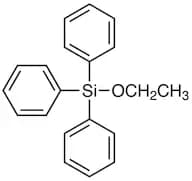
Ethoxytriphenylsilane
CAS :Formule :C20H20OSiDegré de pureté :>95.0%(GC)Couleur et forme :White to Almost white powder to crystalMasse moléculaire :304.46(tert-Butyldimethylsilyloxy)malononitrile
CAS :Formule :C9H16N2OSiDegré de pureté :>93.0%(GC)Couleur et forme :White to Yellow to Green clear liquidMasse moléculaire :196.33N,N-Bis[(diphenylphosphino)methyl]-3-(triethoxysilyl)propylamine
CAS :Formule :C35H45NO3P2SiDegré de pureté :>95.0%(N)Couleur et forme :Colorless to Light yellow to Light orange clear liquidMasse moléculaire :617.78Phenyl[2-(trimethylsilyl)phenyl]iodonium Trifluoromethanesulfonate
CAS :Formule :C16H18F3IO3SSiDegré de pureté :>97.0%(T)(HPLC)Couleur et forme :White to Almost white powder to crystalMasse moléculaire :502.36Chloro(ethyl)dimethylsilane [Dimethylethylsilylating Agent]
CAS :Formule :C4H11ClSiDegré de pureté :>97.0%(GC)Couleur et forme :Colorless to Almost colorless clear liquidMasse moléculaire :122.67Decyltrichlorosilane
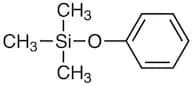
CAS :Formule :C10H21Cl3SiDegré de pureté :>97.0%(GC)Couleur et forme :Colorless to Light yellow clear liquidMasse moléculaire :275.71Trimethyl(phenoxy)silane
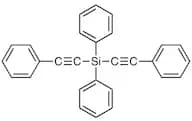
CAS :Formule :C9H14OSiDegré de pureté :>97.0%(GC)Couleur et forme :Colorless to Light orange to Yellow clear liquidMasse moléculaire :166.30Diphenylbis(phenylethynyl)silane
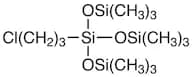
CAS :Formule :C28H20SiDegré de pureté :>98.0%(GC)Couleur et forme :White to Almost white powder to crystalMasse moléculaire :384.55(3-Chloropropyl)tris(trimethylsilyloxy)silane
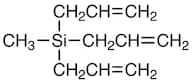
CAS :Formule :C12H33ClO3Si4Degré de pureté :>96.0%(GC)Couleur et forme :Colorless to Light yellow clear liquidMasse moléculaire :373.18Triallyl(methyl)silane
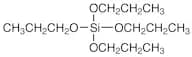
CAS :Formule :C10H18SiDegré de pureté :>95.0%(GC)Couleur et forme :Colorless to Almost colorless clear liquidMasse moléculaire :166.34Tetrapropyl Orthosilicate
CAS :Formule :C12H28O4SiDegré de pureté :>98.0%(GC)Couleur et forme :Colorless to Almost colorless clear liquidMasse moléculaire :264.441,1,2,2-Tetramethyl-1,2-diphenyldisilane
CAS :Formule :C16H22Si2Degré de pureté :>95.0%(GC)Couleur et forme :White to Light yellow powder to lumpMasse moléculaire :270.523-[[Dimethyl(vinyl)silyl]oxy]-1,1,5,5-tetramethyl-3-phenyl-1,5-divinyltrisiloxane
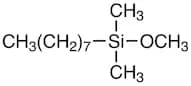
CAS :Formule :C18H32O3Si4Degré de pureté :>98.0%(GC)Couleur et forme :Colorless to Almost colorless clear liquidMasse moléculaire :408.79Methoxy(dimethyl)-n-octylsilane
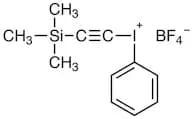
CAS :Formule :C11H26OSiDegré de pureté :>95.0%(GC)Couleur et forme :Colorless to Almost colorless clear liquidMasse moléculaire :202.41Trimethylsilylethynyl(phenyl)iodonium Tetrafluoroborate
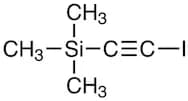
CAS :Formule :C11H14BF4ISiDegré de pureté :>98.0%(T)Couleur et forme :White to Light yellow to Light orange powder to crystalMasse moléculaire :388.03(Iodoethynyl)trimethylsilane
CAS :Formule :C5H9ISiDegré de pureté :>98.0%(GC)Couleur et forme :Colorless to Red to Green clear liquidMasse moléculaire :224.12DIMETHOXYSILYLMETHYLPROPYL MODIFIED (POLYETHYLENIMINE), 50% in isopropanol
CAS :dimethoxysilylmethylpropyl modified (polyethylenimine)
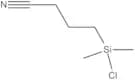
Polyamino hydrophilic dialkoxysilanePrimer for brassViscosity: 100-200 cSt~20% of nitrogens substituted50% in isopropanolCouleur et forme :Straw Yellow Amber LiquidMasse moléculaire :1500-18003-CYANOPROPYLDIMETHYLCHLOROSILANE
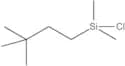
CAS :Formule :C6H12ClNSiDegré de pureté :97%Couleur et forme :Straw Amber LiquidMasse moléculaire :161.71(3,3-DIMETHYLBUTYL)DIMETHYLCHLOROSILANE
CAS :Trialkylsilyl Blocking Agent
Used as a protecting group for reactive hydrogens in alcohols, amines, thiols, and carboxylic acids. Organosilanes are hydrogen-like, can be introduced in high yield, and can be removed under selective conditions. They are stable over a wide range of reaction conditions and can be removed in the presence of other functional groups, including other protecting groups. The tolerance of silylated alcohols to chemical transformations summary is presented in Table 1 of the Silicon-Based Blocking Agents brochure.
Alkyl Silane - Conventional Surface Bonding
Aliphatic, fluorinated aliphatic or substituted aromatic hydrocarbon substituents are the hydrophobic entities which enable silanes to induce surface hydrophobicity. The organic substitution of the silane must be non-polar. The hydrophobic effect of the organic substitution can be related to the free energy of transfer of hydrocarbon molecules from an aqueous phase to a homogeneous hydrocarbon phase. A successful hydrophobic coating must eliminate or mitigate hydrogen bonding and shield polar surfaces from interaction with water by creating a non-polar interphase. Although silane and silicone derived coatings are in general the most hydrophobic, they maintain a high degree of permeability to water vapor. This allows coatings to breathe and reduce deterioration at the coating interface associated with entrapped water. Since ions are not transported through non-polar silane and silicone coatings, they offer protection to composite structures ranging from pigmented coatings to rebar reinforced concrete. A selection guide for hydrophobic silanes can be found on pages 22-31 of the Hydrophobicity, Hydrophilicity and Silane Surface Modification brochure.
3,3-Dimethylbutyldimethylchlorosilane; Neohexyldimethylchlorosilane
Sterically hindered neohexylchlorosilane protecting groupBlocking agent, forms bonded phases for HPLCSummary of selective deprotection conditions is provided in Table 7 through Table 20 of the Silicon-Based Blocking Agents brochureFormule :C8H19ClSiDegré de pureté :97%Couleur et forme :Straw LiquidMasse moléculaire :178.78METHYLTRIETHOXYSILANE, 99+%
CAS :Formule :C7H18O3SiDegré de pureté :99+%Couleur et forme :LiquidMasse moléculaire :178.3N-(2-AMINOETHYL)-11-AMINOUNDECYLTRIMETHOXYSILANE
CAS :N-(2-Aminoethyl)-11-aminoundecyltrimethoxysilane
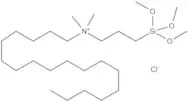
Diamino functional trialkoxy silanePrimary amine and an internal secondary amineUsed in microparticle surface modificationCoupling agent with extended spacer-group for remote substrate binding in UV cure and epoxy systemsLong chain analog of SIA0591.1Formule :C16H38N2O3SiDegré de pureté :97%Couleur et forme :Straw LiquidMasse moléculaire :334.57OCTADECYLDIMETHYL(3-TRIMETHOXYSILYLPROPYL)AMMONIUM CHLORIDE, 60% in methanol
CAS :Quaternary Amino Functional Trialkoxy Silane
Silane coupling agents have the ability to form a durable bond between organic and inorganic materials to generate desired heterogeneous environments or to incorporate the bulk properties of different phases into a uniform composite structure. The general formula has two classes of functionality. The hydrolyzable group forms stable condensation products with siliceous surfaces and other oxides such as those of aluminum, zirconium, tin, titanium, and nickel. The organofunctional group alters the wetting or adhesion characteristics of the substrate, utilizes the substrate to catalyze chemical transformations at the heterogeneous interface, orders the interfacial region, or modifies its partition characteristics, and significantly effects the covalent bond between organic and inorganic materials.
Octadecyldimethyl(3-trimethoxysilylpropyl)ammonium chloride; (trimethoxysilylpropyl)octadecyldimethylammonium chloride; dimethyloctadecyl[3-(trimethoxysilyl)propyl]ammonium chloride
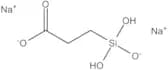
Employed as a glass lubricantOrients liquid crystalsProvides an antistatic surface coatingDispersion/coupling agent for high density magnetic recording media60% in methanolContains 3-5% Cl(CH2)3Si(OMe)3Formule :C26H58ClNO3SiCouleur et forme :Straw LiquidMasse moléculaire :496.29CARBOXYETHYLSILANETRIOL, DISODIUM SALT, 25% in water
CAS :carboxyethylsilanetriol, disodium salt; 3-trihydroxysilylpropanoic acid, disodium salt
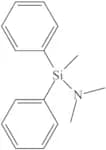
Carboxylate functional trihydroxy silaneUsed in combination with aminofunctional silanes to form amphoteric silicaspH: 12 - 12.525% in waterUsed in microparticle surface modificationFormule :C3H6Na2O5SiCouleur et forme :LiquidMasse moléculaire :196.14(DIPHENYL)METHYL(DIMETHYLAMINO)SILANE
CAS :Phenyl-Containing Blocking Agent
Used as a protecting group for reactive hydrogens in alcohols, amines, thiols, and carboxylic acids. Organosilanes are hydrogen-like, can be introduced in high yield, and can be removed under selective conditions. They are stable over a wide range of reaction conditions and can be removed in the presence of other functional groups, including other protecting groups. The tolerance of silylated alcohols to chemical transformations summary is presented in Table 1 of the Silicon-Based Blocking Agents brochure.
Aromatic Silane - Conventional Surface Bonding
Aliphatic, fluorinated aliphatic or substituted aromatic hydrocarbon substituents are the hydrophobic entities which enable silanes to induce surface hydrophobicity. The organic substitution of the silane must be non-polar. The hydrophobic effect of the organic substitution can be related to the free energy of transfer of hydrocarbon molecules from an aqueous phase to a homogeneous hydrocarbon phase. A successful hydrophobic coating must eliminate or mitigate hydrogen bonding and shield polar surfaces from interaction with water by creating a non-polar interphase. Although silane and silicone derived coatings are in general the most hydrophobic, they maintain a high degree of permeability to water vapor. This allows coatings to breathe and reduce deterioration at the coating interface associated with entrapped water. Since ions are not transported through non-polar silane and silicone coatings, they offer protection to composite structures ranging from pigmented coatings to rebar reinforced concrete. A selection guide for hydrophobic silanes can be found on pages 22-31 of the Hydrophobicity, Hydrophilicity and Silane Surface Modification brochure.
Diphenylmethyl(dimethylamino)silane; N,N,1-Trimethyl-1,1-diphenylsilanamine
More reactive than SID4552.0Liberates dimethylamine upon reactionSummary of selective deprotection conditions is provided in Table 7 through Table 20 of the Silicon-Based Blocking Agents brochureFormule :C15H19NSiDegré de pureté :97%Couleur et forme :Straw LiquidMasse moléculaire :232.78NONAFLUOROHEXYLTRIS(DIMETHYLAMINO)SILANE
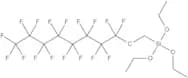
CAS :Formule :C12H22F9N3SiDegré de pureté :97%Couleur et forme :Straw LiquidMasse moléculaire :407.4(HEPTADECAFLUORO-1,1,2,2-TETRAHYDRODECYL)TRIETHOXYSILANE
CAS :Fluorinated Alkyl Silane - Conventional Surface Bonding
Aliphatic, fluorinated aliphatic or substituted aromatic hydrocarbon substituents are the hydrophobic entities which enable silanes to induce surface hydrophobicity. The organic substitution of the silane must be non-polar. The hydrophobic effect of the organic substitution can be related to the free energy of transfer of hydrocarbon molecules from an aqueous phase to a homogeneous hydrocarbon phase. A successful hydrophobic coating must eliminate or mitigate hydrogen bonding and shield polar surfaces from interaction with water by creating a non-polar interphase. Although silane and silicone derived coatings are in general the most hydrophobic, they maintain a high degree of permeability to water vapor. This allows coatings to breathe and reduce deterioration at the coating interface associated with entrapped water. Since ions are not transported through non-polar silane and silicone coatings, they offer protection to composite structures ranging from pigmented coatings to rebar reinforced concrete. A selection guide for hydrophobic silanes can be found on pages 22-31 of the Hydrophobicity, Hydrophilicity and Silane Surface Modification brochure.
Perfluorooctylethyl triethoxysilane; (1H,1H,2H,2H-Perfluorodecyl)triethoxysilane; Triethoxy(3,3,4,4,5,5,6,6,7,7,8,8,9,9,10,10,10-heptadecafluorodecyl)silane
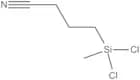
Packaged over copper powderHydrolysis in combination with polydimethoxysiloxane gives hard hydrophobic coatingsTrialkoxy silaneFormule :C16H19F17O3SiDegré de pureté :97%Couleur et forme :Straw LiquidMasse moléculaire :610.383-CYANOPROPYLMETHYLDICHLOROSILANE
CAS :Formule :C5H9Cl2NSiDegré de pureté :97%Couleur et forme :Straw LiquidMasse moléculaire :182.12DIMETHYLDIETHOXYSILANE, 98%
CAS :Alkyl Silane - Conventional Surface Bonding
Aliphatic, fluorinated aliphatic or substituted aromatic hydrocarbon substituents are the hydrophobic entities which enable silanes to induce surface hydrophobicity. The organic substitution of the silane must be non-polar. The hydrophobic effect of the organic substitution can be related to the free energy of transfer of hydrocarbon molecules from an aqueous phase to a homogeneous hydrocarbon phase. A successful hydrophobic coating must eliminate or mitigate hydrogen bonding and shield polar surfaces from interaction with water by creating a non-polar interphase. Although silane and silicone derived coatings are in general the most hydrophobic, they maintain a high degree of permeability to water vapor. This allows coatings to breathe and reduce deterioration at the coating interface associated with entrapped water. Since ions are not transported through non-polar silane and silicone coatings, they offer protection to composite structures ranging from pigmented coatings to rebar reinforced concrete. A selection guide for hydrophobic silanes can be found on pages 22-31 of the Hydrophobicity, Hydrophilicity and Silane Surface Modification brochure.
Dimethyldiethoxysilane; Diethoxydimethylsilane
Viscosity: 0.53 cStVapor pressure, 25 °C: 15 mmΔHcomb: -4,684 kJ/molΔHform: 837 kJ/molΔHvap: 41.0 kJ/molDipole moment: 1.39 debyeVapor pressure, 25 °C: 15 mmCoefficient of thermal expansion: 1.3 x 10⁻³Hydrophobic surface treatment and release agentDialkoxy silaneFormule :C6H16O2SiDegré de pureté :98%Couleur et forme :Colorless To Slightly Yellow LiquidMasse moléculaire :148.28BIS(CYANOPROPYL)DICHLOROSILANE
CAS :Formule :C8H12Cl2N2SiDegré de pureté :95%Couleur et forme :Straw LiquidMasse moléculaire :235.19HEXAMETHYLDISILANE
CAS :Hexamethyldisilane; HMD; 2,2,3,3-Tetramethyl-2,3-disilabutane
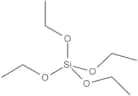
Viscosity: 1.0 cStΔHcomb: 5,909 kJ/molΔHform: -494 kJ/molΔHvap: 39.8 kJ/molVapor pressure, 20 °C: 22.9 mmEa decomposition at 545 K: 337 kJ/molRotational barrier, Si–Si: 4.40 kJ/molSecondary NMR reference: δ = 0.045Source for trimethylsilyl anionReplaces aromatic nitriles with TMS groups in presence of [RhCl(cod)]2Precursor for CVD of silicon carbideBrings about the homocoupling of arenesulfonyl chlorides in the presence of Pd2(dba)3Used as a solvent for the direct borylation of fluoroaromaticsReacts with alkynes to form silolesUndergoes the silylation of acid chlorides to give acylsilanesFormule :C6H18Si2Couleur et forme :LiquidMasse moléculaire :146.38TETRAETHOXYSILANE, 98%
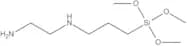
CAS :Formule :C8H20O4SiDegré de pureté :98%Couleur et forme :LiquidMasse moléculaire :208.33N-(2-AMINOETHYL)-3-AMINOPROPYLTRIMETHOXYSILANE, 98%
CAS :N-(2-Aminoethyl)-3-aminopropyltrimethoxysilane, N-[3-(trimethoxysilyl)prpyl]ethylenediamine, DAMO
Diamino functional trialkoxy silaneViscosity: 6.5 cStγc of treated surfaces: 36.5 mN/mSpecific wetting surface: 358 m2/gCoefficient of thermal expansion: 0.8x10⁻³Coupling agent for polyamides, polycarbonates (e.g. in CDs), polyesters and copper/brass adhesionFilm-forming coupling agent/primer, berglass size componentFor cyclic version: SID3543.0 For pre-hydrolyzed version: SIA0590.0 Used in the immobilization of copper (II) catalyst on silicaUsed together w/ SID3396.0 to anchor PdCl2 catalyst to silica for acceleration of the Tsuji-Trost reaction in the allylation of nucleophilesDetermined by TGA a 25% weight loss of dried hydrolysates at 390 °C For technical grade see SIA0591.0 Shorter chain analog of SIA0595.0Available as a cohydrolysate with n-propyltrimethoxysilane (SIP6918.0) ; see SIA0591.3Formule :C8H22N2O3SiDegré de pureté :98%Couleur et forme :Straw LiquidMasse moléculaire :222.36METHYLTRICHLOROSILANE, 99% 5-GAL DRUM
CAS :Alkyl Silane - Conventional Surface Bonding
Aliphatic, fluorinated aliphatic or substituted aromatic hydrocarbon substituents are the hydrophobic entities which enable silanes to induce surface hydrophobicity. The organic substitution of the silane must be non-polar. The hydrophobic effect of the organic substitution can be related to the free energy of transfer of hydrocarbon molecules from an aqueous phase to a homogeneous hydrocarbon phase. A successful hydrophobic coating must eliminate or mitigate hydrogen bonding and shield polar surfaces from interaction with water by creating a non-polar interphase. Although silane and silicone derived coatings are in general the most hydrophobic, they maintain a high degree of permeability to water vapor. This allows coatings to breathe and reduce deterioration at the coating interface associated with entrapped water. Since ions are not transported through non-polar silane and silicone coatings, they offer protection to composite structures ranging from pigmented coatings to rebar reinforced concrete. A selection guide for hydrophobic silanes can be found on pages 22-31 of the Hydrophobicity, Hydrophilicity and Silane Surface Modification brochure.
Methyltrichlorosilane; Trichloromethylsilane; Trichlorosilylmethane
Viscosity: 0.46 cStΔHvap: 31.0 kJ/molSurface tension: 20.3 mN/mIonization potential: 11.36 eVSpecific heat: 0.92 J/g/°Vapor pressure, 13.5 °C: 100 mmCritical temperature: 243 °CCritical pressure: 39 atmCoefficient of thermal expansion: 1.3 x 10⁻³Fundamental builing-block for silicone resinsForms silicon carbide by pyrolysisIn a synergistic fashion with boron trifluoride etherate catalyzes the crossed imino aldehyde pinacol couplingIn combination with H2 forms SiC by CVDStandard grade available, SIM6520.0Formule :CH3Cl3SiDegré de pureté :99%Couleur et forme :Straw LiquidMasse moléculaire :149.48METHYLTRIMETHOXYSILANE
CAS :Alkyl Silane - Conventional Surface Bonding
Aliphatic, fluorinated aliphatic or substituted aromatic hydrocarbon substituents are the hydrophobic entities which enable silanes to induce surface hydrophobicity. The organic substitution of the silane must be non-polar. The hydrophobic effect of the organic substitution can be related to the free energy of transfer of hydrocarbon molecules from an aqueous phase to a homogeneous hydrocarbon phase. A successful hydrophobic coating must eliminate or mitigate hydrogen bonding and shield polar surfaces from interaction with water by creating a non-polar interphase. Although silane and silicone derived coatings are in general the most hydrophobic, they maintain a high degree of permeability to water vapor. This allows coatings to breathe and reduce deterioration at the coating interface associated with entrapped water. Since ions are not transported through non-polar silane and silicone coatings, they offer protection to composite structures ranging from pigmented coatings to rebar reinforced concrete. A selection guide for hydrophobic silanes can be found on pages 22-31 of the Hydrophobicity, Hydrophilicity and Silane Surface Modification brochure.
Methyltrimethoxysilane; Trimethoxymethylsilane; Trimethoxysilylmethane
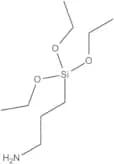
Viscosity: 0.50 cStΔHcomb: 4,780 kJ/molDipole moment: 1.60 debyeIntermediate for coating resinsAlkoxy crosslinker for condensation cure siliconesTrialkoxy silaneHigher purity grade available, SIM6560.1Formule :C4H12O3SiDegré de pureté :97%Couleur et forme :LiquidMasse moléculaire :136.223-AMINOPROPYLTRIETHOXYSILANE
CAS :Monoamine Functional Trialkoxy Silane
Silane coupling agents have the ability to form a durable bond between organic and inorganic materials to generate desired heterogeneous environments or to incorporate the bulk properties of different phases into a uniform composite structure. The general formula has two classes of functionality. The hydrolyzable group forms stable condensation products with siliceous surfaces and other oxides such as those of aluminum, zirconium, tin, titanium, and nickel. The organofunctional group alters the wetting or adhesion characteristics of the substrate, utilizes the substrate to catalyze chemical transformations at the heterogeneous interface, orders the interfacial region, or modifies its partition characteristics, and significantly effects the covalent bond between organic and inorganic materials.
3-Aminopropyltriethoxysilane, ?-Aminopropyltriethoxysilane, Triethoxysilylpropylamine, APTES, AMEO, GAPS, A-1100
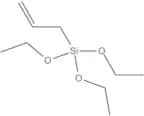
Viscosity: 1.6 cSt?Hvap: 11.8 kcal/molTreated surface contact angle, water: 59°?c of treated surfaces: 37.5 mN/mSpecific wetting surface: 353 m2/gVapor pressure, 100 °C: 10 mmWidely used coupling agent for phenolic, epoxy, polyamide, and polycarbonate resinsUsed to bind Cu(salicylaldimine) to silicaEffects immobilization of enzymesUsed in microparticle surface modificationBase silane in SIVATE A610 and SIVATE E610Low fluorescence grade for high throughput screening available as SIA0610.1Formule :C9H23NO3SiDegré de pureté :97%Couleur et forme :Straw LiquidMasse moléculaire :221.37ALLYLTRIETHOXYSILANE
CAS :Olefin Functional Trialkoxy Silane
Silane coupling agents have the ability to form a durable bond between organic and inorganic materials to generate desired heterogeneous environments or to incorporate the bulk properties of different phases into a uniform composite structure. The general formula has two classes of functionality. The hydrolyzable group forms stable condensation products with siliceous surfaces and other oxides such as those of aluminum, zirconium, tin, titanium, and nickel. The organofunctional group alters the wetting or adhesion characteristics of the substrate, utilizes the substrate to catalyze chemical transformations at the heterogeneous interface, orders the interfacial region, or modifies its partition characteristics, and significantly effects the covalent bond between organic and inorganic materials.
Allyltriethoxysilane; 3-(Triethoxysilyl)-1-propene; Triethoxyallylsilane; Propenyltriethoxysilane
Dipole moment: 1.79 debyeVapor pressure, 100 °: 50 mmExtensive review on the use in silicon-based cross-coupling reactionsComonomer for polyolefin polymerizationUsed in microparticle surface modificationAdhesion promoter for vinyl-addition siliconesFormule :C9H20O3SiDegré de pureté :97%Couleur et forme :LiquidMasse moléculaire :204.34OCTAMETHYLCYCLOTETRASILOXANE, 98%
CAS :ALD Material
Atomic layer deposition (ALD) is a chemically self-limiting deposition technique that is based on the sequential use of a gaseous chemical process. A thin film (as fine as -0.1 Å per cycle) results from repeating the deposition sequence as many times as needed to reach a certain thickness. The major characteristic of the films is the resulting conformality and the controlled deposition manner. Precursor selection is key in ALD processes, namely finding molecules which will have enough reactivity to produce the desired films yet are stable enough to be handled and safely delivered to the reaction chamber.
Octamethylcyclotetrasiloxane; D4; Cyclic tetramer; Cyclomethicone; Cyclohexasiloxane; Cyclotetrasiloxane; OMCTS
Viscosity: 2.3 cStΔHfus: 18.4 kJ/molΔHvap: 45.6 kJ/molDipole moment: 1.09 debyeVapor pressure, 23 °C: 1 mmDielectric constant: 2.39Ring strain: 1.00 kJ/molSurface tension, 20 °C: 17.9 mN/mCritical temperature: 314 °CCritical pressure: 1.03 mPaSpecific heat: 502 J/g/°Coefficient of thermal expansion: 0.8 x 10⁻³Cryoscopic constant: 11.2Henry’s law constant, Hc: 3.4 ± 1.7Ea, polym: 79 kJ/molOctanol/water partition coefficient, log Kow: 5.1Basic building block for silicones by ring-opening polymerizationSolubility, water: 50 ?g/lFormule :C8H24O4Si4Degré de pureté :98%Couleur et forme :Colourless LiquidMasse moléculaire :296.611,2,3,4,5,6 HEXAMETHYLCYCLOTRISILAZANE, tech
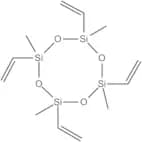
CAS :Formule :C6H21N3Si3Degré de pureté :techCouleur et forme :LiquidMasse moléculaire :219.511,3,5,7-TETRAVINYL-1,3,5,7-TETRAMETHYLCYCLOTETRASILOXANE
CAS :Alkenylsilane Cross-Coupling Agent
The cross-coupling reaction is a highly useful methodology for the formation of carbon-carbon bonds. It involves two reagents, with one typically being a suitable organometallic reagent - the nucleophile - and the other a suitable organic substrate, normally an unsaturated halide, tosylate or similar - the electrophile.
1,3,5,7-Tetravinyl-1,3,5,7-tetramethylcyclotetrasiloxane; Methylvinylcyclosiloxane; Tetramethyltetravinylcyclotetrasiloxane; Tetramethyltetraethenylcyclotetrasiloxane
Viscosity: 3.9 cStExcellent and inexpensive reagent for vinylations in cross-coupling reactions for the formation of styrenes and dienesUndergoes ring-opening polymerizationModifier for Pt-catalyst in 2-component RTVsCore molecule for dendrimersExtensive review of silicon based cross-coupling agents: Denmark, S. E. et al. "Organic Reactions, Volume 75" Denmark, S. E. ed., John Wiley and Sons, 233, 2011Formule :C12H24O4Si4Degré de pureté :97%Couleur et forme :LiquidMasse moléculaire :344.661,3-BIS[2-(3,4-EPOXYCYCLOHEXYL)ETHYL]TETRAMETHYLDISILOXANE
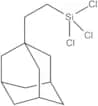
CAS :Formule :C20H38O3Si2Degré de pureté :techCouleur et forme :Straw LiquidMasse moléculaire :382.69ADAMANTYLETHYLTRICHLOROSILANE
CAS :Alkyl Silane - Conventional Surface Bonding
Aliphatic, fluorinated aliphatic or substituted aromatic hydrocarbon substituents are the hydrophobic entities which enable silanes to induce surface hydrophobicity. The organic substitution of the silane must be non-polar. The hydrophobic effect of the organic substitution can be related to the free energy of transfer of hydrocarbon molecules from an aqueous phase to a homogeneous hydrocarbon phase. A successful hydrophobic coating must eliminate or mitigate hydrogen bonding and shield polar surfaces from interaction with water by creating a non-polar interphase. Although silane and silicone derived coatings are in general the most hydrophobic, they maintain a high degree of permeability to water vapor. This allows coatings to breathe and reduce deterioration at the coating interface associated with entrapped water. Since ions are not transported through non-polar silane and silicone coatings, they offer protection to composite structures ranging from pigmented coatings to rebar reinforced concrete. A selection guide for hydrophobic silanes can be found on pages 22-31 of the Hydrophobicity, Hydrophilicity and Silane Surface Modification brochure.
Adamantylethyltrichlorosilane; Trichlorosilylethyladamantane; Trichloro(2-tricyclo[3.3.1.13,7]decylethyl)silane
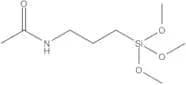
Contains approximately 25% α-isomerForms silica bonded phases for reverse phase chromatographyFormule :C12H19Cl3SiDegré de pureté :97%Couleur et forme :Off-White SolidMasse moléculaire :297.73(3-ACETAMIDOPROPYL)TRIMETHOXYSILANE
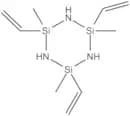
CAS :Formule :C8H19NO4SiDegré de pureté :97%Couleur et forme :LiquidMasse moléculaire :221.331,3,5-TRIVINYL-1,3,5-TRIMETHYLCYCLOTRISILAZANE, 92%
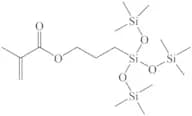
CAS :Formule :C9H21N3Si3Degré de pureté :92%Couleur et forme :LiquidMasse moléculaire :255.54METHACRYLOXYPROPYLTRIS(TRIMETHYLSILOXY)SILANE
CAS :Formule :C16H38O5Si4Degré de pureté :98%Couleur et forme :Straw LiquidMasse moléculaire :422.82DIMETHYLDIMETHOXYSILANE, 99+%
CAS :Alkyl Silane - Conventional Surface Bonding
Aliphatic, fluorinated aliphatic or substituted aromatic hydrocarbon substituents are the hydrophobic entities which enable silanes to induce surface hydrophobicity. The organic substitution of the silane must be non-polar. The hydrophobic effect of the organic substitution can be related to the free energy of transfer of hydrocarbon molecules from an aqueous phase to a homogeneous hydrocarbon phase. A successful hydrophobic coating must eliminate or mitigate hydrogen bonding and shield polar surfaces from interaction with water by creating a non-polar interphase. Although silane and silicone derived coatings are in general the most hydrophobic, they maintain a high degree of permeability to water vapor. This allows coatings to breathe and reduce deterioration at the coating interface associated with entrapped water. Since ions are not transported through non-polar silane and silicone coatings, they offer protection to composite structures ranging from pigmented coatings to rebar reinforced concrete. A selection guide for hydrophobic silanes can be found on pages 22-31 of the Hydrophobicity, Hydrophilicity and Silane Surface Modification brochure.
Dimethyldimethoxysilane; DMDMOS; Dimethoxydimethylsilane
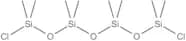
Viscosity, 20 °: 0.44 cStΔHcomb: 3,483 kJ/molΔHform: 716 kJ/molDipole moment: 1.33 debyeVapor pressure, 36 °C: 100 mmCoefficient of thermal expansion: 1.3 x 10⁻³Provides hydrophobic surface treatments in vapor phase applicationsDialkoxy silaneFormule :C4H12O2SiDegré de pureté :99%Couleur et forme :Colourless LiquidMasse moléculaire :120.221,7-DICHLOROOCTAMETHYLTETRASILOXANE, 92%
CAS :Formule :C8H24Cl2O3Si4Degré de pureté :92%Couleur et forme :Straw Amber LiquidMasse moléculaire :351.52n-OCTYLDIMETHYLCHLOROSILANE
CAS :Alkyl Silane - Conventional Surface Bonding
Aliphatic, fluorinated aliphatic or substituted aromatic hydrocarbon substituents are the hydrophobic entities which enable silanes to induce surface hydrophobicity. The organic substitution of the silane must be non-polar. The hydrophobic effect of the organic substitution can be related to the free energy of transfer of hydrocarbon molecules from an aqueous phase to a homogeneous hydrocarbon phase. A successful hydrophobic coating must eliminate or mitigate hydrogen bonding and shield polar surfaces from interaction with water by creating a non-polar interphase. Although silane and silicone derived coatings are in general the most hydrophobic, they maintain a high degree of permeability to water vapor. This allows coatings to breathe and reduce deterioration at the coating interface associated with entrapped water. Since ions are not transported through non-polar silane and silicone coatings, they offer protection to composite structures ranging from pigmented coatings to rebar reinforced concrete. A selection guide for hydrophobic silanes can be found on pages 22-31 of the Hydrophobicity, Hydrophilicity and Silane Surface Modification brochure.
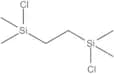
n-Octyldimethylchlorosilane; Dimethyloctylchlorosilane; ChlorodimethyloctylsilaneFormule :C10H23ClSiDegré de pureté :97%Couleur et forme :Pale Yellow LiquidMasse moléculaire :206.831,2-BIS(CHLORODIMETHYLSILYL)ETHANE
CAS :Alkyl Silane - Dipodal Surface Bonding
Aliphatic, fluorinated aliphatic or substituted aromatic hydrocarbon substituents are the hydrophobic entities which enable silanes to induce surface hydrophobicity. The organic substitution of the silane must be non-polar. The hydrophobic effect of the organic substitution can be related to the free energy of transfer of hydrocarbon molecules from an aqueous phase to a homogeneous hydrocarbon phase. A successful hydrophobic coating must eliminate or mitigate hydrogen bonding and shield polar surfaces from interaction with water by creating a non-polar interphase. Although silane and silicone derived coatings are in general the most hydrophobic, they maintain a high degree of permeability to water vapor. This allows coatings to breathe and reduce deterioration at the coating interface associated with entrapped water. Since ions are not transported through non-polar silane and silicone coatings, they offer protection to composite structures ranging from pigmented coatings to rebar reinforced concrete. A selection guide for hydrophobic silanes can be found on pages 22-31 of the Hydrophobicity, Hydrophilicity and Silane Surface Modification brochure.
Bridging Silicon-Based Blocking Agent
Used as a protecting group for reactive hydrogens in alcohols, amines, thiols, and carboxylic acids. Organosilanes are hydrogen-like, can be introduced in high yield, and can be removed under selective conditions. They are stable over a wide range of reaction conditions and can be removed in the presence of other functional groups, including other protecting groups. The tolerance of silylated alcohols to chemical transformations summary is presented in Table 1 of the Silicon-Based Blocking Agents brochure.
Dipodal Silane
Dipodal silanes are a series of adhesion promoters that have intrinsic hydrolytic stabilities up to ~10,000 times greater than conventional silanes and are used in applications such as plastic optics, multilayer printed circuit boards and as adhesive primers for ferrous and nonferrous metals. They have the ability to form up to six bonds to a substrate compared to conventional silanes with the ability to form only three bonds to a substrate. Many conventional coupling agents are frequently used in combination with 10-40% of a non-functional dipodal silane, where the conventional coupling agent provides the appropriate functionality for the application, and the non-functional dipodal silane provides increased durability. Also known as bis-silanes additives enhance hydrolytic stability, which impacts on increased product shelf life, ensures better substrate bonding and also leads to improved mechanical properties in coatings as well as composite applications.
Bis(dimethylchlorosilyl)ethane; Tetramethyldichlorodisilethylene; Ethylenebis[chlorodimethylsilane]; STABASE-Cl
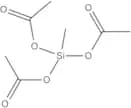
Protection for 1° amines, including amino acid estersSummary of selective deprotection conditions is provided in Table 7 through Table 20 of the Silicon-Based Blocking Agents brochureFormule :C6H16Cl2Si2Degré de pureté :97%Couleur et forme :Off-White SolidMasse moléculaire :215.27METHYLTRIACETOXYSILANE, 95%
CAS :Alkyl Silane - Conventional Surface Bonding
Aliphatic, fluorinated aliphatic or substituted aromatic hydrocarbon substituents are the hydrophobic entities which enable silanes to induce surface hydrophobicity. The organic substitution of the silane must be non-polar. The hydrophobic effect of the organic substitution can be related to the free energy of transfer of hydrocarbon molecules from an aqueous phase to a homogeneous hydrocarbon phase. A successful hydrophobic coating must eliminate or mitigate hydrogen bonding and shield polar surfaces from interaction with water by creating a non-polar interphase. Although silane and silicone derived coatings are in general the most hydrophobic, they maintain a high degree of permeability to water vapor. This allows coatings to breathe and reduce deterioration at the coating interface associated with entrapped water. Since ions are not transported through non-polar silane and silicone coatings, they offer protection to composite structures ranging from pigmented coatings to rebar reinforced concrete. A selection guide for hydrophobic silanes can be found on pages 22-31 of the Hydrophobicity, Hydrophilicity and Silane Surface Modification brochure.
Methyltriacetoxysilane; Methylsilane Triacetate; Triacetoxymethylsilane; MTAC
Vapor pressure, 94 °C: 9 mmMost common cross-linker for condensation cure silicone RTVsFor liquid version see blend, SIM6519.2Formule :C7H12O6SiDegré de pureté :95%Couleur et forme :Off-White SolidMasse moléculaire :220.25


![N,N-Bis[(diphenylphosphino)methyl]-3-(triethoxysilyl)propylamine](/_next/image/?url=https%3A%2Fstatic.cymitquimica.com%2Fproducts%2F3B%2Fthumb-webp%2FB5594.webp&w=3840&q=75)
![Phenyl[2-(trimethylsilyl)phenyl]iodonium Trifluoromethanesulfonate](/_next/image/?url=https%3A%2Fstatic.cymitquimica.com%2Fproducts%2F3B%2Fthumb-webp%2FP1620.webp&w=3840&q=75)
![Chloro(ethyl)dimethylsilane [Dimethylethylsilylating Agent]](/_next/image/?url=https%3A%2Fstatic.cymitquimica.com%2Fproducts%2F3B%2Fthumb-webp%2FD0135.webp&w=3840&q=75)


![3-[[Dimethyl(vinyl)silyl]oxy]-1,1,5,5-tetramethyl-3-phenyl-1,5-divinyltrisiloxane](/_next/image/?url=https%3A%2Fstatic.cymitquimica.com%2Fproducts%2F3B%2Fthumb-webp%2FD5264.webp&w=3840&q=75)












![1,3-BIS[2-(3,4-EPOXYCYCLOHEXYL)ETHYL]TETRAMETHYLDISILOXANE](/_next/image/?url=https%3A%2Fstatic.cymitquimica.com%2Fproducts%2F3H%2Fthumb-webp%2FSIB1092.0.webp&w=3840&q=75)