Chimie organique synthétique
La chimie organique de synthèse est une branche de la chimie axée sur la conception et la construction de molécules organiques par des réactions chimiques contrôlées. Ce domaine joue un rôle crucial dans le développement de produits pharmaceutiques, agrochimiques, polymères et matériaux avancés. Chez CymitQuimica, nous proposons une gamme complète de réactifs, catalyseurs et building blocks de haute pureté, essentiels pour la chimie organique de synthèse. Notre catalogue comprend une variété de composés fonctionnalisés, groupes protecteurs, auxiliaires chiraux et réactifs de couplage, tous rigoureusement testés pour leur qualité et leur constance. En fournissant des matériaux de haute qualité, nous soutenons les chercheurs et les professionnels de l'industrie dans la réalisation de transformations synthétiques précises et efficaces, facilitant la découverte et le développement d'entités chimiques innovantes et de structures organiques complexes. Nos produits permettent des avancées en chimie médicinale, science des matériaux et biologie chimique, stimulant les progrès dans les applications de recherche et industrielles.
Sous-catégories appartenant à la catégorie "Chimie organique synthétique"
- Réactifs synthétiques(15.019 produits)
- Building Blocks(257.045 produits)
- Réactions de formation de liaisons C-C(885 produits)
- Groupes protecteurs(2.696 produits)
- Réactifs pour l'introduction/modification de groupes fonctionnels(1.021 produits)
207 produits trouvés pour "Chimie organique synthétique"
Trier par
Degré de pureté (%)
0
100
|
0
|
50
|
90
|
95
|
100
Sodium hexacyanoferrate(II) decahydrate
CAS :<p>Oxidant, food additive, explosive and chemical reagent</p>Formule :C6FeN6•(H2O)10•Na4Degré de pureté :Min. 99%Couleur et forme :Slightly Yellow Yellow Crystalline Powder PowderMasse moléculaire :484.06 g/molMethyl 3,3-bis(methylthio)-2-cyanoacrylate
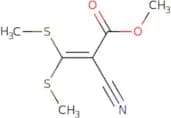
CAS :Methyl 3,3-bis(methylthio)-2-cyanoacrylate is a diphenyl ether that is used as a bactericide. It has been shown to be effective against both Gram-positive and Gram-negative bacteria. Methyl 3,3-bis(methylthio)-2-cyanoacrylate is synthesized by the reaction of malonate with dimethylamine chloride in the presence of hydrochloric acid salt in order to produce chloride ions. The reaction is then heated, which causes the methyl 3,3-bis(methylthio)-2-cyanoacrylate to form. This compound is soluble in organic solvents such as formic acid and can be purified by recrystallization or by distillation.Formule :C7H9NO2S2Degré de pureté :Min. 95%Masse moléculaire :203.28 g/mol4-[(4-cyanophenyl)disulfanyl]benzonitrile
CAS :Please enquire for more information about 4-[(4-cyanophenyl)disulfanyl]benzonitrile including the price, delivery time and more detailed product information at the technical inquiry form on this pageFormule :C14H8N2S2Degré de pureté :Min. 95%Masse moléculaire :268.36 g/molAmmonium iron(III) hexacyanoferrate(II) hydrate, tech.
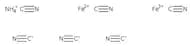
CAS :<p>It is employed as a intermediate for pharmaceuticals. Also used in decorative cosmetics. This Thermo Scientific Chemicals brand product was originally part of the Alfa Aesar product portfolio. Some documentation and label information may refer to the legacy brand. The original Alfa Aesar product / item code or SKU reference has not changed as a part of the brand transition to Thermo Scientific Chemicals.</p>Formule :(NH4)FeFe(CN)6•xH2OCouleur et forme :Dark blue, PowderMasse moléculaire :285.83(anhy)Phosphoramidous acid, N,N-bis(1-methylethyl)-, bis(2-cyanoethyl) ester
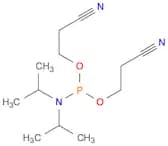
CAS :Formule :C12H22N3O2PDegré de pureté :95%Couleur et forme :LiquidMasse moléculaire :271.2957Sodium hexacyanoferrate (II)
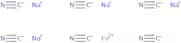
CAS :Produit contrôlé<p>Sodium hexacyanoferrate (II) is a salt of hexacyanoferrate (II) and sodium carbonate. It is used as an oxidizing agent in analytical chemistry, organic synthesis, and the production of ceramics. The compound has high resistance to enzyme activities and also exhibits high reactivity with nitrite ion. Sodium hexacyanoferrate (II) can be used to generate a reaction solution for the determination of ferrocyanide. This salt reacts with citric acid or sodium citrate to yield ferricyanide, which is then determined by measuring the amount of light absorbed at 510 nm. The mechanism for this reaction is believed to be the following: Sodium hexacyanoferrate (II) + 2NaOH → Na2[Fe(CN)6] + 2Na2CO3 Sodium hexacyanoferrate (II) + 3NaCl → Fe(CN)6 + Na3Cl +</p>Formule :Na4FeDegré de pureté :Min. 95%Couleur et forme :PowderMasse moléculaire :303.91 g/molTrihexyl(tetradecyl)phosphonium decanoate, min. 95% CYPHOS® IL 103
CAS :<p>Trihexyl(tetradecyl)phosphonium decanoate, min. 95% CYPHOS® IL 103</p>Formule :(C6H13)3(C14H29)PCH3(CH2)8COODegré de pureté :min. 95%Couleur et forme :pale yellow semi solidMasse moléculaire :655.11

![4-[(4-cyanophenyl)disulfanyl]benzonitrile](/_next/image/?url=https%3A%2Fstatic.cymitquimica.com%2Fproducts%2F3D%2Fthumb-webp%2FGAA33951.webp&w=3840&q=75)