Chimie organique synthétique
Sous-catégories appartenant à la catégorie "Chimie organique synthétique"
- Réactifs synthétiques(16.662 produits)
- Building Blocks(258.137 produits)
- Réactions de formation de liaisons C-C(881 produits)
- Groupes protecteurs(2.686 produits)
- Réactifs pour l'introduction/modification de groupes fonctionnels(1.022 produits)
202 produits trouvés pour "Chimie organique synthétique".
1-(4-chlorophenyl)-N-{3-cyano-4-[4-(morpholin-4-yl)piperidin-1-yl]phenyl}-5-methylpyrazole-4-carboxamide
CAS :Formule :C27H29ClN6O2Degré de pureté :98%Couleur et forme :SolidMasse moléculaire :505.0112Garphos™ Ligand Kit
This kit contains the following products:
100mg of (08-15-1661-100mg) (R)-2,2'-Bis[bis(3,5-dimethylphenyl)phosphino]-4,4',6,6'-tetramethoxy-)-1,1'-biphenyl, min. 97% (R)-Xyl-Garphos™
100mg of (08-15-1662-100mg) (S)-2,2'-Bis[bis(3,5-dimethylphenyl)phosphino]-4,4',6,6'-tetramethoxy)-1,1'-biphenyl, min. 97% (S)-Xyl-Garphos™
100mg of (08-15-1672-100mg) (R)-2,2'-Bis[bis(4-methoxy-3,5-di-t-butylphenyl)phosphino]-4,4',6,6'-tetramethoxy)-1,1'-biphenyl, min. 97% (R)-DTBM-Garphos™
100mg of (08-15-1673-100mg) (S)-2,2'-Bis[bis(4-methoxy-3,5-di-t-butylphenyl)phosphino]-4,4',6,6'-tetramethoxy)-1,1'-biphenyl, min. 97% (S)-DTBM-Garphos™
100mg of (08-15-1666-100mg) (R)-2,2'-Bis[bis(4-methoxy-3,5-dimethylphenyl)phosphino]-4,4',6,6'-tetramethoxy)-1,1'-biphenyl, min. 97% (R)-DMM-Garphos™
100mg of (08-15-1667-100mg) (S)-2,2'-Bis[bis(4-methoxy-3,5-dimethylphenyl)phosphino]-4,4',6,6'-tetramethoxy)-1,1'-biphenyl, min. 97% (S)-DMM-Garphos™
100mg of (08-15-1663-100mg) (R)-2,2'-Bis[bis(3,5-trifluoromethylphenyl)phosphino]-4,4',6,6'-tetramethoxy)-1,1'-biphenyl, min. 97% (R)-BTFM-Garphos™
100mg of (08-15-1664-100mg) (S)-2,2'-Bis[bis(3,5-trifluoromethylphenyl)phosphino]-4,4',6,6'-tetramethoxy)-1,1'-biphenyl, min. 97% (S)-BTFM-Garphos™
100mg of (08-15-1653-100mg) (R)-2,2'-Bis(diphenylphosphino)-4,4',6,6'-tetramethoxy)-1,1'-biphenyl, min. 97% (R)-Ph-Garphos™
100mg of (08-15-1654-100mg) (S)-2,2'-Bis(diphenylphosphino)-4,4',6,6'-tetramethoxy)-1,1'-biphenyl, min. 97% (S)-Ph-Garphos™
100mg of (08-15-1657-100mg) (R)-2,2'-Bis(di-p-tolylphosphino)-4,4',6,6'-tetramethoxy)-1,1'-biphenyl, min. 97% (R)-Tol-Garphos™
100mg of (08-15-1658-100mg) (S)-2,2'-Bis(di-p-tolylphosphino)-4,4',6,6'-tetramethoxy)-1,1'-biphenyl, min. 97% (S)-Tol-Garphos™
,
Ionic Liquid Kit 3: CYPHOS® IL Phosphonium Salt Kit
This kit contains the following products:
10g of (08-15-6370-10g) Trihexyl(tetradecyl)phosphonium bis(trifluoromethanesulfonyl)amide, min. 97% CYPHOS® IL 109
10g of (08-15-6374-10g) Trihexyl(tetradecyl)phosphonium bis(2,4,4-trimethylpentyl)phosphinate, min. 90% CYPHOS® IL 104
10g of (08-15-6378-10g) Trihexyl(tetradecyl)phosphonium bromide, min. 95% CYPHOS® IL 102
10g of (08-15-6382-10g) Trihexyl(tetradecyl)phosphonium chloride, min. 95% CYPHOS IL 101
10g of (08-15-6386-10g) Trihexyl(tetradecyl)phosphonium decanoate, min. 95% CYPHOS® IL 103
10g of (08-15-6390-10g) Trihexyl(tetradecyl)phosphonium dicyanamide, min. 93% CYPHOS® IL 105
,
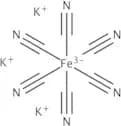
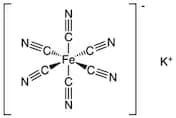
Potassium hexacyanoferrate(III); ACS grade
CAS :Formule :K3Fe(CN)6Degré de pureté :(Titration) ≥ 99.0%Couleur et forme :Orange to red crystalline powder or crystalsMasse moléculaire :329.26Potassium hexacyanoferrate(III), 99+% (ACS)
CAS :Potassium hexacyanoferrate(III), 99+% (ACS)
Formule :K3Fe(CN)6Degré de pureté :99+%Couleur et forme :red xtl.Masse moléculaire :329.26Carbon tetrachloride (99.999%-C) PURATREM
CAS :Produit contrôléCarbon tetrachloride (99.999%-C) PURATREM
Formule :CCl4Degré de pureté :99.999%-CCouleur et forme :colorless liq.Masse moléculaire :153.82Potassium dicyanoaurate(I); 99.95% (metals basis)
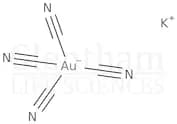
CAS :Formule :KAu(CN)2Degré de pureté :≥ 99.95% (trace metals basis)Couleur et forme :White crystalline powder or crystalsMasse moléculaire :288.10Potassium tetracyanoaurate(III); 99.95% (metals basis)
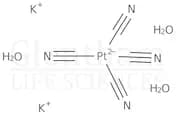
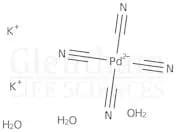
CAS :Formule :KAu(CN)4Couleur et forme :White crystalline powderMasse moléculaire :340.14Potassium tetracyanopalladate(II) hydrate, 99.95% (metals basis)
CAS :Formule :K2Pd(CN)4·xH2OMasse moléculaire :288.72Potassium dicyanoaurate(I)
CAS :Formule :C2AuKN2Degré de pureté :≥ 99.9%Couleur et forme :White crystalline powder or crystalsMasse moléculaire :288.1Trihexyl(tetradecyl)phosphonium chloride, min. 95% CYPHOS IL 101
CAS :Trihexyl(tetradecyl)phosphonium chloride, min. 93% CYPHOS® IL 101
Formule :(C6H13)3(C14H29)PClDegré de pureté :min. 95%Couleur et forme :colorless liq.Masse moléculaire :519.31Bis(2-cyanoethyl)-N,N-diisopropyl Phosphoramidite
CAS :Produit contrôléApplications A useful phosphorylating reagent.
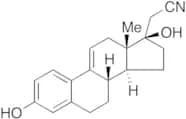
Not a dangerous good if item is equal to or less than 1g/ml and there is less than 100g/ml in the packageFormule :C12H22N3O2PCouleur et forme :NeatMasse moléculaire :271.3∆9,11-Dehydro-17α-cyanomethyl Estradiol
CAS :Produit contrôléApplications ∆9,11-Dehydro-17α-cyanomethyl estradiol is a metabolite of progestin dienogest (D441870), and is currently being investigated for progesterone-receptor binding, progestational, antiprogestational, estrogenic and antigonadotropic activities for the inhibition of fertility. It is also being considered a novel treatment for heavy menstrual bleeding.
References Oettel, M., et al.: Pharmazie, 41, 627 (1993); Kiley, J. & Shulman, L.: Int. J. Womens Health, 3, 281 (2011);Formule :C20H23NO2Couleur et forme :NeatMasse moléculaire :309.42-Amino-4-cyano-5-imidazolecarboxamide
CAS :Applications 2-Amino-4-cyano-5-imidazolecarboxamide (cas# 125815-68-1) is a compound useful in organic synthesis.
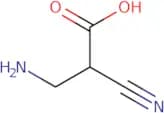
Formule :C5H5N5OCouleur et forme :NeatMasse moléculaire :151.133-Amino-2-cyanopropanoic acid
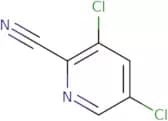
CAS :Please enquire for more information about 3-Amino-2-cyanopropanoic acid including the price, delivery time and more detailed product information at the technical inquiry form on this pageFormule :C4H6N2O2Degré de pureté :Min. 95%Couleur et forme :PowderMasse moléculaire :114.1 g/mol3,5-Dichloro-2-cyanopyridine
CAS :3,5-Dichloro-2-cyanopyridine is an organic compound that can be synthesized in a scalable manner. It is used to make pharmaceuticals and agrochemicals and it also has potential applications in pollution control. 3,5-Dichloro-2-cyanopyridine can be made by the reaction of cuprous cyanide with chlorocarbonyl compounds in organic solvents. This synthesis yields a product with high purity which can then be purified using chromatography. The synthesis is scalable and does not produce any side products or waste because the reactants are inexpensive, commercially available, and the product is stable under most conditions.Formule :C6H2N2Cl2Degré de pureté :Min. 95%Couleur et forme :White PowderMasse moléculaire :173 g/mol
![1-(4-chlorophenyl)-N-{3-cyano-4-[4-(morpholin-4-yl)piperidin-1-yl]phenyl}-5-methylpyrazole-4-carbo…](/_next/image/?url=https%3A%2Fstatic.cymitquimica.com%2Fproducts%2FIN%2Fthumb-webp%2FDA002WO3.webp&w=3840&q=75)